

Table of Contents
Under a vaulted ceiling, set the height of the fitting by what it has to light, not by the ceiling: about 60 cm above a table, at least 2.15 m above the floor anywhere you walk. At 5 m the floor receives four times less light than at 2.5 m, so always add wall lights lower down.
A vaulted ceiling gives a room its volume, and it gives you a real lighting problem. The builder’s pendant point usually ends up five metres overhead, out of reach, and the room still feels dim under a fitting that cost a fortune. This guide gives you the figures: how high to hang, what drop length to order, how many lumens to plan for, and how you are going to change a bulb once the thing is up there.
What a vaulted ceiling changes for the light
A vaulted ceiling follows the line of the roof, with no attic floor above it: the room runs up to the rafters on one or two slopes, and a gable wall closes the volume in a triangle. You see it in new builds over the sitting room, in dormer bungalows, in attic conversions and in the kitchen and dining extensions that go up with a glazed gable. The ridge then sits well above the 2.4 m of an ordinary Irish room, and every lighting rule you are used to changes.
Not because the light gets lost on the way down, since air absorbs nothing over a few metres, but because it spreads out. The illuminance reaching a surface falls with the square of its distance from the source: double the mounting height and the floor directly below receives four times less. That is the inverse square law, and it is the only calculation worth keeping from this article.

Three very practical consequences follow.
- One high source lights nothing. The same fitting, raised from 2.5 m to 5 m, divides by four what lands on the coffee table. The corners of the room, further away again, stay dark. Dark walls make that worse by giving almost nothing back, which is the whole problem in a hall with no window: see our guide to hallway paint colours.
- The room reads as dim even when the floor is lit. Your eye judges a room by its walls, and under a vaulted ceiling the gable is the largest surface you see. Leave it unlit and the whole space stays flat, whatever colour it is painted. Deep shades give back far less than pale ones, which is worth knowing before you commit: our guide to what colour goes with green shows how far one family of shades travels with the light falling on it.
- Everything becomes hard to reach. Changing a bulb, dusting a shade or adjusting a cable needs real access equipment. That is decided before you buy, not after.
It is the exact opposite of a low ceiling, where anything that hangs down crowds the room. Up here, anything that stays stuck to the ceiling is wasted.
How high to hang the fitting
The height of a light is never measured from the ceiling. It is measured from whatever it lights, or from the floor where you walk underneath it. Under a vaulted ceiling the ceiling height therefore serves one purpose only: working out the drop. The reference points themselves do not change.
| Where it hangs | Bottom of the fitting | Measured from |
|---|---|---|
| Over a dining table or an island | about 60 cm | the table or worktop |
| Over a sofa or a coffee table | 1.80 to 2.00 m | the floor |
| Walkway, hall, circulation | 2.15 m at the very least | the floor |
| Over a staircase | 2.15 m at the very least | the nosing of the highest tread |
| Over a double-height void, seen from the landing | the whole fitting stays visible from the rail | the first floor |
The 60 cm figure over a table top comes from licht.de, the German lighting information centre, and it holds whatever the room height is: under a 5 m ridge, exactly as under a 2.4 m ceiling, a dining pendant comes down to the same place. Only the cable gets longer.
The 2.15 m of headroom is our own rule, the one that stops you walking into a shade or looking straight into a bulb as you cross the room. It applies to the whole area you walk through standing up, including under a double-height void, even where the ceiling is six metres away.
The landing case deserves a sentence of its own. A fitting hung near the ridge is seen from two places: from below, where you see its underside, and from the first floor, where you see its top and the inside of its shades. An open design with bare lamps dazzles anyone standing at the rail. A cascade of rings or discs, which shows only a thin edge from the side, copes far better.
Drop length: work it out before you order
The sum is one line long, and it saves you from the single most common mistake in this kind of room.
Drop = height of the ceiling point, minus the height you want the bottom at, minus the height of the fitting itself.
An example. Ridge at 5.00 m, pendant over a table 75 cm high: the bottom of the fitting needs to sit at 0.75 + 0.60 = 1.35 m off the floor. If the fitting is 40 cm tall, you need 5.00 − 1.35 − 0.40 = 3.25 m of cable between the ceiling rose and the top of the light. Three and a quarter metres is a great deal more than comes in the box of an ordinary pendant.

So read the spec sheet before you order, at the line for maximum height or cable length. On most pendants and chandeliers, including the big ones, that maximum sits around 150 cm: enough to come down a metre and a half, not three. When the length supplied is not enough, there are four ways out, from the simplest to the heaviest.
- The manufacturer’s own extension. Some models come with a longer cable or extra rods, or take an additional rod of the same diameter. It is the only extension to fit without a second thought, because it was designed for the weight of that fitting.
- A fitting on adjustable steel cables. Large rings and discs hang on steel cables that you set to the centimetre on the day and then lock off. It is the easiest system to live with at height.
- Offsetting with hooks. Rather than dropping vertically from the ridge, you start at the existing rose and catch the cable on one or more hooks fixed lower down, on the slope or on a beam. The light then sits where you want it, with no electrical work at all.
- A lowering device, or winch. A mechanism fixed to the ceiling brings the chandelier down to floor level for cleaning and lifts it back up. It is chosen by load and fitted by a professional: it is a safety component, not an accessory.
Mind the fixing point itself. A vaulted ceiling is often slabbed or boarded under the rafters, so the fixing has to reach a rafter or a purlin, never the lining alone. A fifteen-kilo chandelier on three metres of cable behaves like a pendulum, and the draught through a double-height room will set it moving. Our guide to installing a ceiling light safely covers isolating the circuit, the connections and choosing a fixing by weight. Adding or moving a lighting point is restricted electrical work under I.S. 10101, and it belongs to a Registered Electrical Contractor, who issues a Completion Certificate for it.
Which fitting suits a vaulted ceiling
In a big volume, a well-sized light looks normal and an undersized one looks forgotten. Your eye does not compare the diameter with the floor area, it compares it with the volume overhead. Our advice: under a ridge of 4 m or more, do not go below 60 cm across for a single piece in the middle of a living room, and prefer a design that occupies some height to a flat disc, however wide. Three families work.
The large chandelier or statement pendant
One wide piece, hung in the centre. It is the obvious answer and the most decorative: a 110 cm ring, a square frame, a branched chandelier. It works best over a dining table, where the bottom sits low and the diameter reads from the chairs. Our large chandelier range gathers the models in that format, in metal, glass and wood.
The cascade, which fills the height
Several rings or tubes of different diameters, hung at staggered heights from one rose. A cascade fills the band of air between the ridge and the living zone, the part a single pendant leaves empty, and it gives you several levels of light instead of one flat plane. It is the best format over a double-height void, because it still looks right seen from below and seen from the landing.
The cluster of several pendants
Instead of one big light, several small ones at different heights. Under a vaulted ceiling the gain is double: each source comes down to where it is needed, and the weight is shared. Some models bring several cables out of a single rose, to be hooked wherever you like on the ceiling, which lets you cover a table and a seating area from one supply point. See our multi-light pendant range for the bar and cluster versions.
And downlights in the slope?
They are the reflex, and on their own they are the disappointment. At five metres a downlight with a narrow beam lights a circle of floor and leaves everything else in shadow, and a recessed fitting in a sloped ceiling throws its light at an angle unless it is a gimbal type made to be tilted. Keep them for grazing the gable wall or for picking out a piece of furniture, and never as the general light of the room.
How many lumens, and how to spread them
The basic sum does not change: multiply the floor area by the target illuminance in lux, then double it to cover what is lost on the walls and ceiling. Our guide to how many lumens you need gives the detail room by room, with a factor of two that holds for a ceiling of about 2.4 m and pale walls.
Under a vaulted ceiling that factor of two is too low. The volume offers far more surface to light for the same floor area, and lighting engineers express this through the room index, which drops as the height rises: the share of the flux that ends up doing useful work goes down with it. Our advice is to count on 2.5 to 3 instead of 2. That is not a figure from a standard, it is a cautious order of magnitude.
A 35 m² living room lit to 200 lux needs 7,000 useful lumens, so 17,500 to 21,000 lumens installed under a high ridge. No single fitting covers that comfortably, not even a large LED chandelier putting out more than 13,000 lumens: the question is not the output of one piece, it is how several are spread.
Spread them over three levels.
- High up, the central piece. It carries the general light and holds the volume. It is the one you look at, not the one that lights the most.
- At eye level, the wall lights. Around 1.70 m off the floor, they bring light back down to where you live and make up the lumens lost in the height. Double-beam models, which throw light up and down, also wash the gable wall and make it exist after dark. Our interior wall light range runs to several hundred models.
- Low down, the lamps. A floor lamp by the sofa, a table lamp on a sideboard, a reading light beside the armchair: these are what make the room feel warm, because their light arrives from close by. They only work if every source carries the same tint: see our guide to warm white vs cool white.

Two points to finish. Stay on warm white, 2700 to 3000 K, in a living room: under a big height, a cool light turns the space into a foyer. And do not forget the enclosed volumes, the presses and fitted storage the central light will never reach; our guide to wardrobe lighting explains how to give them a light of their own.
Changing a bulb and cleaning at five metres
This is the question people ask once the chandelier is up, and it should have been asked before. Decide how you are going to reach it first, and choose the light source second.
- You have no comfortable access, over a staircase or a double-height void for instance: take an integrated LED. No lampholder, no bulb to replace, and a life measured in tens of thousands of hours.
- You have flat, clear floor under the fitting: replaceable bulbs stay possible, with a mobile tower or a long, properly footed ladder, and two people. A step ladder balanced on a stair tread is not access equipment.
- You want a lamped model very high up: plan a lowering device at installation. That is the one case where it genuinely earns its place.
Whatever you do, switch the circuit off at the consumer unit before you touch anything, and let the fitting cool: a bulb that has just been running will burn your fingers, and a glass shade becomes slippery. If what is up there is an old fluorescent batten in a converted garage or utility room, test it from the ground before you climb at all, because going up twice for the wrong part is the real cost: our guide to the fluorescent light starter tells you whether the starter or the tube has failed.
Dust is the part nobody sees from below, and it is the real subject. A dirty fitting loses output, to the point that I.S. EN 12464-1 requires designers to specify a new installation brighter than the level to be maintained, through a maintenance factor. At home, a dusting once or twice a year is enough, at the same time as the windows if someone else does them. A closed fitting, or one with a high first digit in its IP rating, gets dirty inside far more slowly than an open model with exposed lamps.
Finally, three mistakes you see again and again under a vaulted ceiling: keeping the builder’s fitting tight against the ridge, choosing a model that looked enormous in the showroom and vanishes at home, and firing recessed spots into the slope in the hope that they will light the room.
Frequently asked questions about vaulted ceilings
What is the best lighting for vaulted ceilings?
Never one fitting on its own. A single large piece near the ridge for the volume, wall lights at about 1.70 m to bring the light back down to where you live, and floor or table lamps for the evening. The central piece is the one you look at; the wall lights are the ones that actually light the room, because the floor receives four times less at 5 m than at 2.5 m.
What does a vaulted ceiling mean?
A ceiling that follows the line of the roof instead of being flat, with no attic floor above it, so the room runs up to the rafters on one or two slopes with a gable wall closing the triangle. In Irish homes you meet it in dormer bungalows, in attic conversions and in kitchen extensions built with a glazed gable. Cathedral ceiling, sloped ceiling and pitched ceiling all describe the same thing.
What does a 3/12 vaulted ceiling mean?
It is the American way of writing a roof pitch: three units of rise for every twelve of run, which works out at about 14 degrees, a shallow slope. Irish drawings give the pitch in degrees instead, typically 30 to 45 degrees on a pitched roof. The figure matters for lighting because it sets how far the ridge is above the floor, and so your drop length.
Can you hang a chandelier on a vaulted ceiling?
Yes, with two conditions. The fixing has to reach a rafter or a purlin rather than the plasterboard lining, because a heavy chandelier on a long drop swings like a pendulum. And the drop supplied has to be long enough: most pendants top out around 150 cm, while a 5 m ridge over a dining table calls for roughly 3.25 m. Check the maximum height on the spec sheet before ordering.
Can you put downlights in a vaulted ceiling?
You can, but not as the only light. A recessed fitting in a slope aims its beam at an angle unless it is a gimbal type made to be tilted, and at five metres a narrow beam lights a circle of floor and leaves the rest dark. Use them to graze the gable wall or to pick out a piece of furniture, and keep a pendant and wall lights for the general lighting.
How high should a light hang from a vaulted ceiling?
Measure from what it lights, never from the ceiling. About 60 cm above a dining table or an island, 1.80 to 2.00 m above the floor over a sofa, and at least 2.15 m above the floor anywhere you walk, including over the nosing of the highest stair tread. Only the cable length changes with the ceiling height.
Sources
- CIE S 017, ILV: International Lighting Vocabulary, illuminance, luminous flux and the inverse square law. International Commission on Illumination
- I.S. EN 12464-1, Light and lighting, Lighting of work places, Part 1: Indoor work places, maintenance factor. National Standards Authority of Ireland
- I.S. 10101, National Rules for Electrical Installations. National Standards Authority of Ireland
- Restricted electrical works and the Certificate of Completion issued by a Registered Electrical Contractor. Safe Electric
- Suspended luminaire about 60 cm above a table top. licht.de
Related products
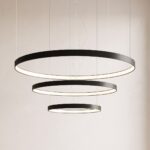
3-ring LED cascade chandelier, 110, 78 and 55 cm, 2 finishes
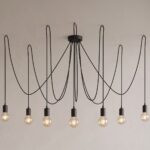
Pendant light, 7-bulb spider with black textile cables
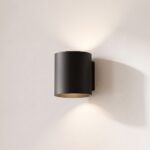
Cylindrical double-beam wall light, 4 colours
See also

Mood Lighting: The Three Settings That Really Create It, Room by Room

How to Change Spotlight Bulbs, With or Without a Clip

Conservatory Lighting: Which Lights Cope With the Heat, the Glass and the Dark
