

Table of Contents
To install a ceiling light safely, switch off the lighting circuit at the fuse board and prove it is dead with a voltage tester, fix the new fitting to something that will hold its weight, then connect each wire to its match: brown to live, blue to neutral, green and yellow to earth. In Ireland, anything beyond a like-for-like swap is a job for a Registered Electrical Contractor.
Changing a tired ceiling light for a new one is one of the most common jobs in any home, and it is also one where a small mistake has serious consequences. This guide explains who may do what under Irish rules, then walks through the job step by step: turning off the power, taking down the old fitting, fixing the new one to the ceiling, connecting the wires and testing. Even if you hand the work to an electrician, knowing the steps helps you choose a fitting that suits your ceiling and your wiring. To pick the fitting itself, browse our ceiling lights.
Can you install a ceiling light yourself in Ireland?
Irish law separates electrical work into categories. Restricted Electrical Works, defined in S.I. No. 264 of 2013, cover most electrical work in a home, including any new circuit, work on the distribution board and work in special locations such as bathrooms. They may only be carried out and certified by a Registered Electrical Contractor, registered with Safe Electric, who must give you a Completion Certificate.
Minor electrical works are outside that category. Safe Electric describes them as generally involving the like-for-like replacement of switches, sockets or lighting fittings, and moving a light fitting without affecting the circuit, with the work still required to comply with the National Rules for Electrical Installations, I.S. 10101. Swapping an old ceiling light for a new one on the same ceiling point is this kind of job.
That does not make it a job for everyone. Safe Electric’s home safety advice is that any alteration or addition to the installation should be made by a Registered Electrical Contractor. Our honest view: if you are not completely sure how to prove a circuit is dead and identify every wire, book an electrician. And for a new light point, a new circuit or anything in a bathroom, you have no choice: it is Restricted Electrical Works.
| Job | Category | Who |
|---|---|---|
| Replacing a ceiling light like for like, same point | Minor works | Registered Electrical Contractor advised |
| Moving a fitting without affecting the circuit | Minor works | Registered Electrical Contractor advised |
| A new circuit, for example for an attic conversion | Restricted Electrical Works | Registered Electrical Contractor only, with certificate |
| Any new work in a bathroom | Restricted Electrical Works | Registered Electrical Contractor only, with certificate |
| Work on the distribution board | Restricted Electrical Works | Registered Electrical Contractor only, with certificate |
Before you start: safety and tools
The golden rule: switch off at the fuse board
Your first step, with no exceptions, is to switch off the lighting circuit at the fuse board, on the circuit breaker for that circuit or on the main switch. The wall switch is not enough: it only breaks one conductor to the light, and an old wiring fault can leave a wire live even with the switch off. If other people are in the house, tell them, and put a note on the board so nobody switches it back on while you work.
Then prove the circuit is dead with a proper voltage tester, checked on a live socket before and after. This is the only way to be certain there is no voltage before you touch a wire. A cheap neon screwdriver is not a reliable test.
Gather your tools
- A stable stepladder, and ideally a second person to hand you the fitting
- A drill with bits to suit the ceiling
- Wire strippers and side cutters
- An insulated electrician’s screwdriver
- A two-pole voltage tester
- Ceiling fixings rated for the weight of the fitting and the type of ceiling
- Connectors: a terminal block or lever connectors, if the fitting does not come with them
Take down the old fitting and photograph the wiring
With the power off and proven dead, unscrew the shade or cover and lower the old fitting. Before you disconnect anything, take a clear photo of the wiring with your phone. Many Irish ceilings have a ceiling rose with a loop-in arrangement, where several cables meet: the supply, the cable to the next light and the switch wire. Your new fitting has to be connected in exactly the same way, and the photo is your reference.
Fixing the light to the ceiling
Mark and drill
Use the mounting bracket of the new fitting as a template to mark the holes in pencil. Do not drill blind: check for cables and pipes with a detector first, and keep clear of the line of the cable running to the ceiling point. Drill straight with a bit suited to the ceiling, then fit the fixings. The fixing carries the whole weight, so it must suit both the ceiling and the fitting.
Which fixing for which ceiling?
| Ceiling | Fixing | What to check |
|---|---|---|
| Concrete slab | Expansion plug for solid material | The load rating on the plug’s packaging |
| Plasterboard | Metal cavity fixing | The rated ceiling load on the packaging |
| Heavier fitting | Screws into a joist or a timber noggin | The joist position, found with a detector |
| Suspended tile ceiling | Support from the structure above | Never rest the fitting on the tiles |
Always read the weight of the fitting on its product sheet before choosing the fixing, and allow a good margin. A compact ceiling light is light: our Japandi ceiling light in light wood and opal glass weighs 0.34 kg. A chandelier can weigh several kilos; for a low ceiling, our flush mount chandeliers sit close to the ceiling and are easier to fix.
The most common fixing mistakes
The first is to think only of the weight at rest. A pendant you pull to adjust, a chandelier you dust or a fitting you open to change a bulb all put more strain on the fixing than its own weight, so keep a margin. The second is using a plug for solid walls in plasterboard, or the reverse: it either spins in the hole or breaks the board. The third, in a suspended ceiling, is letting the fitting rest on the tiles or the grid. Finally, never hang a fitting from its electrical cable unless it is designed for that: the weight must always go through the hook, the bracket or the ceiling plate.
Connecting the wires
The fitting is fixed and secure. Now for the connections. There is nothing mysterious about them: it is a question of matching each wire to its function.
Understanding the wire colours

Modern fixed wiring in Ireland uses the colours harmonised across Europe under the international standard IEC 60446: brown for live, blue for neutral and green and yellow for earth. Older installations can use other colours, and a home that has been partly rewired often has both. Never go by colour alone: the photo you took and the voltage tester are your references, and if a wire’s role is not obvious, stop and ask an electrician.
If there is an earth conductor, green and yellow, or a bare copper wire in older cable, connect it to the earth terminal of the fitting, marked with the earth symbol. Metal light fittings rely on it: in the event of a fault, the earth carries the fault current away and allows the protective device to disconnect the circuit. Under I.S. 10101, every lighting circuit in a home must also be protected by an RCD rated at no more than 30 mA. If there is no earth at the ceiling and your fitting has metal parts, stop and call an electrician.
Connecting step by step
- Strip each wire only to the length the connector needs, so that no bare copper shows outside it.
- Connect like to like: the live from the ceiling to the terminal marked L, the neutral to N, the earth to the earth terminal. If the ceiling rose had a loop-in arrangement, reconnect the loop and switch wires exactly as in your photo. If the light is switched from two places, our guide to two-way switch wiring shows what the extra wires do.
- Tighten each screw firmly, or check that each lever connector is fully closed, then give each wire a gentle tug.
- Check the bulb holder: most traditional pendants in Ireland use a B22 bayonet cap, while many modern fittings take GU10 or G9 bulbs. Our guide to LED bulbs helps you choose the right one.
Three checks before you buy the fitting
- The weight. Read it on the product sheet and compare it with what your ceiling and your fixings can carry. Compact flush lights weigh a few hundred grams; glass chandeliers can weigh several kilos and may need a joist. The same check applies to a wooden chandelier, the signature piece of a modern farmhouse interior.
- The bulb. Check the cap and the maximum wattage the fitting accepts, and buy the bulbs at the same time. Many modern fittings take GU10 or G9 LED bulbs rather than the B22 of an old pendant. If the new fitting is there to light a painting, our guide to picture lights gives the right distance from the wall.
- The switch. If the light is on a dimmer, both the bulbs and the dimmer must be compatible with LED, or the light may flicker or hum. Our guide to the dimmer switch explains what to look for.
No light point where you want one?
If the ceiling point is in the wrong place, or there is none at all, the job changes. Safe Electric counts additions to an existing circuit among minor works, but running a new cable across a ceiling means lifting boards or cutting plaster, checking the circuit can take the extra load and testing the result: it is a job for a Registered Electrical Contractor, who can certify it for you on request. A new circuit, for an attic conversion for example, is Restricted Electrical Works in any case. If you only need light on a wall or in an alcove, there are ways to avoid wiring altogether, set out in our guide to battery operated wall lights.
Finishing and final checks
Tidy the wires and fit the light
Fold the wires and connectors neatly into the ceiling plate or the box. No wire should be trapped when you close it. Push the cover up to the ceiling, then screw the fitting onto its bracket. Check by hand that everything is firm.
The right height for the fitting
No rule sets the height, but it makes all the difference to comfort. Over a table, a pendant should light the tabletop without blocking the view between people: our guide to dining room lights gives the practical checks. In a hall, a landing or a room with a low ceiling, choose a flush ceiling light that never gets in the way, like our black and wood Scandinavian ceiling light, only 14 cm deep. In a bathroom, the position is decided by the zones of the wiring rules, explained in our guide to bathroom lighting.
The final test
Fit the bulb, clear the area, go back to the fuse board and switch the circuit on, then try the wall switch. If the light comes on and the breaker or RCD holds, the job is done. If the breaker trips or the light does not work, switch off again and check each connection against your photo, one by one. If it still does not work, stop and call a Registered Electrical Contractor.
Installing a ceiling light comes down to three things: the power off and proven dead, a fixing sized for the weight, and each wire connected to its function. For spotlights set into the ceiling, which need a cut-out and clearance around them, see our spot ceiling lights for surface-mounted alternatives.
Installing a ceiling light: frequently asked questions
Can I install a ceiling light myself in Ireland?
Replacing a light fitting like for like on the same ceiling point is classed as minor electrical works, outside the Restricted Electrical Works reserved for Registered Electrical Contractors. Safe Electric still advises that alterations to the installation be made by a Registered Electrical Contractor, and a new light point, a new circuit or any work in a bathroom must be done and certified by one.
Do you need an electrician to replace a ceiling light?
Not by law for a like-for-like replacement, but it is the safer choice unless you know how to prove a circuit dead and identify every wire. You do need a Registered Electrical Contractor for a new circuit, work on the distribution board or any new work in a bathroom: that is Restricted Electrical Works, and they must give you a Completion Certificate.
How do I attach a ceiling light to the ceiling?
Fix the mounting bracket first, with fixings chosen for the ceiling: expansion plugs in concrete, metal cavity fixings in plasterboard, or screws into a joist for heavier fittings. Check the load rating on the packaging against the weight of the fitting, with a margin. The weight must never hang on the electrical cable.
What do the wire colours in a ceiling mean?
Modern fixed wiring uses the colours harmonised across Europe: brown is live, blue is neutral and green and yellow is earth. Older installations can use other colours, and partly rewired homes often mix the two, so never rely on colour alone: photograph the old connections and prove the circuit dead with a voltage tester.
Do I need to connect the earth wire on a ceiling light?
Yes, whenever there is one. The earth conductor, green and yellow or bare copper in older cable, goes to the earth terminal of the fitting. On a metal fitting it protects you in the event of a fault. If there is no earth at the ceiling and the fitting has metal parts, have an electrician check the installation.
What are common mistakes when installing a light?
Switching off only at the wall switch instead of the fuse board, not testing that the circuit is dead, reconnecting a loop-in ceiling rose differently from the original, leaving bare copper outside a connector, forgetting the earth, and choosing a fixing that cannot carry the weight of the fitting over time.
Sources
- What are Minor Electrical Works?, contractors’ FAQ, and Restricted and Controlled Electrical Works, guidance for customers. Safe Electric
- Home Safety, advice for householders. Safe Electric
- Safe Electric Newsletter, March 2020: changes introduced by I.S. 10101, RCD protection of lighting circuits. Safe Electric
- IEC 60446, encyclopaedia article on the identification of conductors by colours. Wikipedia
Related products
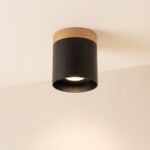
Scandinavian black metal and wood cylindrical ceiling light
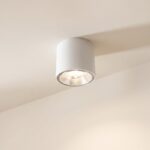
Modern round aluminium ceiling spotlight, GU10

Japandi ceiling light in light wood and opal glass
See also

Teal Bedroom Ideas: Colours, Gold Accents and the Right Light for a Dark Wall

Downstairs Toilet Lighting: The Right Light for a Small, Windowless WC or Cloakroom

Wabi-Sabi Interior Design: The Beauty of Imperfection, Right Down to the Light
