
Table of Contents
Mood lighting comes from three settings, not one: a low level, about 20 lux instead of the usual 100, or roughly 800 lumens in a 20 m² living room; light that leaves a large, soft surface rather than a bare bulb; and three to five low sources that you switch on separately.
Most attempts at mood lighting stop at the first setting. You fit a dimmer, turn the ceiling light down to halfway, and the room looks exactly the same, only darker. A dimmer controls one of the three things that make light feel soft. The other two, how bright the source itself looks and how the light is spread around the room, do not turn with a knob. Through an Irish winter, when the lights are on from late afternoon, that difference is what you live with every evening. Our range runs to 64 lampshade pendant lights, 36 ceramic wall lights and 35 reading wall lights, and this guide shows, figures in hand, how to combine them into mood lighting that works, room by room.
What mood lighting is: three settings, not one dial
Mood lighting is light set for the atmosphere of a room rather than for a task: lower than working light, warmer in colour, softer at the source and deliberately uneven, with pools of light and patches of shadow. In the vocabulary of lighting designers, it is the ambient layer turned right down, with accent light doing most of the work and task light only where you need it. Three separate quantities describe it, and good mood lighting works on all three.
| What you set | The quantity | What you set it with | What it changes |
|---|---|---|---|
| The amount | The average light level in the room, in lux | The lumens you switch on, a dimmer | The room gets darker |
| The brightness of the source | The lumens leaving each square centimetre of glowing surface | A shade, a diffuser, a bounce off a wall | You can look at the light without squinting |
| The spread | How many light points, and how high | Several small, low sources instead of one high one | Bright zones and quiet zones |
A single ceiling light on a dimmer only touches the first row. It cuts the light output, and with it the brightness of its own glowing surface, in the same proportion: the contrast between the fitting and the room stays exactly where it was. You get the same flat light from the ceiling, just less of it. That is why a room that has been turned down looks gloomy rather than soft, while the same room lit by three small lamps at the same average level looks warm.
The rest of this guide takes the three rows in order, with the values to aim for and the traps in each. If you are after the whole look, throws and wall colours included, our guide to cosy lighting approaches it through style; here we stay with the light and the numbers.
How much light for mood lighting: about 20 lux, not half of 100
A living room is usually lit to about 100 lux on average, which takes roughly 200 lumens fitted per square metre: that is the sum worked out in our guide to how many lumens you need, which doubles the target to allow for the light lost on the walls and inside the shades. A typical 20 m² living room therefore needs about 4,000 lumens for everyday light.
For an evening of mood lighting, the benchmark we use is five times lower, about 20 lux, and the late evening glow drops to around 5 lux. Neither figure comes from a standard: no rule sets light levels inside an Irish home. They come from the way the eye responds to light, described by the lightness function of the International Commission on Illumination: perceived brightness follows roughly the cube root of the light received. The consequence runs against intuition.
| Moment | Average level | Lumens to fit in 20 m² | Perceived brightness |
|---|---|---|---|
| Everyday evening light | 100 lux | 4,000 lm | 100% |
| Mood lighting | 20 lux | 800 lm | 52% |
| Late evening, a film | 5 lux | 200 lm | 27% |
How to read it: cutting the light to a fifth only halves the brightness you perceive. That is the good news about low light, and it also explains why a dimmer at halfway disappoints: at 50 per cent of the output, the room keeps about three quarters of its apparent brightness, and you conclude that nothing has happened.
The practical consequence is blunt when you shop. Mood lighting in a living room means about 800 lumens in all, for example three small sources of around 250 lumens each, which is 2 to 3 W of LED apiece. Not one 1,521 lumen bulb turned down. If the fittings you use in the evening add up to 3,000 or 4,000 lumens between them, no shade will make up for it: first take lumens out, or make sure you can switch them off in groups.
The colour of the light: 2,700 K and below
With the level set, the tint comes next. For mood lighting, 2,700 K is the reference, and bulbs sold at 2,200 or 2,400 K give the amber glow an old filament bulb had near the bottom of its dial. Keep to one value across the room: a single bulb at 4,000 K among sources at 2,700 K jumps out at once.
One honest correction, because the opposite is repeated everywhere. The idea that low light has to be warm to look pleasant comes from a graph published in 1941 and copied ever since. A 2017 review of the reliable experiments, published in the journal of the Illuminating Engineering Society of North America, does not support it: for a pleasant room, the data only suggest avoiding low light levels, and favour no colour temperature (Fotios, 2017). In those experiments, people rated a room lit to a set level, and anything under about 300 lux scored as less pleasant whatever its colour. The lesson for the evening is not to dim a whole room evenly, but to keep a few pools of light that still read as properly lit.
The real case for warm light in the evening is sleep, not looks, and our guide to warm white vs cool white sets it out room by room. The level matters too. In a controlled study, ordinary room light of under 200 lux in the eight hours before bed delayed the onset of the sleep hormone melatonin in 99 per cent of participants and cut the time it was produced by about 90 minutes, compared with dim light under 3 lux (Gooley et al., 2011). The study did not test the levels in between, but it shows which way the last hours of the evening should go.
One detail many people only notice afterwards: a dimmed LED does not get warmer as it goes down, unlike a filament bulb, whose glow slid towards orange. If you want that effect, you have to buy it, with a bulb sold as dim to warm, or start from a very low colour temperature. And a 4,000 K bulb cannot be turned into mood lighting: dimmed, it gives a room that is dark and still cold, the worst of both.
Coloured mood lights: where they fit
Search for mood lighting and the first results are colour changing lamps and RGB strips. They have their place: a strip hidden behind a television or under a shelf, a party, a child’s room. As the main light of an evening they work against you. Saturated colours flatten skin and timber, and a deep blue late at night is the opposite of the warm, low light recommended above. Our advice: keep colour to one hidden accent, and let warm white do the rest.
Soften the source: what a dimmer cannot do
This is the point most guides leave out. Two bulbs giving out the same lumens can feel completely different, depending on the size of the surface the light leaves from. That surface is what a shade, a diffuser or a bounce off a wall changes, and it is the one thing a dimmer never touches.
A shade divides the glare, not the lumens
Take one bulb of 806 lumens, the old 60 W, in a B22 or E27 cap, and look at the lumens that leave each square centimetre of glowing surface. This is not a laboratory luminance in candelas per square metre; it is an order of magnitude, worked out by us from typical dimensions and an estimated transmission for each material. It is enough to show what is going on.

Between the clear bulb and the fabric shade, the ratio is more than a thousand. And look at the second bar: the clear bulb dimmed to 18 per cent of its output, the level that halves the perceived brightness of the room, is still seven times brighter than a plain opal bulb at full power. A dimmer divides the output; it does not change the surface the light comes from. That is why an exposed filament bulb, however far down, keeps catching the eye and hollowing out faces: the bright point is still there.
Three fixes, in rising order of cost. The cheapest is to swap the clear bulb for an opal one: it costs a few euro, fits the same cap and divides the glare by about forty without touching the fitting. The second is a closed fitting, an opal globe or a shade lined with a diffuser. The third, and the most effective, is a large shade in fabric, paper or natural fibre, which spreads the same light over the best part of half a square metre.
A rule of thumb for choosing among our lampshade pendant lights: for the same output, the glare falls with the area of fabric. Doubling the diameter of a straight drum shade halves its brightness, and divides it by four if the height doubles too. Check the result once it is lit, sitting down: a fabric that is too thin shows the outline of the bulb and cancels the gain.
Indirect light: the wall becomes the source
Indirect light takes the idea as far as it goes. The light goes up to the ceiling or onto a wall, which sends it back: the visible source is no longer the bulb but a surface several square metres wide. It is the lowest source brightness you can get at home, which is why this kind of light never tires the eye.
The price is known and can be counted. A pale wall sends back most of the light it receives, a mid shade about half, a dark one far less. For work places, I.S. EN 12464-1, published in Ireland by NSAI, asks for ceilings that reflect 70 to 90 per cent of the light and walls 50 to 80 per cent. Paint the ceiling a mid shade, LRV 30 instead of 70, and light sent upwards loses 58 per cent of its effect, as our guide to colour drenching works out. In the sums at the start of this guide, our working figure is that an indirect source on a pale wall delivers about two thirds of its lumens to the room, and about half on a strong colour.

Dimmers for mood lighting: three checks and the bottom end
A dimmer still earns its place: it is what lets the same fittings go from tidying-up light to film light. But it needs three checks, and the third catches out precisely the people setting up mood lighting.
- The bulb has to be dimmable. A non-dimmable LED on a dimmer flickers, buzzes, steps rather than fades, or refuses to go down, and no setting fixes it. Our guide on whether LED bulbs are dimmable shows the three places to check, in order of reliability.
- The dimmer has to see enough load. Every LED dimmer states a minimum, often somewhere between 3 and 10 W depending on the model. Mood lighting runs on very small wattages, and that is where the trap closes: a single 2 W bulb on a dimmer that needs 3 W flickers or stays off, while three 3 W bulbs on the same circuit, 9 W in all, clear a 3 W minimum easily but still fall short of a 10 W one. Choosing the model and working out the load belong to our guide to the dimmer switch; our advice is to have it fitted by a Registered Electrical Contractor.
- An integrated LED is judged on the fitting. With built-in LEDs there is nothing to unscrew: the whole fitting is dimmable or it is not, and the answer is on its product page, not on a bulb box. A non-dimmable model will never become one.
A last point, specific to mood lighting: everything you care about happens at the bottom of the travel. A dimmer whose lowest setting stops at 20 per cent of the output will never reach late evening light. Look for a bulb and a dimmer rated down to 5 or 10 per cent, and if the dimmer lets you set its own bottom end, take five minutes to match it to your bulbs when it goes in.
How many lights for mood lighting, and how high
The third setting is the one that separates a dark room from a room with atmosphere. The 800 lumens of our 20 m² living room are shared between three and five sources, so 160 to 270 lumens each. Our rule of thumb fits in three lines.
- At least three sources, at most five in a living room. With fewer than three, dark corners remain and the room seems to shrink. Beyond five, you are back to even light, which is exactly what you were trying to leave. A simple check: no corner more than about 2 m from a source.
- Place them in a triangle, not in a row. Three points along one wall make a runway. The same three points on three sides of the room, at different heights, give it depth.
- Avoid seated eye level. The eyes of a seated adult sit around 1.20 m off the floor, and a visible source at that height dazzles every time. Keep it well below, under about 1 m, like a lamp on a low side table or a strip under a shelf, or well above: about 1.70 m to the centre of a wall light, the starting point we give for wall light height, and about 60 cm between a dining table and the bottom of the pendant above it.

One detail matters as much as the heights: each source should switch on by itself. Three lights on one switch give you a single setting, all or nothing. A lamp with a switch on its flex needs no electrician at all, and a wall light with a switch on the fitting saves running a separate switch line when it is put in. Among our reading wall lights, an adjustable head does the rest: the beam stays on the page or on the patch of wall you aim it at. That is often the change that transforms a room, more surely than a dimmer.
Mood lighting room by room: living room, bedroom, dining room, hall
The figures below apply the same method to four common rooms, with the lumens to fit for mood lighting worked out as in the table above: floor area × lux × 2.
| Room | Mood level | Lumens to fit | How to share them |
|---|---|---|---|
| Living room, 20 m² | 20 lux | about 800 lm | A shaded pendant off or at its lowest, a wall light on either side of the sofa, one small source in the darkest corner |
| Bedroom, 12 m² | 15 lux | about 360 lm | Two reading lights at the bed, aimed at the wall or at the page; the ceiling light off once you are in the room |
| Dining room, 14 m² | 20 lux in the room, more on the table | about 560 lm | A pendant about 60 cm above the table carrying half of those lumens, making an island of light, and one weak source elsewhere |
| Hall, 5 m² | 20 lux | about 200 lm | One indirect wall light above the hall table, instead of the ceiling light |
The bedroom goes lower than the living room because you read at close range there: the useful light comes from the reading light, not from the room. The dining room is the opposite case, the only one where strong contrast is welcome, because the lit table draws people in and the half-light around it flatters faces. In black with its gold lining, our 50 cm conical fabric pendant does exactly that: the glass diffuser at its base sends the light down onto the table, and the dark shade keeps the rest of the room in half-light. The hall is where the gain comes fastest, since one ceramic wall light washing the wall is enough to replace the ceiling light when you come home in the evening.
Mistakes that spoil mood lighting
- A dimmer on a non-dimmable LED. The first cause of flicker. Neither the dimmer nor the bulb is faulty: it is the pairing that fails.
- Turning down a single ceiling light and stopping there. The amount changes, the spread and the source brightness do not. The room gets dark without getting soft.
- Keeping a clear bulb with nothing in front of it. Even far down, it stays the brightest point in the room. An opal bulb costs a few euro and solves it.
- Buying too many lumens. A 2,000 lumen fitting in a room that wants 800 in the evening leaves you living in the bottom quarter of the dimmer’s travel, where most bulb and dimmer pairings behave worst.
- Mixing colour temperatures. One bulb at 4,000 K among sources at 2,700 K stands out and undoes all the work.
- Putting everything on one switch. Without switching in groups there are no scenes, and without scenes there is no mood lighting in the evening.
Mood lighting: frequently asked questions
What does mood lighting mean?
Mood lighting is light set for the atmosphere of a room rather than for a task. It is lower than everyday light, around 20 lux instead of 100, warm, at 2,700 K or below, and it comes from several low, softened sources instead of one bright ceiling light. Moody lighting means the same thing pushed further: deeper shadows and stronger contrast between the pools of light.
What are some examples of mood lighting?
A ceramic wall light washing the wall with indirect light, a pendant with a fabric shade hung low over the dining table, a reading light by an armchair with the rest of the room in half-light, an LED strip hidden under a shelf, or a small lamp in the darkest corner. What they share is a source you cannot see directly and a light that stays low.
Does mood lighting work?
Yes, as long as it changes more than the brightness. A dimmed ceiling light alone gives a darker room, not a softer one. Lower the level, soften the source with a shade or a bounce off a wall, and spread three to five small sources around the room, and the same space reads as calmer. Keeping the light low and warm in the last hours of the evening also suits sleep better than ordinary room light.
What is the best mood lighting?
Indirect light is the softest, because the light comes off a wall or a ceiling several square metres wide rather than off a bulb. Combine it with warm bulbs at 2,700 K or below, one shaded pendant or reading light for the task at hand, and dimmable LEDs on a dimmer rated low enough to reach 5 or 10 per cent of the output.
How do you add mood lighting to a room without rewiring?
Swap clear bulbs for opal ones of about 250 lumens, switch off the ceiling light in the evening, and bring in two or three small sources on their own switches, such as lamps with a switch on the flex. Turn them towards a pale wall rather than towards the room. Anything that needs a new wall light, switch or dimmer is a job for a Registered Electrical Contractor.
Can a ceiling light give mood lighting?
On its own, rarely. Dimming a ceiling light lowers the level but leaves all the light coming from one point overhead, so the room looks flat and dark. It works as one source among several: a large fabric or paper shade, a pendant hung low over a table, or an uplighter bouncing light off a pale ceiling, with other low sources doing the rest.
Sources
- Lightness function L* of the CIE L*a*b* colour space, 1976. International Commission on Illumination
- I.S. EN 12464-1, Light and lighting, Lighting of work places, Part 1: Indoor work places (reference illuminances and useful reflectance ranges of ceilings and walls). NSAI
- Fotios S., A Revised Kruithof Graph Based on Empirical Data, LEUKOS, 2017, vol. 13, no. 1, pp. 3 to 17, doi 10.1080/15502724.2016.1159137. Illuminating Engineering Society
- Gooley J.J. et al., Exposure to room light before bedtime suppresses melatonin onset and shortens melatonin duration in humans, The Journal of Clinical Endocrinology and Metabolism, 2011, vol. 96, no. 3, pp. E463 to E472, doi 10.1210/jc.2010-2098. Endocrine Society
Related products

Conical fabric shade pendant light, 50 cm, 2 colours

White ceramic half-moon wall light, 31.5 cm
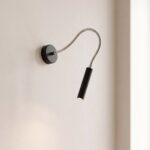
Reading wall light with adjustable head in black steel
See also

Mood Lighting: The Three Settings That Really Create It, Room by Room

How to Change Spotlight Bulbs, With or Without a Clip

Conservatory Lighting: Which Lights Cope With the Heat, the Glass and the Dark
