
Table of Contents
To work out how many lumens you need, multiply the floor area in m² by the lux you want, then double it for the light lost on walls and ceiling. That gives about 200 lumens per m² in a bedroom or hallway, 200 to 300 in a living room and 400 to 600 in a kitchen.
Bulbs are sold in lumens, but lighting advice is given in lux, and no box tells you the lumens per square metre: you work them out from the floor area, the light level the room needs and the share of the light that reaches where you need it. The difference between the two units is explained in our guide to lux vs lumens, and the match between bulbs old and new in our lumens to watts chart. This guide does the sums, room by room, with worked examples and a way to share those lumens between your lights.
The basic rule: floor area × lux × 2
One lux is one lumen landing on one square metre. Lighting a whole room to a given level therefore takes as many lumens as its area in square metres multiplied by that level:
- Useful lumens = floor area (m²) × light level (lux)
- Lumens to fit = useful lumens × 2, in a room with pale walls and a ceiling of about 2.5 m
A 12 m² bedroom that you want to light to 100 lux needs 12 × 100 = 1,200 useful lumens, which means 2,400 lumens to fit. The first figure is what you want to receive; the second is what your bulbs have to give out.
Why double it: the light lost on the way
Not all the light from a bulb reaches the floor, the table or the worktop. The shade or the diffuser holds some of it back. Some goes up to the ceiling and out to the walls, which send back only part of it. Lighting designers call the share of the bulbs’ output that reaches the surface being lit the utilisation factor.
Then comes the maintenance factor. I.S. EN 12464-1, the European standard for lighting indoor workplaces, published in Ireland by NSAI, gives its recommended levels as maintained illuminance: the level that must still be there when the lighting has aged. Bulbs lose output as they age and dust settles on fittings and walls, so a new installation is designed brighter than the level it has to keep.
In a living space with pale walls, our benchmark is that about half the light you fit ends up lighting something useful. Hence the factor of 2, which we use across our guides: our guide to hallway lighting works out roughly 200 lumens installed per square metre of floor for about 100 lux. It is not a figure from a standard but a cautious rule of thumb. A spotlight aimed at a table loses less; an opal globe in the middle of a dark room loses more.
Checking a room you already have
The rule also works backwards. Add up the output of every bulb in the room, printed on its box or its base, divide by 2, then by the floor area: you get the approximate average light level. A 30 m² living room lit by a ceiling light of 1,521 lumens and a lamp of 806 lumens receives about 2,327 ÷ 2 ÷ 30, or 39 lux. That is less than half the 100 lux we suggest, and it explains why the room feels dim.
Many guides online are American and count in lumens per square foot. A square metre is about 10.8 square feet, so divide our figures per m² by 10.8: 200 lumens per m² is about 19 lumens per square foot.
How many lumens per square metre? A room-by-room table
No rule sets light levels inside an Irish home. For workplaces, I.S. EN 12464-1 gives maintained illuminances for spaces much like ours: corridors, stairs, toilets, desks where you read and write. The Health and Safety Authority’s guide to the General Application Regulations 2007 adds that, as a general rule, 300 to 500 lux should suit screen work. We use these figures as benchmarks, and give our own advice where the standard says nothing useful for a home.
| Room | Light level | Lumens to fit per m² | Where the figure comes from |
|---|---|---|---|
| Hall, landing | 100 lux | 200 lm/m² | I.S. EN 12464-1: 100 lux in corridors and circulation areas |
| Stairs | 100 to 150 lux | 200 to 300 lm/m² | I.S. EN 12464-1: at least 100 lux on stairs, 150 where conditions call for more. See our guide to staircase lighting |
| Bedroom | 100 lux | 200 lm/m² | Our advice, with a reading light by the bed |
| Living room | 100 to 150 lux | 200 to 300 lm/m² | Our advice, with a lamp by the reading chair |
| Dining room | 150 lux, 300 on the table | 300 lm/m² | Our advice |
| Kitchen | 200 to 300 lux, 500 on the worktop | 400 to 600 lm/m² | Our advice; the standard gives 500 lux in a restaurant kitchen |
| Downstairs toilet | 200 lux | 400 lm/m² | I.S. EN 12464-1: 200 lux in cloakrooms, washrooms and toilets. See our guide to downstairs toilet lighting |
| Bathroom | 200 to 300 lux | 400 to 600 lm/m² | I.S. EN 12464-1: 200 lux in bathrooms; our advice, 300 lux at the mirror |
| Home office | 300 lux, 500 at the desk | 600 lm/m² | HSA: 300 to 500 lux for screen work; I.S. EN 12464-1: 500 lux for writing and reading. See our guide to office lighting |
| Garage, workshop | 300 lux | 600 lm/m² | Our advice, 500 lux or more at the bench |
How to read it: the lumens column applies to a room with pale walls under a 2.5 m ceiling, and it is simply double the light level. The levels “on the table”, “on the worktop” or “at the desk” do not come from raising the whole room to 500 lux, but from a light placed close to that area. For a long read or a stretch of writing, aim for 300 to 500 lux on the page, with a lamp beside you rather than a brighter ceiling.
Adjusting for ceiling height, wall colour and age
The factor of 2 describes a standard room. Three situations call for more lumens. Here are the corrections we apply, multiplied together when several apply:
| Situation | Correction to the lumens to fit |
|---|---|
| Ceiling of 2.7 to 3 m | + 15% |
| Ceiling above 3 m | + 30%, or bring the lights down |
| Mid-tone walls (deep beige, sage green, mid grey, light wood) | + 20% |
| Dark walls (teal, charcoal, dark wood) | + 40 to 50% |
| Reading or close work after 60 | twice the lux on the reading spot |
Ceiling height
The higher the ceiling light, the more its light spreads before it reaches the floor, and the more of it meets the walls on the way. Rather than fitting a more powerful ceiling light at 3.2 m, bring the light down: a pendant hung over the table or the coffee table gets back the efficiency of a standard room. Our guide to choosing a living room pendant light gives the heights to aim for.
Wall and ceiling colour
A white wall sends back most of the light it receives; a dark wall absorbs most of it. For workplaces, I.S. EN 12464-1 gives useful reflectance ranges of 0.6 to 0.9 for the ceiling, 0.3 to 0.8 for the walls and 0.1 to 0.5 for the floor. At home, a white or pale linen paint sits comfortably in that range. A teal, a deep green or a dark wooden floor are far from it: with the same lumens, the room looks darker.
Use and age
Our eyes need more light as they get older. According to licht.de, the German lighting information centre, a 60 year old needs twice as much light as a 20 year old to read with the same sharpness. Our advice: do not double the lumens of the whole room, only those of the reading chair or the worktop, with an adjustable light close to the page or the task.
Worked examples: a 25 m² living room, a 12 m² bedroom and a 10 m² kitchen
Three common rooms, with pale walls and a 2.5 m ceiling. We round up to the output of standard LED bulbs: 470 lumens (the old 40 W), 806 lumens (60 W) and 1,521 lumens (100 W).
How many lumens for a 25 m² living room: about 5,000
General light at 100 lux: 25 × 100 = 2,500 useful lumens, so 5,000 lumens to fit, or 200 lumens per m². A living room where you read and entertain, lit to 150 lux, needs 7,500.
Here is one way to share them, adding up to 5,087 lumens. On the ceiling, a pendant over the coffee table with a 1,521 lumen LED, and a ceiling light with three 450 lumen spots (1,350 lumens) aimed at the sofa and the bookcase. For tasks, a floor lamp of 806 lumens by the reading chair and a table lamp of 470 lumens. For mood, two wall lights of 470 lumens, 940 lumens in all.
With sage green walls and a 2.8 m ceiling, the same room needs 5,000 × 1.15 × 1.20 = 6,900 lumens. With class E LED bulbs, which give 110 to 135 lumens per watt on the EU energy label, 5,000 lumens draw 37 to 45 W in total. Over the floor area, that is 1.5 to 1.8 W per m², the “watts per square metre” figure you are sometimes asked for.

How many lumens for a 12 m² bedroom: about 2,400
At 100 lux: 12 × 100 = 1,200 useful lumens, so 2,400 lumens to fit. A ceiling light with a 1,521 lumen LED and two bedside reading lights of 470 lumens give 2,461 lumens. The ceiling light is for tidying and making the bed; in the evening, the reading lights are enough. That is the point of an adjustable reading light: aimed at the page from close by, it easily gives the 300 to 500 lux you want for a long read, without raising the light in the whole bedroom.

How many lumens for a 10 m² kitchen: about 5,500, 1,300 of them on the worktop
A kitchen is worked out in two steps. General light at 200 lux: 10 × 200 = 2,000 useful lumens, so 4,000 lumens on the ceiling. Then the worktop: 3 m long and 0.6 m deep makes 1.8 m², and at 500 lux it needs 900 useful lumens. Fixed under the wall units, a few tens of centimetres above the worktop, a strip or a batten loses less light than a ceiling light. We allow for a loss of about 30%, so 900 ÷ 0.7, roughly 1,300 lumens.
For example: two ceiling lights with three 450 lumen spots (2,700 lumens), a pendant of 1,521 lumens over the table and 1,300 lumens under the units, 5,521 lumens in all. Our guide to kitchen lighting shows where to put each of these lights.

Sharing the lumens between ceiling light, pendant and lamps
The total should almost never come from a single fitting. One ceiling light of 5,000 lumens lights the room, but it flattens everything and dazzles when you look up. We suggest sharing your lumens in three layers, roughly like this:
- Main light, 50 to 60% of the lumens: ceiling lights, spots or a pendant. It lights the whole room for moving around, tidying and cleaning.
- Task light, 25 to 30%: reading light, desk lamp, lighting under the kitchen units. It brings 300 to 500 lux to one area, close to what you are doing.
- Mood light, 15 to 20%: wall lights, low lamps, hidden LED strips. It warms the walls and creates the soft pools of shade that make a room feel cosy.

A few rules so that those lumens really work:
- Add up the outputs: a fitting with three lampholders and three 450 lumen LEDs gives 1,350 lumens.
- Put each layer on its own switch, so you can turn on the task light without the main light.
- Keep one colour temperature per room, around 2,700 K in the living room and the bedroom, 3,000 K in the kitchen.
- With downlights, divide the lumens of the main light by the output of one spot: 2,400 lumens make six spots of 400 lumens. Their spacing depends on the beam angle.
- With an integrated LED fitting, read the output in lumens on its product page and count it as it is in your total.
Is 1,000 lumens enough for a room?
It depends on the size of the room and what it is for. With our rule, the floor area a given total can light is the lumens divided by 2, then by the lux you want:
| Lumens fitted | Area lit to 100 lux (bedroom, living room) | Area lit to 200 lux (kitchen, toilet) | Area lit to 300 lux (home office) |
|---|---|---|---|
| 400 lm | 2 m² | 1 m² | 0.7 m² |
| 1,000 lm | 5 m² | 2.5 m² | 1.7 m² |
| 2,000 lm | 10 m² | 5 m² | 3.3 m² |
| 3,000 lm | 15 m² | 7.5 m² | 5 m² |
| 5,000 lm | 25 m² | 12.5 m² | 8.3 m² |
So 1,000 lumens light a box room or a small hall, and 400 lumens a narrow toilet of about 1 m². In a 12 m² bedroom, 1,000 lumens give only about 40 lux: you need more than twice as much. A typical 20 m² living room needs about 4,000 lumens at 100 lux, so 3,000 lumens fall a little short unless the walls are very pale.
Frequently asked questions about how many lumens you need
How do you calculate how many lumens you need?
Multiply the floor area in square metres by the light level you want in lux, then double the result to allow for the light lost on the walls, the ceiling and inside the shades. For a 12 m² bedroom at 100 lux: 12 × 100 × 2 = 2,400 lumens, or 200 lumens per m².
Is 1,000 lumens bright enough for a room?
Only for a small one. With our rule, 1,000 lumens give about 100 lux over 5 m², enough for a box room or a small hall, or 200 lux over 2.5 m², a small toilet. In a 12 m² bedroom they give only about 40 lux: you need more than twice as much.
Is 3,000 lumens enough for a living room?
For a living room of about 15 m² with pale walls, yes: 3,000 lumens give around 100 lux. A 20 m² living room needs about 4,000 lumens, and 6,000 if you want 150 lux for reading and entertaining. Share them between a main light, a reading lamp and some wall lights.
Is 5,000 lumens too bright?
Not for a 25 m² living room: 5,000 lumens is exactly what our rule gives for 100 lux. It becomes too bright when it all comes from one ceiling light. Split it between three layers of light and put the main light on a dimmer switch compatible with LED.
How many lumens do I need for a kitchen?
Allow 400 to 600 lumens per m² for general light, then add light under the wall units for the worktop. A 10 m² kitchen needs about 4,000 lumens on the ceiling, plus about 1,300 lumens under the units to bring 500 lux to 3 m of worktop.
How many lumens do I need for a bedroom?
About 200 lumens per m², or 2,400 lumens for a 12 m² bedroom. A ceiling light with a 1,521 lumen LED and two reading lights of 470 lumens cover it. For reading in bed, an adjustable reading light gives 300 to 500 lux on the page without lighting the whole room.
Sources
- I.S. EN 12464-1, Light and lighting, Lighting of work places, Part 1: Indoor work places (maintained illuminance: circulation areas and corridors 100 lx, stairs 100 to 150 lx, cloakrooms, washrooms, bathrooms and toilets 200 lx, writing and reading 500 lx; maintenance factor; useful reflectance ranges of interior surfaces). NSAI
- Guide to the Safety, Health and Welfare at Work (General Application) Regulations 2007: Chapter 1 of Part 2, Workplace, Regulation 8 on natural and artificial lighting; Chapter 5 of Part 2, Display Screen Equipment (300 to 500 lux as a general rule). Health and Safety Authority
- Wohnzimmer, Lichtanwendungen Wohnen (light needed by a 60 year old compared with a 20 year old). licht.de
- Commission Delegated Regulation (EU) 2019/2015 on the energy labelling of light sources (energy efficiency classes A to G by total mains efficacy, class E from 110 to 135 lm/W). EUR-Lex
Related products
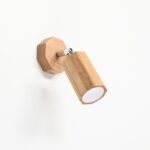
Natural oak wood spotlight wall light

Design natural wood ceiling light with 3 adjustable spots
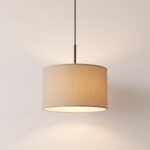
Beige fabric drum pendant light, timeless design
See also

Colour Rendering Index: The Number That Decides Whether Your Colours Look True

Light Stays On When Switch Is Off: Why LED Bulbs Glow and How to Stop It

Sloped Ceiling Lighting: What to Fit Under an Attic Slope
