

Table of Contents
The best low ceiling lighting ideas keep the top of the room clear and put light on the ceiling itself: a flush or LED ceiling light instead of a pendant, wall lights that shine upwards, and a pale matt ceiling that bounces their light back. Vertical lines, long curtains and low furniture then finish the job.
You cannot raise a ceiling without major building work, but you can change how high it looks. Two things count more than the rest: how pale the surfaces are, which researchers have measured, and the light itself, which most advice skips. This guide takes them in turn, then the fittings that suit a low room, the drop to allow for each ceiling height and the decorating tricks that complete the effect.
What makes a low ceiling look higher
A ceiling feels low when you become aware of it above your head, which tends to happen at around 2.4 m or less. The Irish Building Regulations set no general minimum ceiling height. Technical Guidance Document F, on ventilation, only suggests 2.4 m in habitable rooms, and 2.1 m under a beam or in a bay window, as dimensions consistent with good room design and standard materials. In a room directly under the roof, it suggests 2.4 m over at least half of the floor area that has 1.5 m or more of headroom. The apartment guidelines issued in July 2025 repeat the 2.4 m of TGD F as the general figure and add one firm rule: ground-floor apartments must have at least 2.7 m. The 2007 Quality Housing guidelines simply ask for living rooms and bedrooms that are well proportioned in floor shape and ceiling height, without giving a figure. Attic conversions, dormer bedrooms and older cottages can easily fall below 2.4 m.
The good news is that perceived height does not depend on the tape measure alone. A team at the University of Mainz asked people to judge the height of virtual rooms while changing how light the ceiling, the walls and the floor were. The rooms looked higher when the ceiling was lighter, and also when the walls were lighter, with the two effects adding up. A later study by the same team found that what counts on the ceiling is its lightness, not its hue or saturation, whatever the colour of the other surfaces. A third showed that pale walls also look farther away.
Three ideas to keep in mind:
- Lightness beats contrast. The old trick of a white ceiling over dark walls is not the most effective: pale walls under a pale ceiling give more height.
- Light does the rest. A pale surface only looks pale when light reaches it. Left in shadow in the evening, a white ceiling turns grey and feels lower.
- Anything that hangs down brings the ceiling down. A long pendant, a crystal chandelier, a heavy cornice: everything in the top band of the room marks where the space ends.
Low ceiling colours: white, tone on tone and vertical lines
A white, matt, genuinely pale ceiling
The ceiling is the surface that sends the most light back into the room, especially the light of wall lights and floor lamps that shine upwards. Choose a pure white or a barely softened white in a matt finish, which spreads the light and hides the flaws of an old ceiling. Avoid deep shades overhead, however fashionable: the Mainz team found that a dark ceiling looks lower, the opposite of what you want.
Tone on tone, to blur the edge
On the walls, stay with pale shades: off-white, linen, soft beige or a very light grey. Two approaches work. Paint the walls and the ceiling in the same pale colour, which blurs the corner between them so the eye cannot measure the height. Or keep the ceiling a shade lighter than the walls, in the same colour family. If you like grey, pick light, warm greys that do not turn dull in the evening: our guide to what colour goes with grey helps you pair them, and a greige colour gives the same softness with a little more warmth.
A stronger colour still has its place on a feature wall, ideally the one facing the door, or below a dado rail on the lower part of the walls: the upper wall stays pale and gains importance. A band of colour at mid-height, on the other hand, cuts the wall in two and shortens it.
Vertical lines, to stretch the walls
Anything vertical pulls the eye upwards: wallpaper with fine vertical stripes, tongue and groove panelling fitted upright, timber battens, rectangular tiles laid on end, doors and wardrobes that run from floor to ceiling. One striped wall is enough, often the one behind the sofa or the bed. Horizontal patterns, borders and large-print wallpaper do the opposite.
Lights for low ceilings: flush, LED, recessed or wall lights
The right light for a low ceiling follows one rule: it must stay out of the top band of the room. Three families of fittings meet that rule, and they are often combined.
The flush ceiling light
This is the most logical main light. Fixed tight to the ceiling, it only takes up its own depth: a 12 cm model leaves 2.28 m clear in a 2.4 m room, and an 8 cm model leaves 2.32 m. Our advice is to stay under 15 cm deep when the ceiling is 2.4 m or lower. Look for a frosted or opal glass diffuser, which sends some of the light sideways and onto the ceiling, rather than a closed disc that only lights the floor. A semi-flush light, on a short stem, suits a ceiling of 2.5 m or more. Our flat ceiling light range brings together models in wood, glass, metal and concrete.

The LED ceiling light
With an integrated LED there is no bulb holder to house, so the fitting can be very slim. It also runs cool, which matters when the light is within reach of a raised hand in a low room. On the product sheet, check the colour temperature, 2,700 to 3,000 K for a warm light in living spaces, and the light output in lumens rather than the wattage. To size that output, our guide how many lumens do I need works it out room by room.
Recessed downlights
Recessed into the ceiling, downlights do not protrude at all. They do need a void above the plasterboard, and a new suspended ceiling costs a few centimetres, so in a room that is already low keep them for ceilings that already have a void above them. Their other limit is that they shine downwards and leave the ceiling in shadow between them. Pair them with uplighting, or choose adjustable models to wash the walls. Spacing and fitting are covered in our guide to downlights.
Wall lights
A wall light frees the ceiling entirely. In a low room it often becomes the main mood light, with the ceiling light kept for cleaning and tidying. Choose shallow models in a hall, and wall lights that shine upwards in the living room and the bedroom. Our interior wall light collection covers ceramic, glass, wood and metal designs.
Whatever the model, a ceiling or wall light is fitted with the power off at the fuse board, on a fixing suited to its weight, and a new light point is a job for a Registered Electrical Contractor. The steps are set out in our guide on how to install a ceiling light.
Uplighting: the idea that makes a low ceiling look higher
It is the most effective idea, and the least mentioned. An uplighter sends its light onto the ceiling, which bounces it back into the room. The ceiling becomes the brightest surface in view, loses its dark-lid look and seems farther away. The Mainz researchers varied the luminance of the ceiling, in other words the amount of light it sends back to the eye: the higher it was, the higher the ceiling looked. They changed it with paint; lighting the ceiling acts on the same quantity. This indirect light does not dazzle, either.

Where to put uplighting wall lights
Our usual starting point for a wall light is eye level, about 1.70 m from the floor to the centre of the light, as our guide to wall light height explains. A wall light that shines upwards can go a little higher: under a 2.4 m ceiling, we suggest centring it at about 1.90 m. It stays above the line of sight, and its light still has around 45 cm to spread across the ceiling as a soft wash rather than a bright patch.
To carry the effect across the whole ceiling, spread the sources: a pair either side of a mirror or a sideboard, or, as a rule of thumb, one every 2 to 3 m along the longest wall. The white half-moon ceramic wall light with indirect lighting in our main photo works this way: its light leaves through the top and through the glass underneath, for a double halo on the wall. At 40 cm wide and 15 cm deep, its white ceramic blends into a pale wall. It takes an E27 bulb of up to 15 W, not included.
Other ways to light the ceiling
- An uplighter floor lamp, whose bowl sends all its light to the ceiling: handy in a rented home, since it needs no new wiring.
- LED strip lights hidden on top of a wardrobe, a bookcase or a coving, drawing a line of light along the ceiling.
- A ceiling light with open or glass sides, which lights the room and the ceiling around it at the same time.
Keep a warm light, around 2,700 K, in living spaces, and a single colour temperature in each room. A dimmer lets you keep the ceiling softly lit in the evening without an office feel.
No low pendants: the maximum drop for your ceiling height
A pendant lowers a low ceiling more than any other fitting, because it fills exactly the band you want to keep clear. No rule sets the headroom under a light fitting in an Irish home. For comparison, TGD K asks for at least 2 m of headroom over a stairs; in a room where people walk under the light, we suggest a little more, 2.15 m between the floor and the bottom of the fitting, so that a tall visitor passes without ducking. That line sets the maximum length of the fitting, flex and ceiling rose included. Under 2.4 m, it leaves 25 cm: a pendant with a 60 cm drop would hang at 1.80 m, at eye level.
| Ceiling height | Maximum drop where people walk | What we suggest |
|---|---|---|
| 2.2 m | 5 cm | Recessed or extra-slim ceiling light, uplighting wall lights |
| 2.3 m | 15 cm | Flush light 8 to 12 cm deep, uplighting wall lights |
| 2.4 m | 25 cm | Flush or LED ceiling light, or a very short pendant away from walkways |
| 2.5 m | 35 cm | Semi-flush light or a short pendant, ceiling rose included |
| 2.7 m | 55 cm | Pendant possible: the ground-floor minimum for new apartments |
There are two exceptions. Over a dining table, a kitchen island or a coffee table, nobody walks underneath standing up, so the pendant can come lower, and the reference becomes the table top: about 60 cm above it, according to licht.de, the German lighting information centre. Under a low ceiling, choose a compact pendant of modest diameter, in clear glass or pale paper, that does not form a dark mass in your line of sight; our guide to dining room lights covers the table itself. The second exception is the semi-flush light on a short stem, which works as long as its total height stays within the table above.
Keep crystal chandeliers and large rattan pendants for high ceilings, and bring their style in through a wall light or a table lamp instead.

Mirrors, curtains and low furniture
Mirrors
A tall, narrow mirror hung or leaned upright extends the room and adds a high line to the wall. The higher it reaches, the stronger the effect: a full-length mirror standing on the floor does more than a round mirror over a console table. Placed opposite a window or next to an uplighter, it also bounces the light around the room.
Curtains
Fit the pole or the track as close to the ceiling as you can, well above the window frame, and let the curtains fall to the floor. The window looks taller, and the whole wall reads as one tall surface. Choose pale, light fabrics, linen or voile, plain or with vertical stripes. A ceiling-mounted track is more discreet than a pole with large finials.
Low furniture and hanging pictures
The lower the furniture, the more space there is between it and the ceiling: a low sofa, a platform bed, a long sideboard instead of a tall wardrobe, a wide coffee table. Keep the top of the walls as clear as you can, and hang pictures in a vertical arrangement rather than a long horizontal line. For storage, built-in presses that run from floor to ceiling, painted the colour of the walls, work better than a single tall piece of furniture.
Finally, heavy cornices and dark beams draw the eye to the limits of the room. In a cottage with exposed beams, lighten them, or run an LED strip along their top face to light the ceiling between them.
Low ceiling lighting ideas: frequently asked questions
What is the best type of lighting for a low ceiling?
Light that stays out of the top of the room and reaches the ceiling itself: a flush or LED ceiling light for general light, wall lights or a floor lamp that shine upwards for the evening, and recessed downlights only where the ceiling already has a void. A lit ceiling looks farther away than one left in shadow.
What are the best ceiling lights for a low ceiling?
Flush ceiling lights less than 15 cm deep, ideally with a frosted or opal glass diffuser that also lights the ceiling. Integrated LED models are the slimmest. Under a 2.4 m ceiling, a 12 cm flush light leaves 2.28 m clear. Keep pendants for over a table, where nobody walks underneath.
How do you make a low ceiling look good?
Paint the ceiling a pale matt white and keep the walls pale, in the same colour family. Light the ceiling with uplighting wall lights, hang curtains from just below the ceiling to the floor and choose low furniture. Avoid borders at mid-height, dark beams and large chandeliers, which all mark where the room ends.
What colour makes a low ceiling look higher?
A pure or barely softened white, in a matt finish. Studies in virtual rooms show that a lighter ceiling looks higher than a darker one, whatever its hue, and that paler walls add to the effect. Painting the walls and ceiling in the same pale colour blurs the corner between them.
How do you decorate a room with a low ceiling?
Choose low furniture, built-in storage that runs from floor to ceiling in the wall colour, a tall narrow mirror and pictures hung in a vertical arrangement. One wall with vertical stripes or upright panelling draws the eye up. Replace a pendant with a flush ceiling light and add wall lights that shine upwards.
What ceiling height is considered low in Ireland?
Most people feel a ceiling as low at around 2.4 m or less. The Building Regulations set no general minimum: TGD F only suggests 2.4 m in habitable rooms, and 2.1 m under a beam. The 2025 apartment guidelines require at least 2.7 m for ground-floor apartments.
Sources
- Oberfeld D., Hecht H., Gamer M., Surface lightness influences perceived room height, The Quarterly Journal of Experimental Psychology, 2010. doi.org/10.1080/17470211003646161
- von Castell C., Hecht H., Oberfeld D., Bright paint makes interior-space surfaces appear farther away, PLOS ONE, 2018. doi.org/10.1371/journal.pone.0201976
- von Castell C., Hecht H., Oberfeld D., Which attribute of ceiling color influences perceived room height?, Human Factors, 2018. doi.org/10.1177/0018720818789524
- Technical Guidance Document F, Ventilation, Building Regulations 2019: par. 1.2.1.7 and Diagram 3 (suggested height of habitable rooms); Technical Guidance Document K, Stairways, Ladders, Ramps and Guards, Building Regulations 2014: par. 1.1.9 (headroom). Government of Ireland
- Planning Design Standards for Apartments, Guidelines for Planning Authorities, July 2025: section 3.5 and Specific Planning Policy Requirement 4 (2.7 m floor to ceiling height at ground level). Department of Housing, Local Government and Heritage
- Quality Housing for Sustainable Communities, Best Practice Guidelines, 2007: section 5.3.2 (space requirements and room sizes). Department of the Environment, Heritage and Local Government
- Pendant over a table: about 60 cm between the table top and the bottom of the light. licht.de
Related products
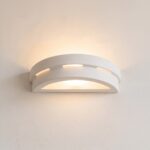
White half-moon ceramic wall light, indirect lighting
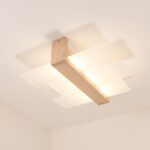
Scandinavian living room ceiling light in light wood and glass

Round raw concrete ceiling light, industrial style
See also

Mood Lighting: The Three Settings That Really Create It, Room by Room

How to Change Spotlight Bulbs, With or Without a Clip

Conservatory Lighting: Which Lights Cope With the Heat, the Glass and the Dark
