

Table of Contents
Downlights are small lights set into the ceiling so that only a slim trim shows below the plasterboard. To choose them, check the depth of the void above the ceiling first, then the type of light source, GU10 or integrated LED, whether the ceiling needs fire rated fittings, the IP rating for the room, the lumens and the beam angle.
Downlights are popular because they disappear: the ceiling stays clean and the light seems to come from nowhere. They also need the most planning, because every one is a hole in the ceiling. This guide follows the order of the job: which downlight, how many and where, fire rating and insulation, bathrooms, who can fit them in Ireland, and swapping halogens for LED. If your ceiling cannot take recessed lights, ceiling spotlights fix to the surface instead.
What are downlights?
A downlight has two parts: a body that sits in the void above the ceiling, and a trim, the visible ring that covers the edge of the hole. Two spring clips hold it tight against the plasterboard. A downlight is any light recessed into the ceiling that throws its light downwards. A recessed spotlight is a downlight whose head tilts, so you can aim it at a wall, a picture or a worktop. Surface spotlights, on the other hand, sit on the ceiling rather than in it.
Within downlights there are two families. The first takes a bulb you can replace, almost always a GU10. The second has the LED built into the fitting with its own driver: it is often slimmer, but when the LED eventually fades, you replace the whole downlight. Each family comes as fixed models, which shine straight down, and adjustable or tilting models.
GU10 or integrated LED: which downlight to choose?
The type of light source decides the depth you need, the voltage and how easy the fitting is to maintain.
GU10: the standard mains downlight
The GU10 is the most common base in Irish downlights. It runs directly on the 230 V mains with no transformer: its two pins are 10 mm apart and end in small feet, so the bulb goes in and locks with a quarter turn. Its drawback is depth: the lampholder, the bulb and the connector all have to fit above the ceiling. It is the right choice when the void is generous, because the bulb stays replaceable for years and you can change the colour or the beam simply by changing it.
MR16 and GU5.3: the low voltage option
The GU5.3 base, found on MR16 lamps, has two round pins 5.33 mm apart and runs at 12 V. It needs a transformer, either above the ceiling or in the fitting. You find it mostly in older installations. When you modernise, the transformer is often the weak point: one designed for 35 W or 50 W halogens can struggle with the few watts an LED draws, and the light flickers or will not start.
Integrated LED and slim downlights
Integrated LED downlights suit ceilings where depth is limited, often with a driver on a short lead beside the fitting. You give up swapping bulbs and gain the ability to recess almost anywhere. The flat GX53 base, a puck-shaped lamp with pins 53 mm apart and a twist-lock fitting, sits between the two.
| Type | Voltage | Depth needed | Maintenance | Best for |
|---|---|---|---|---|
| GU10 | 230 V | The most | Replaceable bulb | Ceilings with a generous void |
| MR16 (GU5.3) | 12 V | Depends on the transformer | Bulb and transformer | Older installations |
| GX53 | 230 V | Low | Replaceable flat lamp | Shallow voids |
| Integrated LED | 230 V | Lowest | Whole fitting replaced | Very shallow voids |
The exact recess depth and cut-out diameter are on every product sheet: take them from there, not from a rule of thumb, and measure your void before you buy.

Fixed or adjustable?
A fixed downlight sends its light straight down, for even general lighting. An adjustable one tilts, so you can aim it at a wall, a picture or a worktop, and it forgives a layout that ends up slightly off. Fixed lights in the centre and a few adjustable ones around the edges suit most rooms.
How many downlights do you need, and where?
Think in lumens and beam angle
As with any LED, watts no longer tell you how much light you get: compare lumens. European rules require the packaging of a light source sold on its own to show its useful luminous flux in lumens in large type, its colour temperature and, for a directional lamp such as a GU10, its beam angle. With downlights, that beam angle matters as much as the lumens. A narrow beam concentrates light into a pool for accent lighting, on a picture or a worktop. A wide beam spreads it evenly for general lighting. A wide beam also lets you space the lights further apart.
Plan by zones, not by grid
The classic mistake is a regular grid of downlights across the whole ceiling. It lights the floor evenly and everything else badly. Think in zones instead: a line of downlights above the kitchen worktop, set slightly in front of the wall units so you do not work in your own shadow; two adjustable lights washing a bookcase; a separate row along a hallway. Put each zone on its own switch, ideally with a dimmer. Keep downlights roughly in line with the walls and the furniture, and mark the positions on the floor with tape first, then transfer them to the ceiling: it is the easiest way to see the result before you cut a single hole.
In the kitchen, downlights often work best together with pendants over an island or a table: our kitchen pendant lights add the warm focal point that a flat ceiling of spots lacks.
Colour temperature
Use the same colour temperature for every downlight in a room. Around 2,700 K to 3,000 K, light is warm and suits living rooms and bedrooms. Around 4,000 K, a neutral white helps you see accurately in a kitchen, a bathroom or a utility room.
Avoid glare
A badly placed downlight dazzles more than it lights. Never look straight into the source from where you sit or lie: avoid downlights directly above a sofa or a bed, and keep them along the walls or over circulation areas. Models with the LED set deep in the body, or with a diffuser, cut direct glare, and a wide beam on a dimmer is kinder than a narrow beam at full power.
Fire rated downlights and insulation
Every downlight is a hole in the ceiling, and in some ceilings that matters for fire safety. The Irish building regulations guidance on fire safety in dwelling houses, Technical Guidance Document B, asks that openings through any part of the building that acts as a barrier to fire be kept as few and as small as possible, and fire-stopped. A clear example is the ceiling between an integral garage and the house, which the same document expects to give 30 minutes of fire resistance. A fire rated downlight is designed to close off its own hole when exposed to fire, so the ceiling keeps its protection. Where the ceiling forms part of the fire protection of the house, that is what you fit, and your electrician or builder will confirm where that applies.
Insulation is the second point. A downlight, and even more a transformer or driver, must not be buried in mineral wool or blown insulation unless it is designed for it, or it cannot shed its heat. You then either fit an insulation cover that keeps an air space around the fitting, or choose a downlight rated to be covered by insulation, which its instructions must say. In an attic ceiling, every hole is also a potential air leak into a cold roof space, so covers and sealed fittings help keep both the heat and the airtightness of the ceiling.
Bathroom downlights and IP ratings
The IP rating tells you how well a fitting is protected against solid objects and water. The first digit covers solids, the second covers water: a 4 in second place means water splashing from any direction has no harmful effect, a 5 means it withstands water projected from a nozzle, a 7 means it can be briefly immersed. An X in place of a digit simply means that part was not tested. In a living room or a bedroom, an IP20 downlight is enough. In a kitchen near the sink, or a porch, an IP44 fitting protects against splashes.
Bathrooms follow stricter rules. The National Rules for Electrical Installations, I.S. 10101, divide a bathroom into zones around the bath or shower, and each zone limits what can be installed and the protection it must have: the closer to the water, the stricter the rule, and inside the shower itself only special low voltage equipment is allowed. For a downlight above a shower, that means a fitting with the IP rating that zone requires, never an ordinary IP20 downlight. Bathrooms are also a special location under the Irish rules, so any electrical work there is Restricted Electrical Works, which only a Registered Electrical Contractor can carry out and certify. Let them set out the positions, and add a bathroom wall light at face height by the mirror: coming from above, downlights cast shadows under your eyes.
Which downlights for which room?
In the living room, downlights give a discreet background light on a dimmer, while a floor lamp or living room wall lights provide the warm pools of light. In the kitchen, they go above the worktop in a neutral white, with IP44 near the sink. In the hallway, a line of wide-beam downlights guides the way. In the bedroom, keep them away from above the bed and leave reading to reading wall lights or a bedside lamp.
Who can fit downlights in Ireland?
Fitting downlights means cutting the ceiling and wiring each position, and Safe Electric is clear on where the line sits. Restricted Electrical Works cover most electrical work in a home and must be carried out and certified by a Registered Electrical Contractor; only minor works, such as like-for-like replacements or moving a light fitting without affecting the circuit, fall outside that. A new layout of downlights, a new circuit or any work in a bathroom is a job for a REC, who will give you a completion certificate at the end. Replacing a GU10 bulb, on the other hand, is simple maintenance.
You can still prepare the job: decide the zones and switching, mark the positions, and choose fittings with the depth, cut-out, fire rating and IP rating your ceiling needs. The classic mistakes are a hole cut before the fitting is in hand, a downlight that lands on a joist, and insulation pushed back over a fitting with no cover.
Replacing halogen downlights with LED
This is often where a project starts. With GU10, it is easy: take out the halogen, put in a GU10 LED with a similar light output, and the fitting is converted. Just check that any dimmer on the circuit is rated for LEDs, or the new bulbs may flicker.
With MR16 on 12 V, it is trickier. A transformer made for 35 W or 50 W halogens may not start, or may make a low wattage LED flicker. You then need an LED compatible driver, or you use the job as a chance to move to 230 V GU10 fittings.
No void above the ceiling? The alternatives to downlights
When the ceiling is concrete, when the void is too shallow or when you rent, recessed lights are not the only way to get directional light. Spotlight ceiling lights fix to the surface on a single existing light point, with one or several adjustable heads, and take the same GU10 bulbs as downlights. The LED ceiling lights in our range include compact models that fit where there is no depth at all.

These fittings leave the insulation untouched and move with you when you leave. Whatever you choose, three habits make a good ceiling: measure the void first, plan by zones rather than by grid, and read the recess depth, fire rating, IP rating and cut-out on the product sheet.
Downlights: frequently asked questions
What is the difference between downlights and recessed lights?
Recessed light is the broad term for any fitting set into the ceiling. A downlight is a recessed light that throws its light straight down, usually for general lighting. A recessed spotlight is a downlight whose head tilts, so you can aim it at a wall, a picture or a worktop. Surface spotlights look similar but sit on the ceiling rather than in it.
Do I need an electrician to replace downlights?
Swapping a GU10 bulb is simple maintenance. Replacing a fitting like for like is listed by Safe Electric as minor works, but a new layout, a new circuit or any work in a bathroom is Restricted Electrical Works and must be carried out and certified by a Registered Electrical Contractor. If in doubt, use a REC and ask for the completion certificate.
What type of downlights are best?
It depends on the ceiling. With a generous void, GU10 downlights keep a replaceable bulb and let you change the beam or colour later. With a shallow void, a slim integrated LED downlight fits where a GU10 cannot. Choose fire rated fittings where the ceiling is part of the fire protection, the IP rating your bathroom zone requires, and warm white for living spaces.
How many downlights do I need?
There is no single number: it depends on the lumens, the beam angle and what you want to light. A wide beam lets you space downlights further apart, a narrow beam needs them closer. Plan by zones rather than a grid: a line above the worktop, a few adjustable lights for a wall or bookcase, a row along a hallway, each on its own switch.
What are the downsides of recessed lighting?
Every downlight is a hole in the ceiling, which can affect fire protection, insulation and airtightness if the wrong fitting is used. They need enough depth above the ceiling, and the layout is hard to change once cut. Badly placed, they cause glare and a flat, even light. Fire rated, insulation-safe fittings and a zoned layout avoid most of these problems.
How many years should LED downlights last?
Makers quote lifetimes in hours, often tens of thousands for the LED itself. Real life depends mostly on heat: a fitting buried in insulation without a cover, or a driver with no air around it, ages much faster. With a GU10 downlight, a worn bulb is simply replaced; with an integrated LED downlight, the whole fitting is changed at the end of its life.
Sources
- Technical Guidance Document B, Fire Safety, Volume 2, Dwelling Houses: paragraph 3.7.5 on fire-stopping of openings, and Table A1 on the fire resistance of the ceiling between a garage and a dwelling. gov.ie
- Restricted and Controlled Electrical Works, definitions under S.I. No. 264 of 2013, minor works and special locations. Safe Electric
- Commission Regulation (EU) 2019/2020, Annex II: information to be displayed on the packaging of light sources, including useful luminous flux, colour temperature and beam angle. EUR-Lex
- Bi-pin lamp base: GU10, GU5.3 and GX53 pin spacing and voltage. Wikipedia
- IP code: meaning of the first and second digits. Wikipedia
Related products

Loft-style spotlight wall light in natural wood and metal
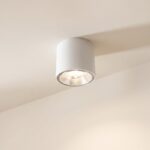
Modern round aluminium ceiling spotlight, GU10

Design natural wood ceiling light with 3 adjustable spots
See also

Flickering Lights: Causes, Warning Signs and How to Fix Them

Bookcase Lighting: How to Light Your Books, Shelves and Reading Nook

How Many Lumens Do I Need? Lumens per m² for Every Room
