

Table of Contents
Good dining room lights come in three layers, not one: a pendant over the table, a ceiling light or chandelier for general light, and wall lights or lamps for atmosphere. In an open-plan dining and sitting room, keep the same warm white, 2,700 to 3,000 K, in both areas, and repeat one material so the whole space hangs together.
Choosing lights for a room that eats at one end and relaxes at the other often turns into a puzzle. One flat light from the middle of the ceiling squashes the space and serves neither the table nor the sofa. The better approach marks out the dining area from the sitting area while keeping them visually connected. To help you choose, our range includes 271 dining room pendant lights and 261 dining room chandeliers. Here is how to combine them and how to set the mood for each moment.
How to light a dining room: think in three layers
General light: the base layer
Think of general light as the foundation of the room, the layer that gives an even overall brightness. Its job is practical: moving around, tidying up, seeing clearly without tripping on the rug. It should stay soft, without hard shadows, so the room is comfortable straight away.
A discreet ceiling light is the simplest answer, or a central pendant if your ceiling height allows. Our black and wood Scandinavian ceiling light, a short tube that takes a GU10 bulb, does this job without hanging into the room. But be careful: relying on this single source quickly turns a dining room into a waiting room.
Task light: the pendant over the table
Here the aim is not decoration but a targeted, stronger light that lets you do something precise without squinting. In a shared space, that means a pendant over the dining table, hung low enough to light the plates and high enough not to dazzle anyone or block the view across the table. Add a reading light beside the sofa, or an adjustable spot if you have a corner for working from home.
Each activity, eating, reading or working, is better with its own light source. It also marks out the zones visually without putting up a wall. The trick is a direct light that lights the area in use without glaring into the rest of the room.
Mood light: the finishing touch
This is the most neglected layer, yet it brings depth, warmth and character. It is what creates that easy atmosphere where people want to linger after the meal. Use wall lights that send a soft indirect light up or down the walls, a small lamp on a sideboard, or a discreet LED strip in a bookcase to pick out favourite objects.
Lighting an open-plan dining and sitting room
Once the three layers are clear, the real challenge begins: making them live together in one open space without visual clutter.
A common thread of materials and finishes
The most direct way to hold two zones together is a shared material or finish. There is no need for a matching collection, which tends to look like a catalogue page. If the pendant over the table is in brass, choose a floor lamp for the sitting area with a brass base or brass details. The same principle works with pale timber, black metal or smoked glass: the aim is a quiet link between the two areas. If you are decorating in Scandinavian style, pale timber with white or grey fabric is the easiest thread to follow.
Play with shapes without creating chaos
Avoid piling up complicated shapes. If the pendant over the table is a strong, sculptural piece, the other lights in the sitting area should stay quieter. Aim instead for a conversation between shapes: a round pendant over the table balances well with a floor lamp with straight, clean lines by the sofa. Your pendant is the lead; the other lights are the supporting cast.
One colour temperature for the whole space
Colour temperature, measured in kelvin (K), describes the tint of white light, from a yellowish, intimate white to a bluish, clinical one. It is the tipping point for the whole room: a very warm bulb at 2,700 K over the table and a very white one at 4,000 K in the sitting area make an unpleasant break. Stay within one range for the whole space. A warm white between 2,700 and 3,000 K is almost always the best choice for a welcoming room, and it suits the evening: the European Commission’s scientific committee SCHEER notes that all light affects the body clock and that evening exposure to light may have an effect on sleep patterns.
The dining table: which light to choose
The pendant, star of the dining room
Over the eating area, the pendant light is the natural choice. Unlike ceiling spots, it anchors the table visually and concentrates light where you need it, on the table top. It does two jobs at once: it lets you see what you are eating, and it acts as the decorative centrepiece that sets the style of the room.

Height and size: get the proportions right
There is no single figure that suits every room, because it depends on the ceiling, the fitting and the people at the table. The simplest test is to sit down: the bottom of the pendant should hide the bulb from your eyes, and you should still see the face of the person opposite under or around it. Check it before the pendant is fixed, holding the fitting at the planned height, and prefer a model with an adjustable cable so you can fine-tune it afterwards.
For size, a fitting that is too small looks lost in the room, while one that is too big crushes the space. Keep the pendant clearly narrower than the table, so the light falls on the plates and not on the backs of the chairs. On a long table, several smaller pendants or one linear fitting spread the light better than one large globe.
The right choice for the shape of your table
| Table shape | Recommended light | Our advice |
|---|---|---|
| Round or square table | One central pendant | Pick a shape that echoes the table for a strong effect. One centrepiece is enough. |
| Rectangular table | A linear pendant or several small pendants in a row | A row creates rhythm and makes sure nobody eats in shadow. |
| Very large table or island | A large chandelier or several pendants in a row | Go for a statement piece that owns its role as the focal point, in scale with the room. |
Over a small round table, a single globe works beautifully. Our Japandi-style wood and opal glass globe pendant, 11 cm across with a G9 bulb, can also hang in a row of two or three above a longer table.
The sitting area: a flexible cocoon of light
The table is lit; now for the other half of the room, a space that has to adapt to far more than a meal. The most common mistake is one ceiling light that is too bright and flattens everything. The aim is to remove gloomy shadows without turning the room into a railway station.
The floor lamp, your most flexible friend
A floor lamp moves wherever you want and only needs a socket. Its role changes with its direction: pointed at the ceiling, it spreads a general glow; beside an armchair, it becomes a reading light. An arc lamp lights a coffee table with no ceiling point above it, a tripod lamp adds a sculptural touch, and a reading floor lamp gives a direct, adjustable light for a book.
Wall lights to structure the space
Wall lights are often underrated. They take no floor space, and your walls instantly gain character. They give a soft indirect light and frame a sofa, a sideboard or a painting. Fit them in pairs for a symmetrical effect: the calm rhythm changes the balance of the whole room.
Matching your dining room lights to your style
Lighting that clashes with the furniture is enough to spoil a well furnished room.
- Scandinavian: simple shapes, light that moves freely, natural materials such as pale timber or rattan, fabric shades in white or grey, floor lamps on slim legs.
- Japandi: the calm of Japanese design and the warmth of Scandinavian style, with timber, opal glass and paper, and a low, soft light. Our Japandi pendant lights are built on that balance, and our guide to Japandi style covers its colours and materials. Its rawer, earthier cousin is wabi-sabi interior design.
- Industrial: black or aged metal bell shades over the table, jointed arm wall lights in the sitting area, bare filament bulbs as decoration.
- Modern or Art Deco: the light becomes a sculpture, in brass, ribbed or opal glass, with graphic shapes such as globes and arches.
The technical details that make the difference
LED bulbs: savings and a long life
LED bulbs give the same light as an old incandescent bulb for much less electricity, which is why we compare them in lumens and not watts: under the equivalences set by EU rules, an LED of 806 lumens replaces a 60 W bulb. Their life is counted in years, so you climb the stepladder far less often to change a bulb over the table.
A dimmer: one light, two moods
A dimmer is the best investment for a dual-purpose room. Full light for homework on the table, then, with one touch, a low light for dinner or a film. Check that your LED bulbs are marked dimmable and that the dimmer switch is designed for LED. Fitting a new dimmer switch is work on the fixed wiring: in Ireland, Safe Electric advises homeowners to always use a Registered Electrical Contractor.
The right colour temperature
- Below 3,000 K (warm white): the best option. A relaxing, welcoming light, close to the old bulbs, ideal for meals and unwinding.
- Around 4,000 K (neutral white): more stimulating. Keep it for a work corner, not as the main light.
- 5,000 K and above (cool white): best avoided in a dining or sitting room, where this bluish light looks impersonal.
Good dining room lighting is a balance between function and looks. By adding light sources and keeping one colour temperature, you create a sociable space that suits every moment of the day.
Dining room lights: frequently asked questions
What type of lighting is best for a dining room?
Layered lighting: a pendant over the table for task light, a ceiling light or chandelier for general light, and wall lights or lamps for atmosphere. The pendant is the key piece, because it puts the light on the table top. Use warm white bulbs, around 2,700 to 3,000 K, and a dimmer to move from bright to intimate.
How high should a light be over a dining table?
Low enough to light the plates, high enough that nobody sees the bulb or loses sight of the person opposite. The simplest test is to sit at the table while someone holds the pendant at the planned height. A model with an adjustable cable lets you fine-tune it after fitting.
How do you light an open-plan dining and sitting room?
Do not rely on one central light: give each zone its own layer. A pendant over the table, a reading light or floor lamp by the sofa, and wall lights or lamps for atmosphere. Keep one colour temperature for the whole space and repeat one material, such as timber, brass or black metal, from one fitting to the next.
Should all the lights in a dining and sitting room match?
No: identical fittings everywhere look like a catalogue page. Look for a common thread instead, such as a shared material or an echoed shape. The two areas then talk to each other while keeping their own character, and the pendant over the table stays the centrepiece.
What colour temperature is best for a dining room?
A warm white, from 2,700 to 3,000 K, gives the most welcoming atmosphere and suits the evening. Avoid cool light, 4,000 K and above, which makes the room feel impersonal. Above all, keep the same colour temperature in the dining area and the sitting area so the space feels coherent.
Why put dining room lights on a dimmer?
A dimmer lets one room do several jobs: bright light for homework or working at the table, then low light for dinner or a film. Use LED bulbs marked dimmable with a dimmer switch designed for LED, otherwise the light may flicker. In Ireland, have a new dimmer switch fitted by a Registered Electrical Contractor.
Sources
- Commission Regulation (EC) No 244/2009 on ecodesign requirements for non-directional household lamps, Annex II, Table 6: claimed equivalent incandescent lamp power by luminous flux. EUR-Lex
- SCHEER, Opinion on potential risks to human health of Light Emitting Diodes (LEDs), 2018, and its easy-read summary: light and the circadian rhythm. European Commission
- Safe Electric, Home Safety: always use a Registered Electrical Contractor for electrical works. Safe Electric
Related products
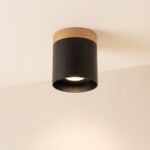
Scandinavian black metal and wood cylindrical ceiling light

Japandi-style wood and opal glass globe pendant light
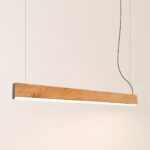
Modern linear oak LED pendant light
See also

Teal Bedroom Ideas: Colours, Gold Accents and the Right Light for a Dark Wall

Downstairs Toilet Lighting: The Right Light for a Small, Windowless WC or Cloakroom

Wabi-Sabi Interior Design: The Beauty of Imperfection, Right Down to the Light
