

Table of Contents
No rule sets the height of a wall light in a living room, bedroom or hall. Our starting point is about 1.70 m from the floor to the centre of the light, roughly eye level, so the bulb stays out of your line of sight. Over a bed, set it by your reading position; in a bathroom, the wiring zones decide where it may go.
The height of a wall light is best decided before you buy it, because it depends on a cable outlet in the wall that cannot be moved without opening the plaster. Get it wrong and the light dazzles everyone who walks past, or sits so high it lights nothing but the ceiling. This guide gives you a practical starting point, then the right height room by room, how the size of the fitting changes things, and how far apart to space them. Our range of wall lights covers every case, from adjustable reading lights to ceramic uplighters.
What height should wall lights be?
The simplest reference is eye level: we suggest mounting wall lights with the centre of the light source about 1.70 m from the floor. At that height, the bulb stays above the line of sight of someone walking past or sitting down, and the light spreads across the wall without glare. No standard sets this height in a living space: it is a sensible starting point, not a rule, and part of it is a matter of taste.
Three things move that reference up or down:
- Which way the light shines. A wall light that throws its light upwards can go higher, to wash the ceiling. One that shines downwards must stay high enough that you cannot see the bulb from the front.
- The ceiling height. Under a high ceiling, a light at 1.70 m can look low: raise it a little to keep the wall balanced. Under a low ceiling, as in many Irish cottages and attic rooms, stay at the reference or just below.
- The furniture. Above a console, a sideboard or a headboard, the wall light is placed in relation to the furniture, not the floor.
The easiest method is to test before you drill. Ask someone to hold the light against the wall at the planned height, shine a torch from behind it, and look from the doorway, standing and then sitting. If the light bothers you, go up a few centimetres.
How high should a bedside wall light be?
Above a headboard, the wall light is no longer there to light the room but to read by. So the reference is no longer the floor but your position sitting up in bed, which depends on the height of the mattress and the thickness of your pillows. No standard sets this height either: the right method is to measure it on the spot.
- Sit up in bed, leaning back as you would to read, with an open book in your hand.
- Ask someone to hold the light a little above and to the side of your shoulder, with the head pointing at the page.
- Check that the light falls on the book, that you cannot see the bulb, and that it does not light the pillow next to you.
- Mark the spot, then transfer it to the other side of the bed for a symmetrical layout.

An adjustable head forgives a slightly approximate height, since you can correct the angle. A switch on the fitting saves getting up to turn it off. Our headboard lights bring these models together, and for an armchair next to the bed, our reading wall light with adjustable head in black steel reaches up to 52 cm from the wall to put the light right on the page.
What height for wall lights in a living room?
In a living room, wall lights complement the ceiling light and create a mood light at wall level. The 1.70 m reference works well, with a few special cases.
- On either side of a sofa: mount both lights at the same height, in line with the arms or slightly outside them. Seated, your eyes pass beneath the light.
- Around a picture or a mirror: line up the top or the centre of the lights with the top or centre of the frame, so the whole reads as one composition.
- On each side of a fireplace or a sideboard: take the top of the furniture as your baseline and keep the same gap on each side.
Wall lights that shine both up and down draw two beams on the wall and add depth to the room. With this kind of light, the height also sets the length of the two beams: mounted higher, the upper beam is shorter and the lower beam longer, so hold it in place and switch it on before you decide. Our natural wood Scandinavian wall light works this way, with two GU10 LED bulbs, and our living room wall lights include ceramic, wood and metal designs.
What height for wall lights in a hall or on the stairs?
In a hall, a wall light has to guide without getting in the way. There are two constraints: it must not dazzle someone walking towards it, and it must not stick out from the wall at shoulder or head height, where someone could knock into it. Choose flat or shallow designs, and place them above the 1.70 m reference if the ceiling allows.
Space them at regular intervals, all at the same height, for continuous light. On the stairs, follow the slope: each light stays the same distance above the nosing of the step opposite it. Our guide to hallway lighting covers the choice of fittings for these narrow spaces.
What height for a bathroom wall light in Ireland?
In a bathroom, the position is not only a matter of taste. The National Rules for Electrical Installations, I.S. 10101, divide the space around the bath and the shower into zones, and each zone limits the type of fitting allowed and its protection against water. The exact dimensions are applied by the electrician on site, and any new electrical work in a bathroom is Restricted Electrical Works under S.I. No. 264 of 2013: it can only be carried out and certified by a Registered Electrical Contractor.
In practice, a wall light above the basin is usually well away from the bath and the shower, unless the basin is right next to the shower. Above a mirror, place it high enough to light your face from the front without dazzling you, and choose a fitting rated at least IP44 wherever it may catch splashes: the second digit, 4, means it withstands splashing water from any direction. Our bathroom wall lights give the IP rating of each model, and our guide to bathroom lighting explains the zones and ratings in detail.
Take the size of the wall light into account
The mounting height has to be read together with the dimensions of the fitting, which every product sheet gives. Three measurements count.
The height of the fitting. For the 1.70 m reference, the most logical point to aim at is the centre of the light source, since that is what dazzles or not. A tall wall light, like our designer natural wood and glass wall light, 30.5 cm high and 16 cm wide, then has its lower edge about 15 cm below that line. Also check where the cable enters the back plate: it is not always in the centre.
The depth. This is the measurement that decides passageways. Our wood and glass wall light stands 12 cm off the wall; our bedside wall light stays compact, with a 15 x 5 cm base and a 6 x 10 cm head; our adjustable reading light, on the other hand, can reach 52 cm. In a narrow hall or along a stairs, a deep wall light at shoulder height gets knocked: choose a flat model, or mount it above head height.
The bulb it takes. The cap and the maximum wattage are on the product sheet too: an E14 bulb of up to 10 W LED for the wood and glass wall light, a GU10 of up to 10 W LED for the bedside light. An enclosed wall light tolerates less heat than an open one, which is one more reason to choose LED bulbs, which run cool.
How many wall lights, and how far apart?
There is no single figure for the spacing: it depends on the output of the lights, their beam and what they frame. Three principles are enough to get a wall right.
- Symmetry first. Two wall lights framing something, a bed, a sofa, a mirror or a picture, go at the same height and the same distance from its centre line.
- Equal intervals next. Along a hall or a long wall, the same gap between each light gives even light, with no dark patches.
- A beam test last. Switch on one light fixed temporarily and see where its pool of light on the wall fades: the next one goes where the first begins to fade.
Do wall lights have to come in pairs? No. Pairs suit anything symmetrical, like a bed or a fireplace, but a single wall light works well beside an armchair, at the end of a hall or next to a mirror.
Wall light ideas room by room
| Room | Type of wall light | Placement |
|---|---|---|
| Bedroom | Adjustable reading light with a switch | Either side of the bed, set to your reading position |
| Living room | Up and down light, ceramic or glass | Around the sofa, a picture or a fireplace, at about 1.70 m |
| Hall | Flat, shallow wall light | At regular intervals, above eye level |
| Bathroom | IP44 or higher | Above or either side of the mirror, well away from the bath and shower |
| Kitchen | Adjustable spot or downlight | Over the worktop, under or above the wall units |
| Porch or entrance | Decorative wall light with diffused light | Near the mirror and the door, to welcome visitors |
The bulb matters as much as the height: a wall light with a bare bulb dazzles even when well placed. Choose a frosted or opal diffuser, or a shade that hides the bulb from the side you look at it.
Before you fit it: the cable outlet, wiring and safety
The height of the wall light is set by the cable outlet in the wall. If there is one already, choose a model whose back plate covers the box. If a new one is needed, decide the height before the wall is chased, using the references in this guide.
In Ireland, replacing a wall light like for like on an existing outlet is minor electrical works, but a new light point or a new circuit is a job for a Registered Electrical Contractor, and anything in a bathroom is Restricted Electrical Works. Whoever does the work, the power must be switched off at the fuse board and the circuit proven dead before any connection, and the back plate fixed with plugs suited to the wall: plasterboard, brick or block.
No outlet where you want the light? A wall light with a switch and a plug-in cable plugs into a socket, with no building work. Our guide to battery operated wall lights sets out the other options.
Wall light height: frequently asked questions
What height should wall lights be?
No rule sets it in a living room, bedroom or hall. Our starting point is about 1.70 m from the floor to the centre of the light, roughly eye level, so the bulb stays out of your line of sight. Go a little higher under a high ceiling or for an uplighter, and set it by the furniture when the light frames a bed, a sideboard or a mirror.
Is there a standard height for wall lights?
Not in living spaces: the height is a matter of comfort and taste, and about 1.70 m is only a reference point. The bathroom is the exception, because the Irish wiring rules divide the space around the bath and shower into zones that limit which fittings may go where.
How high should a bedside wall light be?
It depends on your bed and how you read, which is why no rule sets it. Sit up against the headboard with a book, and have someone hold the light a little above and to the side of your shoulder: the light should fall on the page without you seeing the bulb. Mark the spot, then repeat it on the other side.
What are the rules for a bathroom wall light in Ireland?
The National Rules for Electrical Installations, I.S. 10101, divide the space around the bath and shower into zones that limit the fittings allowed in each. Any new electrical work in a bathroom is Restricted Electrical Works, carried out and certified by a Registered Electrical Contractor. Choose at least IP44 wherever the light may catch splashes.
How far apart should wall lights be?
No single figure fits every case. Around a bed, a sofa or a mirror, mount them at the same height and the same distance from its centre line. Along a hall, keep the same gap between each. To set it, switch on one light held temporarily and place the next where its pool of light fades.
Do wall lights have to be in pairs?
No. Pairs suit anything symmetrical, such as a bed, a sofa or a fireplace, but a single wall light works well beside an armchair, at the end of a hall or next to a mirror. What matters is that lights on the same wall sit at the same height.
Sources
- Restricted and Controlled Electrical Works, guidance for customers, and What are Minor Electrical Works?, contractors’ FAQ. Safe Electric
- IP code (IEC 60529), encyclopaedia article. Wikipedia
Related products
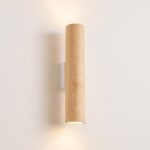
Natural wood Scandinavian wall light
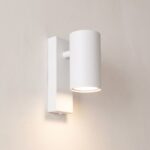
White or black steel bedside wall light

Designer natural wood and glass wall light
See also

Teal Bedroom Ideas: Colours, Gold Accents and the Right Light for a Dark Wall

Downstairs Toilet Lighting: The Right Light for a Small, Windowless WC or Cloakroom

Wabi-Sabi Interior Design: The Beauty of Imperfection, Right Down to the Light
