

Table of Contents
Not all of them. An LED bulb dims properly only if its driver was built for it, and the maker has to warn you on the packaging when it was not. The surest check is the EU product information sheet, reached by scanning the QR code on the energy label, where one line reads yes, no, or only with specific dimmers.
The word sits on half the boxes in the lighting aisle and is almost never explained. It decides whether you can drop the light at the end of the evening, or go home with a bulb that flickers the moment you touch the dial. Here is what dimmable means, the three places to check it in order of reliability, and the part nobody mentions: what dimming really does to the light in the room.
Are LED bulbs dimmable? What the word on the box means
Dimmable comes from the verb to dim, and from dimmer, the control that does it. Applied to a bulb, a strip or a whole fitting, the adjective says one thing: this light source is built to run at a reduced output. It accepts less power than it is rated for and keeps lighting cleanly, from full brightness down to the bottom of its range.
Manufacturers do not all use the same wording, and Irish shelves carry boxes printed for the whole European market. These are the forms you will meet.
| What the box says | What it means |
|---|---|
| Dimmable | The bulb is made to work on a dimmer. The most common marking, often shown as a small dimmer knob symbol. |
| Non-dimmable, not suitable for dimmers, a knob symbol with a line through it | The warning the EU rules require. Do not put it on a dimmer. |
| Dimmable with specific dimmers | It works only with a named list of dimmers, which the maker has to publish on its website. |
| Trailing edge or leading edge dimmable, triac dimmable | Dimmable, with the type of dimmer spelled out. Most LEDs want trailing edge. |
| Nothing at all | Not an answer. See the next section. |
Three things get mixed up constantly, and are worth clearing away first.
- Dimmable does not mean weaker. A dimmable bulb rated at 806 lumens gives exactly as much light as a non-dimmable one rated at 806 lumens. It can simply go below that.
- Dimmable does not mean smart. A bulb you control from an app changes its output by radio, with no dimmer on the wall. That is a different technique, covered in our guide to smart bulbs.
- Dimmable has nothing to do with the cap. Dimmable and non-dimmable versions exist in B22, the standard Irish bayonet, and in E27, E14, GU10 and G9 alike. The bulb fitting tells you nothing about dimming.
How to tell if an LED bulb is dimmable: three places, in order of reliability
No tools and no expertise needed, but the order matters: the first place everyone looks is the least dependable.
1. The packaging: a warning, not a promise
Since 1 September 2021, the European ecodesign rules on light sources have required the packaging to carry a warning if the light source cannot be dimmed, or can be dimmed only with specific dimmers or specific dimming methods. In that second case the manufacturer has to publish a list of compatible dimmers on its website. The rules allow the information to be given as a drawing or a symbol, which is where the crossed-out knob on the box comes from.
Read that obligation carefully, because it runs the opposite way to the way people use it: the law is about the negative. The pack has to tell you when dimming will not work. In strict logic a silent box would mean a dimmable bulb, but makers print the positive and plenty of boxes carry neither mark. Silence is not a yes.
Nothing requires any of it on the bulb itself, either: the only values that have to appear on the glass or the cap are the lumens and the colour temperature, plus the beam angle on a spotlight. There is no point turning the bulb over.
2. The EU product information sheet: the answer in writing
This is the check almost nobody uses, and the one that settles the question. Since 1 May 2021 every supplier has had to enter a standard product information sheet for each light source into the European product database. That sheet, set out in Table 3 of the energy labelling regulation, has a line of its own: Dimmable, which can take only three values, yes, only with specific dimmers, or no.
To read it, scan the QR code printed on the energy label of the box, the A to G one. The regulation defines that code as a barcode linking to the model’s entry in the public part of the product database. It opens that model’s page, free, with no account to create. Our advice: do it in the shop, in front of the shelf.
One point worth making, since the rules are European: both regulations are binding in their entirety and directly applicable in every member state, so the energy label, its QR code and the database work in an Irish shop exactly as they do anywhere else in the EU. The Sustainable Energy Authority of Ireland is the market surveillance authority that polices energy labelling here, and it inspects labelled products in store and online. The same sheet also carries the flicker and stroboscopic figures, which matter further down.
3. The retailer’s datasheet
Online, the information belongs in the specifications, usually as a line reading dimmable or compatible with a dimmer. A blank is not a yes, and a page that stays silent while the title suggests a dimmable product deserves a question before you buy. On our own product pages the point is spelled out where it applies, as on the mini wavy ceramic wall light, whose sheet reads “compatible with a dimmable bulb”.
| Where to look | What you get | How reliable |
|---|---|---|
| Packaging, wording or symbol | The warning required when the bulb cannot be dimmed | Good when the mark is there, worthless when the box is silent |
| QR code on the energy label | The “Dimmable” line of the product information sheet: yes, no, or only with specific dimmers | The best there is, and the supplier is answerable for it |
| Retailer’s datasheet | A dimmable or dimmer compatible line in the specifications | Good when explicit, worth a question when absent |
| The glass or the cap of the bulb | Nothing about dimming: only lumens, kelvins and beam angle are required | None, do not bother |
What dimming actually does to the light
Here is the part the definitions leave out, and the one that changes how you use a dimmer: your eye does not measure light the way a meter does.


Half the lumens is not half the light
The eye responds to quantity of light along roughly a cube root, described since 1976 by the lightness function of the International Commission on Illumination. The practical consequence is blunt: to make a room look half as bright, you have to come down to 18 per cent of the light output, not to 50 per cent.

That gap explains two familiar disappointments. The first: you turn the dial to the middle, the room looks barely different, and you decide the dimmer was a waste of money. It has already given up half its lumens. The second: everything you care about happens in the last quarter of the travel. A dimmer that stops at 20 per cent will never go below dinner party light. For the late evening glow, look for a bulb and dimmer rated down to 5 or 10 per cent, and check that the dimmer lets you set its own bottom end.
The colour stays where it is
This is the real break with the old filament bulb. Turn one of those down and the filament cooled: the light slid from 2,700 K to a far more orange glow, around 2,000 K at the bottom of the dial. That drift is what made low light feel warm.
A dimmed LED keeps its colour temperature. Measurements published in 2005 on phosphor converted white LEDs found that between 100 per cent and 3 per cent of power the colour shift stayed under four MacAdam ellipses, which is to say practically invisible, whether the dimming was done by chopping the supply or by reducing the current (Dyble et al., 2005). So you get a darker room in the same colour, where the old bulb gave you a darker room in a warmer colour.
Two things follow. If you are chasing candlelight late in the evening, the dimmer alone will not get you there: start from a bulb that is already warm, or choose a dim to warm source, built to slide towards 1,800 K as it goes down. And dimming never replaces picking the right tint in the shop, a separate decision covered in our guide to warm white vs cool white.
Flicker is measured at full load, not while dimmed
Since 1 September 2021 the ecodesign rules have capped flicker and the stroboscopic effect of mains LED light sources, at a Pst LM of 1.0 or less and, since 1 September 2024, an SVM of 0.4 or less. Both figures appear on the European product sheet. The detail that matters is in the wording: they are required at full load, meaning at maximum output, undimmed. No rule covers how an LED behaves while dimming, so a clean datasheet guarantees nothing at the bottom of the dial. Try the pair before you commit it to a child’s room or a desk. If the light pulses, our guide to flickering lights works through the diagnosis.
A dimmable bulb and a compatible dimmer are two conditions, not one
This is the most common mistake of all. The word dimmable on the bulb says nothing about the device controlling it, and the reverse is just as true. The four combinations fit in a table.
| On an ordinary switch | On a dimmer rated for LEDs | |
|---|---|---|
| Dimmable bulb | Lights normally, at full output. No risk, simply no dimming. | The intended pairing. It runs from maximum down to the bottom of its range. |
| Non-dimmable bulb | The intended pairing. It lights, and that is that. | Avoid: flicker, buzz, refusal to strike, shortened life. |
A dimmable bulb on an ordinary switch is therefore no problem at all, and a sensible precaution if a dimmer might go in later. The opposite case cannot be rescued by any setting.
The reason sits in a component you will never see. An LED never connects straight to the mains: it carries a small electronic power supply, the driver, which turns 230 V alternating current into steady direct current. A dimmer works by cutting away part of each half wave. The driver in an ordinary bulb then receives a chopped waveform it was never designed to read, and answers with visible flicker, a buzz, a refusal to light below a certain setting, or an early failure. A dimmable driver is built to read that chopped wave and set its output from it.
Two traps survive even with the right bulb, and both belong to the dimmer. One is the type of cut, leading edge for old filament loads against trailing edge for LEDs. The other is minimum load: every dimmer states a wattage range, and the minimum bites hardest with LEDs. Seven 7 W LEDs on a seven bulb spider pendant add up to 49 W, plenty to wake any dimmer, while the same dimmer driving a single 5 W wall light may not see it at all. Choosing the dimmer, working out the load and wiring it belong to our guide to the dimmer switch, which also sets out where Irish rules draw the line: our advice is to have one fitted by a Registered Electrical Contractor.
Fittings with integrated LEDs: the bulb no longer decides
When a fitting has no lampholder the question changes shape. There is no bulb to swap: the LEDs and their driver are built in, and the datasheet of the fitting, and nothing else, has to say whether it accepts a dimmer. If it does not say so, do not put it on one, because you cannot put it right later by changing a bulb.
In our own range, the large integrated LED ring chandeliers and ceiling lights come with their own electronics and no stated dimmer compatibility, so they belong on an ordinary switch. You will find them in our LED lights section, where each page states what the fitting takes. A fitting with a lampholder leaves the decision with you: an E27 pendant, or the wall lights in our guide to wardrobe lighting, become dimmable the day you screw in a dimmable bulb. That assumes the holder itself is sound, and our guide to how to change a lamp holder shows how to open one and what to look at inside.
Three other routes exist before anyone opens a wall. A smart bulb carries its own dimming electronics and is set by radio. An inline or foot dimmer on the flex suits a table or floor lamp and touches nothing in the installation. And splitting the light between several sources, switched in stages through the evening, is often the better answer over a table: our guide to the off centre pendant light shows how to bring light where you want it without touching the ceiling rose.
Should you buy dimmable by default?
A dimmable bulb costs a little more than a non-dimmable one of the same lumens. Here is how we weigh it up.
Yes, without hesitating, over a dining table, in a sitting room and in a bedroom: these are the three places where the light has to change through the evening. Yes, as insurance, if the switch might one day become a dimmer, since the bulb runs at 100 per cent meanwhile. Not worth it in a hall, a utility room or a garage, where you switch on and switch off: put the same euro into a better choice of LED bulb instead. Avoid it where the fitting is already controlled another way, by a smart head or a low voltage transformer: you would be dimming the same light twice. The hall is the one line on that list worth a second look: our guide to narrow hallway lighting ideas explains when a dimmer or a sensor earns its keep by the front door.
A last word on running costs. Turning the light down does cut the power the lamp draws, and the saving follows the lumens rather than the brightness you perceive: what your eye calls half as bright is around 18 per cent of the output. The saving is bigger than it feels, but on an LED that already draws a few watts it is counted in watts. The case for a dimmer is comfort.
Dimmable LED bulbs: frequently asked questions
How do I know if my LED bulbs are dimmable?
Three places, in order of reliability. The surest is the European product information sheet: scan the QR code on the energy label of the box and read the line marked Dimmable, which says yes, no, or only with specific dimmers. Next comes the packaging, which has to carry a warning or a crossed-out dimmer symbol when the bulb cannot be dimmed. Last comes the retailer’s datasheet. Do not look at the glass or the cap: only the lumens, the colour temperature and, on a spotlight, the beam angle are required there.
Can any LED bulb be dimmable?
No. The difference sits in the driver, the small power supply inside every LED. A dimmable driver measures how much of the mains wave the dimmer lets through and works out the output to produce. An ordinary driver expects a complete wave and copes badly once it is chopped. At equal lumens the two bulbs give the same light at full output, so the marking says nothing about brightness, only about the ability to be turned down.
Can I make my LED lights dimmable?
Not by changing the dimmer or its settings: a non-dimmable bulb stays non-dimmable. What you can change is the bulb. If the fitting takes one, in B22, E27, E14, GU10 or G9, fit a dimmable bulb and pair it with a dimmer rated for LEDs. If the fitting has integrated LEDs there is nothing to swap: your options are an inline dimmer where the maker allows it, a smart bulb in a fitting that takes one, or splitting the light between several sources switched in stages.
What does the dimmable symbol on a bulb look like?
There is no single official pictogram. The rules let manufacturers give the information as a drawing or a symbol, so you will meet a small rotary knob, a knob with a line through it for a bulb that cannot be dimmed, a half-filled bulb, or simply the word dimmable. Since the shapes vary from one maker to the next, read a symbol as a clue and confirm it on the product information sheet behind the QR code.
Do LED bulbs last longer when dimmed?
Probably a little, but nobody guarantees it. A dimmed LED draws less power and runs cooler, and heat is what ages the driver and the phosphor. The rated life printed on the box, however, is declared at full load, and no rule covers behaviour while dimming, so there is no figure to rely on. Treat longer life as a side benefit, not a reason to buy.
Does dimming an LED bulb save electricity?
Yes, though it is worth little. The power the lamp draws follows its light output fairly closely, so halving the lumens roughly halves what the bulb consumes. What your eye calls half as bright is about 18 per cent of the output, so the saving is bigger than the impression suggests. On a bulb that already draws 7 W, that is still only a few watts. Dim for comfort, not for the bill.
Sources
- Commission Regulation (EU) 2019/2020, ecodesign requirements for light sources, Annex II: packaging warning where a light source cannot be dimmed, flicker and stroboscopic limits at full load, and the information required on the light source itself. European Union
- Commission Delegated Regulation (EU) 2019/2015, energy labelling of light sources, Annex V Table 3: the “Dimmable” line of the product information sheet, and the QR code that links to the public part of the product database. European Union
- Energy labelling and ecodesign market surveillance, and the inspection of labelled products sold in Ireland. Sustainable Energy Authority of Ireland
- Dyble M., Narendran N., Bierman A., Klein T., Impact of dimming white LEDs: chromaticity shifts due to different dimming methods, Proc. SPIE 5941, 2005, doi 10.1117/12.625924. Scientific publication
- Lightness function L* of the CIE L*a*b* colour space, 1976. International Commission on Illumination
Related products

Wall light in white wavy ceramic, mini size
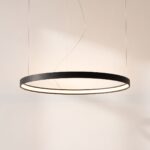
LED ring chandelier, 78 cm, 4 finishes
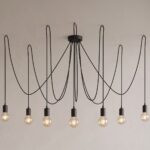
Pendant light, 7-bulb spider with black textile cables
See also

Mood Lighting: The Three Settings That Really Create It, Room by Room

How to Change Spotlight Bulbs, With or Without a Clip

Conservatory Lighting: Which Lights Cope With the Heat, the Glass and the Dark
