

Table of Contents
A lamp holder opens from the outside in. Switch off at the fuseboard and prove the circuit dead, take the bulb out, unscrew the shade ring, then ease the two lugs at the base of the body apart with a small flat screwdriver, one side at a time. The shell separates without force and the terminals are in front of you.
Most of the damage done to lamp holders happens in the first ten seconds, when someone pulls at a part that is still held by another one. There are only a few families of holder in an Irish house, and each one opens in its own way. Some of them do not open at all. This guide shows how to change a lamp holder without snapping anything: which one you have, where to press, what the ceiling rose above it changes, and why a tired holder is the reason a perfectly good bulb keeps blinking.
Which lamp holder are you looking at?
Thirty seconds of looking saves a broken part. Start with where the holder sits: on the end of a flex, inside a light fitting, or screwed flat to the ceiling. That alone sorts out the families you will meet at home.
| What you are holding | How to recognise it | How it comes apart |
|---|---|---|
| Push fit lamp holder, plastic | Smooth body, no screw heads, a horizontal seam and two small slots on opposite sides of the base | Unscrew the shade ring, then ease the two lugs apart with a flat screwdriver |
| Screw fit lamp holder, brass, bakelite or ceramic | One or two small grub screws on the side, or a threaded joint between the two halves | Slacken the screw, then unscrew the halves by hand |
| Batten lamp holder, on the ceiling | A round base screwed flat to the ceiling with the holder built on it, no flex at all | Undo the two fixing screws and lift the holder off its base; the conductors stay in the base |
| Ceiling rose | The white moulding on the ceiling that the flex comes out of | It is not the lamp holder. The holder is at the other end of that flex |
| Moulded holder, sealed on its flex | No seam, no screw, no slot anywhere on the body | It does not open. Holder and flex are replaced together |
Two families cover almost everything sold today. The push fit holder clicks together in the factory without a tool, which is exactly why it fights back: nothing on the outside tells you where the lugs are. The screw fit holder is the older design, and it is the one you still find on brass and ceramic fittings and on the decorative pendants in our range of bulb pendant lights.
One Irish quirk is worth naming now. The traditional cap here is the B22 bayonet, the one with two pins that you push and twist, and that is what you will find on an older ceiling fitting. Almost everything sold new, including our own fittings, takes the E27 or E14 Edison screw. So the replacement holder you buy may not match the bulbs in the drawer, and that is a decision to make before you start, not after.
Switch off at the fuseboard, and prove it dead
A lamp holder is worked on dead, with no exceptions. The wall switch is not isolation: depending on how the circuit was run it may break the live or it may break the neutral, and a switch wire that has been looped the wrong way leaves a conductor live with the lamp off.
- Switch off at the fuseboard, on the MCB for the lighting circuit. Lighting is often split into more than one circuit, upstairs and downstairs, so expect more than one room to go dark.
- Lock it off and say so. A strip of tape over the switched off MCB and a word to whoever else is in the house costs nothing. An RCD on the circuit does not make the job safe; it limits how badly a shock ends, which is not the same thing.
- Prove the circuit dead at the holder itself, with a two pole voltage indicator. Prove the tester on a known live source first, test the circuit, then prove the tester again. A tester with a flat battery reads zero volts everywhere.
- Work in good light. Most broken lugs are broken by people levering at a shadow. A head torch or a cordless work light leaves both hands free.
Where you stand legally in Ireland is clear enough. Replacing a light fitting or a lamp holder on an existing circuit counts as minor works: the Electricity Regulation Act 1999 lists replacing or relocating a light fitting, where the existing circuit is kept, outside the restricted electrical works reserved to a Registered Electrical Contractor. A new light point, a new circuit, anything in the fuseboard, or work in a bathroom zone is restricted, and it has to be certified. Minor works still have to comply with I.S. 10101, the National Rules for Electrical Installations, and if the ceiling is involved our guide on how to install a ceiling light goes through the fixing and the connection in order.
Opening a push fit lamp holder, and wiring the new one
A push fit holder comes apart from the outside in. Taking the parts in the wrong order means pulling on something that another part is still holding.

- Take the bulb out, then unscrew the shade ring, the collar that holds the shade or the glass. It comes off by hand, anticlockwise. A rubber glove gives the grip you are missing if it has seized.
- Slide the threaded skirt back. On many holders it is part of the shade ring and comes away with it. On others it lifts once the body is free.
- Find the two slots at the base of the body, directly opposite each other: two nicks of 2 to 3 mm, sometimes barely moulded. That is where the shell opens, and nowhere else.
- Lever one side at a time. Put the blade of a small flat screwdriver into the first slot, turn it a quarter turn to push the lug outwards, and lift the upper part slightly. Do the second side straight after. The body separates with no effort.
- Note what goes where before you undo anything. A photograph on your phone takes a second and settles every argument at the reassembly stage.
- Release the conductors. Screw terminals need half a turn with a terminal screwdriver. Push terminals have a small lever or button beside each conductor: press it and pull the wire at the same time, never one without the other. Pulling alone flattens the spring and the terminal never grips properly again.
- Wire the new holder the same way. Strip 8 to 10 mm, with no nicked copper and no stray strand showing. On an Edison screw holder the live goes to the centre contact and the neutral to the threaded shell, so that the first thing a finger meets while unscrewing a bulb is the neutral. A B22 bayonet holder has two equal pin contacts and no live side, which is one good reason the bayonet caught on here. If the fitting is Class I, in metal, the earth goes to its terminal and it is not optional.
- Close it up. Tighten the cord grip onto the sheath of the flex, never onto the bare cores, line up the two lugs with their housings and push until you hear the click on both sides. A shell that clicks on one side only is not seated.
Our advice: buy the new holder before you open the old one. Holders look interchangeable and are not. The shade ring diameter, the entry thread and the depth of the body all vary, and a shade that fitted the old ring may sit crooked on the new one.
Ceiling roses and batten holders are a different job
In most Irish houses the ceiling point is a loop in ceiling rose: the circuit runs into the rose, out of it to the next light, and down to the switch, and the pendant flex hangs from two of its terminals. That matters because people reach for the rose when the part that has failed is a metre lower down.

The loop bank is permanently live, switch or no switch, which is the single most useful thing to know about a ceiling rose. Only the brown and blue cores of the flex belong to your light fitting; everything else in there is the circuit passing through. If the lamp holder on the end of the flex is the problem, you never have to open the rose at all. If you are painting the room in one shade for colour drenching, do the rose at the same time: a white rose stands out on a dark ceiling.
Two things catch people out when they do open one. The first is the switch wire: in older Irish cable it is black, in newer cable blue, and in both cases it is a live conductor, not a neutral, which is why it should carry a brown or red sleeve at each end. The second is the earth. Lighting circuits in older houses here were commonly run without a protective conductor at the ceiling point, so there is simply nothing to connect a metal fitting to. A Class II fitting, marked with the double square, is designed for that case. A Class I fitting is not, and it needs an electrician to bring an earth up before it goes on the ceiling.
Both situations exist in our own range. The one bulb pendant below is Class II, with an N and L terminal block and no earth terminal. The industrial wood and black metal ceiling light with adjustable sockets is Class I and earthed, so it belongs on a point that has a protective conductor. The product sheet says which is which on every fitting we sell.
A batten lamp holder is simpler than either. It is a bayonet holder built onto a round base that is screwed straight to the ceiling, with no flex and no rose. Undo the two fixing screws, lift the holder off, and the conductors are waiting in the base. It is also the fitting most likely to be heat damaged, because it has been sitting under an incandescent lamp in an unventilated hall for thirty years. If you would rather move the light than renew it where it is, our guide to the off centre pendant light covers doing that without touching the wiring.
What breaks when you force it
Lamp holders fail in the same five places, and always for the same reason: an effort applied beside the point that was designed to take it.
- A sheared lug. The screwdriver went under the edge of the shell instead of into the slot. The lug snaps clean off and the body no longer stays shut. It is replaced, not glued.
- A split thread. The shade ring was started crossways, or a seized bulb was turned while the holder was gripped by its top half. The next bulb no longer sits square.
- A flattened contact. On an Edison screw holder the centre contact is a springy tongue, and a bulb done up hard flattens it. On a bayonet holder the two spring loaded plungers lose their travel the same way. Neither comes back up on its own.
- A dead push terminal. The conductor was yanked out without pressing the lever. The spring stays open, and the connection becomes a matter of luck.
- Heat damage. A holder that is browned, brittle or smells hot has already run beyond what the fitting could get rid of. It does not go back on, whatever it looks like from the front. Moving to LED bulbs usually stops it happening again, because a LED draws 5 to 6 times less power than the incandescent lamp it replaces for the same light. Under a conservatory roof, where the summer heat gathers against the glass, that margin matters even more, as our guide to conservatory lighting explains.
Then there are the holders that were never meant to open: moulded onto their flex, or bonded into a metal body, with no seam, no screw and no slot. Persistence achieves nothing there. The holder and its flex are changed as one piece.
The holder decides the bulb, so it decides the light
This is the part the step by step videos skip. A lamp holder is not a neutral piece of hardware. It fixes the cap you can fit, the power the fitting will take and the temperature the whole assembly will sit at, and those three things decide what the room actually looks like in the evening.
The cap first. Replace like for like. An E27 holder takes E27 bulbs, an E14 takes E14, a B22 takes B22, and these are not sizes of the same thing: they are different fits, each defined by its own gauges. Our article on the B22 bulb sets the bayonet and the screw families side by side. Fitting an E27 holder to a wall light drawn around an E14 looks harmless and is not: the bulb stands proud of the glass, heats the diffuser and throws the light at the wrong angle.
Then the power. The international standard for Edison screw lamp holders is built on the assumption that an E14 cap serves a lamp drawing no more than 2 A and an E27 cap a lamp drawing no more than 4 A, but the holder is not what sets the limit in practice. The complete fitting does, which is why a maximum is printed on the fitting itself and has to be respected even when the holder alone would take more. Our one bulb pendant with a coloured socket states 15 W maximum in LED; the wenge wood and matte glass wall light states 10 W in LED on an E14. A lamp holder also carries a temperature marking, a T followed by the temperature in degrees that it is rated for, and that figure is the reason a holder destined for an enclosed fitting is not the cheapest one on the shelf.

And then the light itself. The same holder will take a 2,700 K bulb or a 4,000 K one, so the holder you have just repaired is also the moment to decide between warm white and cool white, and whether you want the fitting on a dimmer, which depends entirely on the bulb: our guide answers are LED bulbs dimmable and shows where to look on the pack.
One last symptom is worth knowing, because it sends people out to buy bulbs they do not need. A lamp that blinks, or that goes out when you brush against it, is usually the holder rather than the bulb. The flattened centre contact, or the bayonet plunger that has lost its spring, no longer presses on the cap: the contact makes and breaks and the light stutters. Before you buy a third bulb, kill the circuit and look into the holder. A tongue lying flat can often be lifted with the tip of a screwdriver. The other causes, an incompatible dimmer, a tired driver or a shared neutral, are covered in our article on flickering lights.
And if the holder is sound but the fitting has had its day, the question changes. The N and L terminals you have just opened are the same ones that the bulb wall lights in our range connect to, with no further work on the circuit.
Frequently asked questions about lamp holders
What is the part of a lamp that holds the bulb called?
The lamp holder, also written lampholder and often called the bulb holder or the socket. It is the part that grips the cap of the bulb and feeds it, and it is named after the cap it takes: an E27 holder for the large Edison screw, an E14 for the small one, a B22 for the bayonet. Two other names turn up in the same conversation and mean something else. The shade ring is the collar that holds the shade or the glass onto the holder. The ceiling rose is the moulding on the ceiling the flex comes out of, and it is not a holder at all.
Do you need an electrician to change a light socket?
Not in every case. In Ireland, replacing or relocating a light fitting where the existing circuit is retained is listed as minor works, outside the Restricted Electrical Works that only a Registered Electrical Contractor may carry out and certify. Changing a lamp holder on an existing point falls into that category. It still has to comply with I.S. 10101, the National Rules for Electrical Installations, and you still isolate at the fuseboard and prove the circuit dead first. Anything beyond it is restricted: a new light point, a new circuit, any work inside the fuseboard, or work in a bathroom zone. If the ceiling point has no earth and the fitting is metal, that is a job for a contractor too.
How do you change a light socket in a table lamp?
Unplug the lamp. That is the whole isolation procedure, and it is the one advantage a table lamp has. Take the bulb and the shade off, unscrew the shade ring, then look for the two slots at the base of the body and ease the lugs apart with a small flat screwdriver, one side at a time. Photograph the terminals before you free the cores. On a two core flex with no earth, the two conductors of a Class II lamp go to the two terminals. Fit the new holder, tighten the cord grip onto the sheath rather than onto the bare cores, and push the body together until it clicks on both sides.
How do I wire a ceiling light socket?
Hanging a pendant from a loop in ceiling rose, only two cores of the flex are yours: the brown goes to the switched live terminal, the blue to the neutral bank, and the earth to the earth terminal if the fitting has one. The loop bank beside them is permanently live whatever the wall switch is doing, which is why the job starts at the fuseboard and not at the switch. Strip 8 to 10 mm, leave no stray strand, and take the weight of the fitting on the cord grip rather than on the terminals. If there is no protective conductor at the point and the fitting is metal, stop and call a Registered Electrical Contractor.
How do you remove a bulb from a bulb holder?
A screw cap unscrews anticlockwise. A bayonet cap is pushed in a few millimetres against its springs and turned anticlockwise about an eighth of a turn, then it lifts out. Hold the holder itself, not the body of the lamp, so the thread does not take the twist. If the bulb is seized in an old holder, switch off first, then widen your grip with a rubber glove or a strip of grip tape rather than squeezing the glass harder. A bulb that only comes out in pieces leaves the cap behind: with the circuit dead, long nose pliers on the rim of the cap will turn it out.
What are the different types of lamp holders?
They are sorted two ways, by the cap they take and by the way they are built. By cap, the common ones at home are the B22 bayonet, traditional in Ireland, the E27 Edison screw and the small E14, plus the pin holders of spot lamps such as GU10 and G9. By build, a holder is push fit, in plastic with no visible screws, screw fit, in brass, bakelite or ceramic with a grub screw or a threaded joint, or a batten holder screwed flat to the ceiling on its own base. A fourth kind exists and cannot be opened: the holder moulded onto its flex, which is replaced complete.
Sources
- Electricity Regulation Act 1999, section 9E, and S.I. No. 264 of 2013: minor works, including replacing or relocating a light fitting where the existing circuit is retained, and the Restricted Electrical Works reserved to a Registered Electrical Contractor. Irish Statute Book and Safe Electric
- I.S. 10101, National Rules for Electrical Installations: isolation, proving dead at the point of work, and RCD protection of lighting circuits in domestic premises. National Standards Authority of Ireland and Safe Electric
- I.S. EN IEC 60238, Edison screw lampholders: the E14, E27 and E40 fits, a standard based on lamps drawing no more than two amps on an E14 cap and four amps on an E27 (clause 1), the T marking for the maximum rated operating temperature, and maximum temperatures in a luminaire set by IEC 60598. International Electrotechnical Commission
- I.S. EN IEC 61184, Bayonet lampholders: the B15d and B22d fits for a 250 V supply, defined by the gauges of IEC 60061. International Electrotechnical Commission
- Electrical wiring colour codes, encyclopaedia article: red line, black neutral and green earth in older Irish installations, harmonised brown, blue and green and yellow in newer work. Wikipedia
Related products

1-bulb pendant light, coloured socket, 6 colours
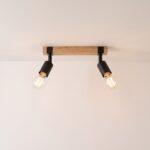
Industrial wood and black metal ceiling light, adjustable sockets

Designer wenge wood and matte glass wall light
See also

Mood Lighting: The Three Settings That Really Create It, Room by Room

How to Change Spotlight Bulbs, With or Without a Clip

Conservatory Lighting: Which Lights Cope With the Heat, the Glass and the Dark
