

Table of Contents
An off centre pendant light is fixed by moving the fitting, not the wiring: you leave the ceiling rose where it is, run the flex across to a hook screwed in above the table, and let it drop straight down from there. Allow the horizontal run plus the drop, fix the hook into something structural, and never pull the flex tight.
The ceiling point sits in the middle of the room, the table is over beside the window, and nobody wants to chase a new cable across the ceiling to put that right. Moving the fitting instead of the wiring takes about an hour. Here are the figures: how much flex to order, which hook for which ceiling, the tension you must never put into the cord, and what the move does to the light landing on the table.
Three ways to move a pendant off the ceiling rose
The principle never changes: the current keeps arriving where it always arrived, and the fitting travels on the end of its flex. Three systems do that, and a flush ceiling light does none of them, because each one assumes a fitting hanging on a cord.
- A hook and the flex. A hook screwed into the ceiling directly above the table takes the cord, which then drops vertically. It is the cheapest answer and the only one that gives you a long reach. The flex stays visible between the rose and the hook, and that is its single drawback.
- A rail or a bar. A bar fixed to the existing ceiling plate carries one or more fittings that slide along it. The reach is limited to the length of the bar, usually 30 to 50 cm, but nothing crosses the room and you keep a single fixing point.
- A swing arm or a telescopic arm. It screws onto the existing point and pivots, from 50 cm to almost a metre, with no second hole to drill. In exchange it imposes its own style and carries very little, often around a kilo.
There is a fourth route: pendants built from the outset to be spread out. A spider pendant light leaves one ceiling rose and sends several long cords to hooks placed wherever you want them. The diagonal stops being an accident and becomes the design.
How much flex to allow
Work this out before you order, not standing on the stepladder, and it comes down to one addition.
Flex needed = the horizontal distance from the rose to the hook + the vertical drop + 15 cm for adjustment.
Take a common Irish room. Ceiling at 2.40 m, a table 75 cm high, the rose 1.80 m from the centre of that table. The bottom of the pendant should sit 60 cm above the table top, so 1.35 m off the floor. If the fitting is 30 cm tall, the cord drops 2.40 less 1.35 less 0.30, which is 0.75 m. Total: 1.80 + 0.75 + 0.15 = 2.70 m of flex.

Compare that figure with the maximum height quoted on the product page. On an ordinary pendant it sits between 100 and 150 cm: enough to drop, nowhere near enough to cross a room. A flex that is too short cannot be rescued, so buy a model with a long cord in the first place, and remember that fabric cords lengthen easily while rigid rods do not. Under the sloping ceilings covered in our guide to vaulted ceiling lighting, where the drop alone often passes three metres, the sum gets tighter still.
The 60 cm above the table top is the figure published by licht.de, the German lighting information centre. Raise it a little if the shade is wide and open, lower it if the shade is deep and throws its light straight down. With an open weave shade the same drop prints the weave on the ceiling as well, which is the whole point of urban jungle interior design.
The hook, and what your ceiling will carry
Once the pendant has moved, the hook carries almost all of its weight and the rose only keeps the connection. So it is the hook you size, and you choose it on what your ceiling is made of.
| Ceiling | Fixing for the hook | Working load |
|---|---|---|
| Concrete slab or concrete beam | Expansion anchor for solid material, then a screw hook | Whatever the anchor’s instructions state |
| Plasterboard on joists | Metal cavity fixing or spring toggle, never a plastic plug | 3 to 10 kg per fixing, depending on the board |
| Timber joist, rafter or purlin | Screw hook driven straight into the timber | The safest option, aim for solid timber |
| Lath and plaster, older houses | Find the joist above and screw into it, never into the lath | Nothing on the plaster itself |
| Suspended ceiling with lay-in tiles | Hang back from the structure above the grid | No load at all on the tiles |
The 15 kg or more printed on a pack of metal cavity fixings is a wall figure. Overhead, the weight pulls the fixing straight out of the board, and plasterboard makers quote far less: 3 to 10 kg per fixing, depending on the board thickness and on whether the fixing holds in the board alone or in a metal frame. Above 10 kg, the hook has to go through to a joist or the structure above. A dining room pendant rarely passes three kilos, which already reaches the lowest of those figures, so aim for a joist whenever you can. An ordinary plastic wall plug simply spins in the void overhead. Keep a margin: people pull on a pendant to level it far harder than it ever weighs. Our guide on how to install a ceiling light covers switching off at the consumer unit and choosing the fixing.
One last check before you drill: run a detector over the ceiling. There are cables up there, and sometimes heating pipes serving the room above.
Never pull the flex tight
This is the most common mistake, and you can see it from the door. A cord stretched like a washing line pulls on the terminal block, works the cord grip out of the rose over time, and gives the room the look of an extension lead. The reason is mechanical: the tighter a cord is pulled, the faster the force climbs. Over a two metre span, a flex sagging only 5 cm carries five times its own weight in tension, against 1.25 times at 20 cm of sag. So leave a clear curve, 10 to 15 cm over two metres.
The other mistake is skipping the hook and pulling the flex diagonally to the fitting. The shade then hangs out of true, its opening no longer faces the table, and the bulb sits in the direct line of sight of everyone seated. The hook is not a detail: it is what makes the drop vertical.
On looks, two approaches work. Either the cord follows one clean line, parallel to a wall or to the axis of the table, in a colour chosen on purpose: black fabric on a white ceiling reads as a drawn line. Or you multiply the cords until the diagonals become a pattern. A single white cord wandering across at an angle never works.
Where the light lands once you move it
This is the real reason to get the position right, and nobody on this subject says it. Light falling on a surface drops with the square of the distance to the source, and drops again when it arrives at an angle instead of straight down. Both effects stack the moment the pendant is no longer overhead: the table does not lose a little light, it loses most of it.

In figures: an 800 lumen bulb in an open shade, 60 cm above the table top, gives something like 350 lux straight below it. Slide it 30 cm sideways and about 250 lux reach the centre of the table; 60 cm, 125 lux; a metre, under 50 lux, and the light has gone off to the back of a chair. To convert your own numbers, our guide to lux vs lumens gives the formulas.
Two things follow. A roughly judged move is worth nothing: aim at the centre of the table. And because the light concentrates under the fitting, a long table wants two or three drops rather than one large shade pulled across. The same holds anywhere light has to land on a defined surface, a worktop, a desk, or the clothes in our guide to wardrobe lighting. Over an island the move is usually combined with a bar, as on several of our kitchen pendant lights. Give two or three drops identical bulbs: our guide to warm white vs cool white explains why two tints over one table never settle.
That leaves glare. Once it has moved, a bare bulb often lands inside the field of view of people sitting at the table, when it was safely out of it in the middle of the room. The test takes ten seconds: hold the pendant at its future position, sit down, and look at the person opposite. You should see their whole face with no bulb in your eye. With exposed bulbs, a frosted glass settles it. And if you want to bring the light down at dessert, the bulbs have to allow it: our guide explains whether LED bulbs are dimmable and how to check.
Renting, and ceilings you will not drill
A tenant can drill and make good on the way out: a 6 mm hole disappears under a dab of filler. But on a stretched ceiling, old tongue and groove boarding or a suspended ceiling tile, better to open nothing. Three answers hold without a second fixing point.
- A bar or a rail on the existing plate. Everything hangs off the original point and the offset happens along the bar. It is the only arrangement that genuinely moves the light without a second hole.
- A swing arm. Same idea, adjustable, but a low load and a strong style of its own.
- A plug-in pendant. A pendant supplied with a plug hangs from something already there, a shelf, a beam or a rail. Our guide to battery operated wall lights covers that and the rest of the no-wiring options.

A word on adhesive hooks, recommended to tenants constantly. Their rated load is low, it falls with heat and with time, and a light fitting hangs there day and night. Our advice: keep them for guiding the cord, never for the point that carries the fitting.
One more thing worth saying plainly. Swapping a fitting on an existing point, with the power off at the consumer unit, is not the same as altering the fixed wiring. Adding a light point, running a new circuit or touching the distribution board falls under I.S. 10101, the National Rules for Electrical Installations, and belongs to a Registered Electrical Contractor listed with Safe Electric. Moving the fitting rather than the point is how you stay on the right side of that line. And if you move house often, a light model with a long cord travels with you: our dining room pendant lights give the maximum height on every product page.
Frequently asked questions about an off centre pendant light
What do you do when the light fitting is off centre?
You move the fitting, not the point. Switch off at the consumer unit, screw a hook into the ceiling directly above the spot you want lit, run the flex from the rose through that hook, and let it drop vertically. Moving the point itself means chasing the ceiling or building a bulkhead, work for a Registered Electrical Contractor. The hook takes an hour.
Should pendant lights be centred?
Centred on what matters, not on the room. A pendant is there to light a surface, so it belongs over the centre of the table or the island, even if that leaves it off centre in the room. The exception is a fitting meant to light the whole space rather than one surface, such as a wide shade in a square sitting room.
Can a chandelier be off centre?
Yes, and it often has to be. Over a few kilos, though, the hook has to reach something structural, a rafter, a joist or a concrete slab, never plasterboard on its own. A moved chandelier swings and works its fixing far harder than it does at rest. Keep a wide margin on the load quoted for the fixing, and check that the original cord or chain accepts the length you need.
Why are ceiling lights off centre?
Usually because the point was set out before anyone knew where the furniture would go, and it was centred on the room as it stood then. Extensions, a wall taken out, an island added or a table moved to catch the window all shift the furniture without shifting the wiring. In older Irish houses, a point often sits where an old gas fitting once was.
How high should an off centre pendant hang above a table?
About 60 cm between the table top and the bottom of the shade, the figure published by licht.de. Anywhere people walk underneath, keep at least 2.15 m of clear height below the fitting. Ceiling height changes neither mark: it only changes how much flex you order, since the drop is measured down from the ceiling and the two figures up from the floor.
Do you need a registered electrician to move a ceiling light in Ireland?
Not to move the fitting. Changing a light on an existing point, with the power off at the consumer unit, is ordinary household work, and a hook plus a longer flex changes nothing in the installation. Creating a new light point, running a new circuit or touching the distribution board is another matter: that falls under I.S. 10101 and belongs to a Registered Electrical Contractor listed with Safe Electric.
Sources
- Dining room lighting: the bottom of a pendant about 60 cm above the table top. licht.de, German lighting information centre
- I.S. 10101, National Rules for Electrical Installations, and the register of Registered Electrical Contractors. Safe Electric and the National Standards Authority of Ireland
- Restricted Electrical Works in a dwelling, and what a homeowner may do on an existing point. Safe Electric
- Fixings into a plasterboard ceiling: 3 to 10 kg per fixing depending on the board and the frame, heavier loads into the structure. Plasterboard manufacturers’ fixing guidance, Gyproc and Placo, Saint-Gobain
Related products

Industrial pendant light, 2 bulbs, coiled-cable rail
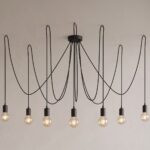
Pendant light, 7-bulb spider with black textile cables
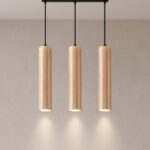
Pendant light, 3 natural wood tubes on bar
See also

Mood Lighting: The Three Settings That Really Create It, Room by Room

How to Change Spotlight Bulbs, With or Without a Clip

Conservatory Lighting: Which Lights Cope With the Heat, the Glass and the Dark
