

Table of Contents
To choose LED bulbs, start with the base, which must match the lampholder: B22 bayonet in most Irish ceiling roses, or E27, E14, GU10 or G9 on many fittings. Then read the lumens, not the watts: 806 lumens replace an old 60 W bulb. Finally pick the colour temperature, 2,700 K for warm light, and check for “dimmable” if you have a dimmer switch.
Watts no longer mean much on the box of an LED bulb, and that is the main reason people come home with the wrong one. An LED uses so little power that its wattage says almost nothing about the light it gives. Across the fittings in our range, the E27 base is used on 324 models, G9 on 130, GU10 on 128 and E14 on 50, each one waiting for the right bulb. This guide takes the criteria in the order you should check them, with the lumens to watts equivalents, the traps with dimmers, the EU energy label, and what is known about the downsides of LED.
Why switch to LED bulbs?
An LED bulb makes light with a light-emitting diode, a semiconductor chip that glows when current passes through it. There is no filament heated until it shines, as in an incandescent or halogen bulb, and no gas, as in a compact fluorescent. Hence its first advantage: it turns far more of the electricity it uses into light instead of heat.
The gap is large. An LED gives the light of an old 60 W incandescent bulb for a fraction of that wattage, and it comes on at full brightness straight away, with none of the warm-up time of the old energy saving bulbs. The European Commission notes that the average energy efficiency of LEDs quadrupled between 2009 and 2015 while their prices fell sharply.
Regulation has done the rest. Incandescent bulbs and most halogen bulbs for the home have left the shelves under EU ecodesign rules, and since 1 September 2021 a new energy label, graded from A to G with a QR code, applies to bulbs and other light sources. The new scale is deliberately strict: the Commission explains that the most efficient products on the market were typically labelled C or D when it came in. So compare classes between recent bulbs, and do not expect to see the A++ you remember from the old label.
Lumens and watts: how much light do you need?
The watt measures what a bulb consumes. The lumen measures how much light it gives out. With incandescent bulbs the two went together, and we got used to asking for “a 60 watt” to mean a fairly bright bulb. With LED that link is broken: read the lumens.
To get the light of an old incandescent bulb, EU rules set these reference points for any LED bulb that claims an equivalence on its packaging:
| Old incandescent bulb | LED output to look for | Typical use |
|---|---|---|
| 25 W | 249 lm | Night light, small mood lamp |
| 40 W | 470 lm | Wall light, bedside lamp |
| 60 W | 806 lm | Pendant, reading lamp |
| 75 W | 1,055 lm | Ceiling light in a small room |
| 100 W | 1,521 lm | Main light in a large room |
These values apply to one bulb. A five-arm chandelier with five 470 lumen bulbs gives more than 2,000 lumens in total: it is the sum that lights the room. On the other hand, a very bright bulb inside an opaque shade or a thick glass globe loses part of its light. And a clear bulb lights differently from a frosted one of the same output: the clear bulb gives crisp shadows and sparkles in the glass of a chandelier, the frosted bulb spreads a softer light.

Which base for your LED bulb: B22, E27, E14 or GU10?
The base does not change with the technology: an LED B22 replaces a B22 bulb, an LED GU10 replaces a halogen GU10. The code is printed on the old bulb, and it is listed on the page of every fitting in our shop.
- B22: the bayonet cap, pushed in and turned. It is the standard base in Irish homes, found in most ceiling roses, pendant sets and traditional lamps.
- E27: the large screw base, used on a great many modern and European fittings, pendants and ceiling lights.
- E14: the small screw base, found on wall lights, chandeliers and small table lamps.
- GU10: the two-pin twist-and-lock base of mains spotlights.
- G9: the small capsule with two looped pins, used in compact designer wall lights.
This matters in Ireland because a fitting bought from a European maker often takes E27, while the pendant set left in the ceiling rose takes B22. Check the lampholder before you buy a pack. Two more traps: the same base does not mean the same size, since an LED can be longer than the bulb it replaces, especially in G9 and E14, and no longer fit inside the globe. And low-voltage bases such as GU5.3 and G4 depend on a transformer that must cope with very small loads.
Which colour temperature should you choose?
Colour temperature, given in kelvin (K), describes the tint of white light. Low values are warm and yellowish, high values are cool and bluish, and neutral white sits in between.
- 2,700 K: the colour of the old incandescent bulbs. Living room, bedroom, dining room, anywhere you unwind. Decorative filament bulbs sometimes go lower, towards an amber glow.
- 3,000 K: a slightly crisper warm white, a good compromise for a hall, a landing or a kitchen open to the living area.
- 4,000 K: a neutral white that helps you see true colours. Worktop, desk, bathroom mirror, wardrobe.
- 5,000 to 6,500 K: a cool light close to daylight, best kept for a garage, a workshop or a utility room.
Keep the same colour temperature within one room: a pendant at 2,700 K next to a ceiling light at 4,000 K looks patchy. If you want to change the mood through the day, a smart bulb with tunable white moves from warm to cool from an app.
The other criteria that make a good LED bulb
Dimmers: look for the symbol
An ordinary LED bulb on a dimmer switch flickers, buzzes or cuts out too early. You need a bulb marked dimmable, with a dimmer symbol on the box, and a dimmer switch designed for LED, because the older ones made for incandescent bulbs cope badly with such small loads. If you change the dimmer switch itself, that is work on the fixed wiring: in Ireland, Safe Electric advises homeowners to always use a Registered Electrical Contractor.
Colour rendering
The colour rendering index, or CRI, measures on a scale up to 100 how faithfully colours look under the light compared with a reference light. The closer it is to 100, the more food, timber or fabric keep their real colour. Serious bulbs state it on the box. Check it closely for a kitchen, a bathroom mirror or a wardrobe.
Shape and finish
A bare bulb under a bulb pendant light becomes part of the decor: choose a filament LED, in clear or amber glass, as a globe, a pear or a tube. Our minimalist pendant with a black cord and no shade is made for exactly that: an E27 lampholder on a fabric cord, and the bulb you choose does the rest. Under a lampshade, a classic frosted bulb is enough. For a wall light or a chandelier, candle and golf ball shapes in E14 stay discreet.
Rated life
Boxes quote 15,000, 20,000 or 25,000 hours. Take these figures with caution: they are measured in test conditions, and heat is what wears LEDs out. A bulb shut inside a sealed globe with no ventilation ages faster than the same bulb in an open shade. The maker’s guarantee often tells you more than the number of hours printed on the pack.
What is the downside of LED light bulbs?
LED is not perfect, and it is better to know its limits before you buy.
- Uneven quality. Between a good bulb and the cheapest one, the difference lies in lifespan, stability of the light and colour rendering. The purchase price is higher than an old bulb’s, and the savings come from the electricity.
- Flicker. Some LEDs, especially on an unsuitable dimmer, flicker more or less visibly, which can tire the eyes.
- Blue light. In its 2018 opinion on LEDs, the European Commission’s Scientific Committee on Health, Environmental and Emerging Risks (SCHEER) points out that children are more sensitive to blue light, and that light from blue-emitting LEDs can be very dazzling for young children. In children’s rooms and at the bedside, prefer warm tones and frosted bulbs that stop you looking straight at the light source.
- Compatibility. Old dimmers, 12 V transformers and small closed globes can cause trouble: check them before replacing every bulb in the house at once.
How to read the energy label on a bulb
Since September 2021, the EU label on a bulb box shows the brand, the model, the energy class from A to G, the energy use in kWh, and a QR code that links to the EU product database. SEAI explains a distinction that is useful when you buy a fitting. A light source, such as a bulb or a lamp with built-in LEDs that cannot be removed easily, carries the energy label on its packaging. A containing product, such as a lamp whose bulb can be taken out, does not carry a label on its box; if it is sold with a bulb included, the class of that bulb must appear in its technical documentation. To estimate running costs, SEAI suggests multiplying the kWh figure by the price of a unit of electricity on your bill.
Which LED bulb for which light fitting?
The fitting decides most things: the base, the maximum wattage allowed and the shape that fits. Above a table, an E27 pendant takes a bulb of 806 lumens or more, a filament one if it stays on show. A bulb wall light often needs only an E14 or G9 of 250 to 470 lumens, because it lights a wall rather than the whole room.

For a multi-bulb fitting, count the lumens together. Our industrial black steel ceiling light with 6 bulbs takes six E27 LEDs of 15 W at most: six bulbs of 470 lumens already give more than 2,800 lumens, enough for a kitchen table or a living room. The same logic applies to our industrial chandeliers. For spot ceiling lights, choose GU10 LEDs and watch the beam angle: narrow to pick out an object, wide to light a surface. And if you never want to change a bulb again, our LED lights with built-in LEDs settle the question: the light source is designed to last as long as the fitting.
One last check before you buy: look at the fitting’s page for the maximum wattage the lampholder accepts and whether a bulb is included. You will know straight away which LED to buy, and how many.
LED bulbs: frequently asked questions
Can I replace normal bulbs with LED?
Yes, in the vast majority of cases: choose an LED with the same base, B22 for B22 or E27 for E27. Check three things: the size of the LED, which can be a little longer than the old bulb, the word dimmable if the light is on a dimmer switch, and the transformer for low-voltage bases such as GU5.3.
How many lumens replace a 60 W bulb?
Look for an LED bulb of about 806 lumens to get the light of an old 60 W incandescent bulb. The other reference points set by EU rules are 470 lumens for 40 W, 1,055 lumens for 75 W and 1,521 lumens for 100 W. An LED gives that light for a fraction of the old wattage.
Can I use a 100 W equivalent LED instead of a 60 W?
Usually yes, as long as the LED’s real wattage stays below the maximum printed on the fitting: a 100 W equivalent LED draws far less than 100 W. Check the fitting’s maximum, then ask whether you want that much light: 1,521 lumens in a small room or a bare bulb can be dazzling.
What’s the difference between LED and regular bulbs?
An incandescent bulb heats a filament until it glows, and most of the energy leaves as heat. An LED bulb makes light with a semiconductor chip, which is far more efficient, comes on instantly at full brightness and lasts much longer. Incandescent and most halogen bulbs have been phased out under EU ecodesign rules.
What is the downside of LED light bulbs?
Quality varies from one bulb to another, the purchase price is higher than an old bulb’s, and some flicker, especially on an unsuitable dimmer. The EU scientific committee SCHEER also notes that children are more sensitive to blue light. Warm tones and frosted bulbs in children’s rooms and at the bedside limit that.
How long do LED bulbs last?
Boxes quote 15,000 to 25,000 hours, measured in test conditions. In real use, heat is the main enemy: a bulb in a sealed globe with no ventilation ages faster than one in an open shade. A decent guarantee from the maker is often a better guide than the number of hours printed on the pack.
Sources
- Commission Regulation (EC) No 244/2009 on ecodesign requirements for non-directional household lamps, Annex II, Table 6: claimed equivalent incandescent lamp power by luminous flux. EUR-Lex
- European Commission, Simpler EU energy labels for lighting products applicable from 1 September, press release, 31 August 2021. European Commission
- SEAI, Understanding the labelling on lighting products: light sources and containing products. SEAI
- SCHEER, Opinion on potential risks to human health of Light Emitting Diodes (LEDs), 2018, and its easy-read summary. European Commission
- Safe Electric, Home Safety: always use a Registered Electrical Contractor for electrical works. Safe Electric
Related products
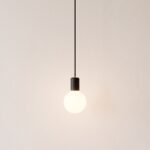
Minimalist black pendant light with no shade, fabric cable

Industrial black steel ceiling light with 6 exposed bulbs

Designer natural wood and glass wall light
See also

Teal Bedroom Ideas: Colours, Gold Accents and the Right Light for a Dark Wall

Downstairs Toilet Lighting: The Right Light for a Small, Windowless WC or Cloakroom

Wabi-Sabi Interior Design: The Beauty of Imperfection, Right Down to the Light
