

Table of Contents
To replace a fluorescent tube with LED, switch off at the consumer unit, find out which ballast the fitting has, then choose the tube to match: a tube made for magnetic ballasts with an LED starter, a tube listed for your electronic ballast, or a mains tube after a ballast bypass. The tube’s instructions give the exact wiring.
The strip light in the garage, the utility room or an older kitchen almost always holds a fluorescent tube. Since August 2023, most T5 and T8 fluorescent tubes can no longer be placed on the EU market, Ireland included, and LED is taking their place in existing fittings.
LED tube or a new LED batten: which to choose?
| Option | What you do | The original fitting | Best for |
|---|---|---|---|
| LED tube compatible with the ballast | Change the tube, and the starter if there is one | Unchanged: it can still take a fluorescent tube | A fitting in good condition with a ballast the tube is made for |
| Mains LED tube with a ballast bypass | Remove the ballast, starter and capacitor, then rewire the lampholders | Rebuilt: its safety now depends on your wiring | Someone confident with electrical work, on a sound fitting |
| New LED batten or light fitting | Take down the old fitting and connect the new one | Replaced by a product designed, tested and marked for LED | A tired or damaged fitting, a damp space, a living area |
The compatible tube is the simplest route: no wires to touch. A magnetic ballast stays in the circuit and still uses a little energy, but far less than with the fluorescent tube. The bypass removes those losses, at the price of a real change to the fitting. Either way, the LED tube sits in a body designed for a fluorescent tube, so the spread of light and the glare change. Emergency lights and fittings built for heat or vibration are not converted.
A new LED batten settles everything at once: one product, tested as a whole by its maker. It is the right choice when the diffuser has yellowed, the lampholders are cracking, or the space is a damp garage that needs a sealed fitting. Our guide to garage lighting covers battens, and the one on IP ratings tells you which rating a shed or a damp utility room needs.
In a living space, it is also the moment to lose the workshop look. Above a worktop or a dining table, a linear pendant keeps the long line of the tube: our modern oak linear pendant light comes in 120 and 150 cm, the lengths of a 4 ft and a 5 ft T8 tube, with integrated LEDs in warm white (3,000 K) or neutral white (4,000 K). In a hallway or a utility room, a wall light or an LED ceiling light takes over from the old strip light.


Identify your tube (T8, T5 or T12) and your ballast
The tube: diameter, cap and length
The number after the T is the diameter in eighths of an inch. The EU ecodesign regulation for light sources puts a T8 at about 26 mm and a T5 at about 16 mm. Their caps differ, so you cannot mix them up: pins 13 mm apart (G13) on a T8, 5 mm apart (G5) on a T5. Neither has anything in common with the B22 bulb of an Irish pendant.
| Tube | Diameter | Cap | Common lengths | Fluorescent wattage |
|---|---|---|---|---|
| T8 | 26 mm | G13 | 2 ft (600 mm), 4 ft (1,200 mm), 5 ft (1,500 mm) | 18, 36 and 58 W |
| T5 | 16 mm | G5 | from about 55 to 145 cm | depends on the model |
| T12 (older) | 38 mm | G13 | varies | depends on the model |
Measure the tube including its pins: a “4 ft” T8 is 1,200 mm to within a few millimetres. The LED tube must have the same length and cap. To compare the light, think in lumens rather than watts, as our lumens to watts chart explains: an LED tube draws less than the fluorescent tube it replaces.
The ballast: magnetic or electronic
The ballast limits the current through the tube. To tell which kind you have, look for the starter, a small cylinder plugged into the body that comes out with a quarter turn. If there is one, the fitting has a magnetic ballast, a heavy copper coil that needs the starter to strike the tube; a tube that blinks for a few seconds before lighting gives it away. If it blinks and never lights, the starter is the first suspect: here is how to test a fluorescent light starter. With no starter, the fitting normally has an electronic ballast, which does the work of starter, ballast and capacitor on its own, and the tube lights at once.
To be sure, open the cover with the power off and read the label on the ballast: note its reference, since it decides whether an LED tube will work with an electronic ballast. Count the ballasts too: if two tubes share one magnetic ballast (a tandem circuit), an LED tube will not go in without rebuilding the fitting. And if you find neither starter nor ballast, the fitting may already have been converted: put nothing in it until you understand its wiring.
How to wire an LED tube: the three cases
The wiring depends on the ballast and on the tube. The diagrams below show the principle only: the exact wiring is in the tube’s instructions, which say which end it is fed from.
First: switch off and prove it is dead
Switch off the MCB for the lighting circuit at the consumer unit, or the main switch if you are not sure which one it is: the wall switch alone is not enough. Then prove the circuit is dead with a proper voltage tester, checked on a live socket before and after. Photograph the original wiring before you disconnect anything, and keep the green and yellow earth wire fixed to the body of a metal fitting: it protects you if a live wire ever touches the case.
Take the old tube out with a quarter turn, without breaking it: it contains mercury. The steps are the same as when you install a ceiling light safely. If in doubt, hand the job to a Registered Electrical Contractor.
With a magnetic ballast and a starter
In the original circuit, the live passes through the ballast to one pin of the tube; the starter links the next two pins, one at each end; the last pin goes to neutral. The capacitor, if there is one, sits across live and neutral where the supply enters.
With an LED tube made for this ballast, you do not touch a single wire: take out the starter, fit the LED starter supplied with the tube, then fit the tube. These tubes are fed from one end; at the other end, their pins are linked together and isolated from the rest, so you cannot touch a live pin while fitting them.
With an electronic ballast
There is no starter here. You need an LED tube listed as compatible with your electronic ballast: tube makers publish lists of tested ballasts, to check against the reference on the label. Some tubes, sold as universal, accept both types of ballast. If yours is not listed, move on to a bypass or a new batten.

No ballast: the bypass, single or double-ended
A ballast bypass means removing the ballast, the starter and the capacitor, then taking live and neutral straight to the lampholders. It needs an LED tube made to run directly on 230 V mains. A single-ended tube takes live and neutral on the two pins of the same end, marked on the tube, and nothing at the other end. A double-ended tube takes live at one end and neutral at the other, on one or both pins of each end as the instructions say.
Insulate the wires you no longer need, clamp every connection in a terminal, and close the cover. Then label the fitting clearly: “230 V LED tube only”. A fluorescent tube fitted by mistake would sit on the mains with no ballast to limit its current: it would be destroyed, and could injure the person fitting it.

The power factor capacitor
The capacitor is the small cylinder or box wired across live and neutral near the ballast. It only offsets the reactive current drawn by a magnetic ballast; wired in parallel, the tube does not need it. With a compatible tube that keeps the ballast, it stays in place. In a bypass, it has nothing left to offset. Our advice: take it out along with the ballast, unless the tube’s instructions say otherwise, and replace any capacitor that has swollen or is leaking.
What a bypass changes for the fitting
A bypass is not a lamp change. The guidance published by ZVEI, the German electrical industry association, with the VDE testing and certification institute draws a clear line. Changing the tube and replacing the starter with the bridge supplied does not alter the fitting, which can still take a fluorescent tube. Removing the ballast changes how the fitting is built and turns it into a new product: its original marks no longer apply, and whoever converted it takes on responsibility for its compliance.
In Ireland, Safe Electric treats the like-for-like replacement of a light fitting as minor works, which must still comply with the National Rules for Electrical Installations, I.S. 10101; a new light point, a new circuit or work in a bathroom is Restricted Electrical Works, for a Registered Electrical Contractor only. A bypass leaves the fixed wiring alone but rebuilds the fitting. Our advice: keep it for a sound fitting and someone at ease with electrical work, and choose a compatible tube or a new batten otherwise.
LED tube starter: keep it, swap it or remove it
With a fluorescent tube, the starter is a small automatic switch: it closes to heat the electrodes, then opens, and the ballast releases the voltage spike that strikes the tube. An LED tube needs none of this, so the starter’s role depends on the setup:
| Fitting and tube | The starter |
|---|---|
| Fluorescent tube on a magnetic ballast | Keep it, and change it with the tube when it wears out |
| LED tube made for a magnetic ballast | Swap it for the LED starter supplied with the tube |
| LED tube on an electronic ballast | None: this ballast has no starter |
| Mains LED tube after a bypass | Remove it, with the ballast and the capacitor |
An LED starter looks like an ordinary one, so it fits the same holder, but it is only a bridge that keeps the circuit closed, sometimes with a small fuse inside. Never mix them up: an old starter stops an LED tube working properly, and an LED starter stops a fluorescent tube from lighting.
LED tube not working or flickering after the swap?
Most faults come down to a detail. Switch off before each check, and go through them in this order:
- The old starter is still in place. On a magnetic ballast, it keeps opening and closing the circuit: the tube stays dark or blinks. Fit the LED starter.
- The tube does not match the ballast. A mains tube on a ballast, a magnetic ballast tube on an electronic one, or a ballast missing from the maker’s list: read the packaging again.
- The tube is the wrong way round. After a single-ended bypass, the marked end must sit at the wired end.
- The tube is not locked in. It needs a quarter turn until it stops. A cracked or scorched lampholder gets replaced.
- The electronic ballast is failing. An ageing ballast can make even a compatible tube flicker; a bypass or a new batten solves it.
- The tube glows faintly when off. An illuminated switch or a sensor without a neutral lets a tiny current through. Change the control, or ask an electrician.
Otherwise, check the wiring wire by wire against the instructions. If other lights in the house flicker, our guide to flickering lights goes through every cause, and the ones that should worry you.
What to do with old fluorescent tubes in Ireland
A fluorescent tube never goes in the bin: the crossed-out wheelie bin symbol on it means it must be recycled. It contains a little mercury, up to 3.5 mg for a recent T8 under EU rules, which recycling plants remove before recovering the glass and metals.
Take it unbroken to a collection point. The EPA points out that recycling electrical waste is free at your local civic amenity site, and that you can also hand it in at a shop when you buy a new product. WEEE Ireland, the compliance scheme for electrical waste, offers lighting recycling in every county, at civic amenity sites and participating retailers. The ballast, starter and capacitor removed in a bypass go the same way.
Spare fluorescent tubes can still be used up: only their sale has ended. For the rest of the house, our guide to LED bulbs helps you choose the right cap and colour. If that room has green walls, colour rendering matters more there than anywhere else: our guide to what colour goes with green explains why.
Questions about replacing a fluorescent tube with LED
Can I just replace a fluorescent tube with LED?
Yes, in most fittings: with an LED tube made for the ballast already there, without touching any wires, or with a mains LED tube after a ballast bypass. A damaged fitting is better replaced with a new LED batten.
Will LED tubes work in old fluorescent fittings?
Yes, if the tube matches the ballast. With a starter, choose a tube made for magnetic ballasts and fit the LED starter supplied. Without one, choose a tube listed for your electronic ballast, or bypass the ballast and use a mains tube.
Can I just remove the ballast and put in LEDs?
Only with an LED tube made to run directly on 230 V, wired as its instructions say. Remove the starter and capacitor too, and label the fitting “230 V LED tube only”. The fitting is then no longer the product its maker certified.
What happens if I put an LED on a ballast?
A tube made for that ballast works normally. A mains tube, or one meant for the other type of ballast, may stay dark, flicker or fail early. The packaging says whether the tube is for a magnetic ballast, an electronic ballast or direct mains.
Do LED tubes need a starter?
Never an ordinary starter. On a magnetic ballast it is replaced by an LED starter, a simple bridge supplied with the tube. With an electronic ballast, or after a bypass, there is no starter at all.
Can I replace my circular fluorescent tube with LED?
LED replacements exist for circular tubes, but the choice is narrower and the same ballast question applies. It is often simpler to fit an LED ceiling light, which has its own driver and no tube to change.
Sources
- Commission Delegated Directive (EU) 2022/284 of 16 December 2021, mercury exemption for double-capped linear fluorescent lamps (points 2(a)(2) and 2(a)(3) of Annex III to Directive 2011/65/EU: expired on 24 August 2023 for T5 and T8 tubes, 3.5 mg of mercury at most for a T8), and Commission Regulation (EU) 2019/2020 of 1 October 2019 on the ecodesign of light sources (definitions of T5 and T8 tubes, tighter requirements from 1 September 2023 for T8 tubes of 600, 1,200 and 1,500 mm). EUR-Lex
- Hinweise zum Einsatz von LED-Lampen als Alternative zu zweiseitig gesockelten Leuchtstofflampen in Leuchten, October 2020, in German (retrofit and conversion lamps, starter replaced by a bridge, compliance of a converted fitting). ZVEI and VDE Testing and Certification Institute
- Restricted and Controlled Electrical Works, definitions under S.I. No. 264 of 2013, including minor works. Safe Electric
- Waste electrical and electronic equipment (WEEE): free recycling at civic amenity sites and return to a shop when buying a new product. Environmental Protection Agency; Where can I recycle?, lighting recycling in every county. WEEE Ireland
- Fluorescent lamp and Electrical ballast (starter, power factor correction, tube diameters and lengths), encyclopaedia articles. Wikipedia
Related products
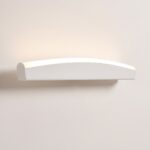
Horizontal wave LED aluminium wall light
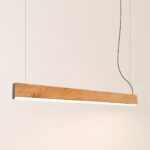
Modern linear oak LED pendant light
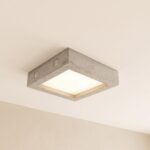
Modern square LED ceiling light in grey concrete and glass
See also

Mood Lighting: The Three Settings That Really Create It, Room by Room

How to Change Spotlight Bulbs, With or Without a Clip

Conservatory Lighting: Which Lights Cope With the Heat, the Glass and the Dark
