

Table of Contents
IP ratings tell you how well an electrical product resists solid objects and water. The code is the letters IP followed by two digits: the first, from 0 to 6, covers solids and dust; the second, from 0 to 9, covers water. So an IP44 light fitting is protected against splashing water, and an IP65 fitting against water jets.
For a light fitting, the IP rating is the line to read before you buy anything for a bathroom, a porch, a patio or a garage. In a country where the rain comes sideways off the Atlantic for half the year, it matters more than most spec-sheet figures. On our shop, it appears in the specifications of every product that carries one, and our bathroom wall lights and outdoor wall lights are selected with it in mind. This guide explains how to read IP ratings, gives you the full chart from the standard, and shows which rating suits which place, with the Irish rules that apply when the fitting goes into a bathroom.
What is an IP rating?
An IP rating measures the protection given by the enclosure of an electrical product, in other words its casing, against the intrusion of solid objects and liquids. IP stands for ingress protection, sometimes also read as international protection. The rating is defined by the international standard IEC 60529, adopted in Europe as EN 60529 and published in Ireland by NSAI as I.S. EN 60529. You will also see it called the IP code or the ingress protection rating: it is all the same thing.
The code is always read the same way:
- the letters IP, for ingress protection;
- the first digit, from 0 to 6, for protection against solid objects, from a hand down to fine dust;
- the second digit, from 0 to 9, for protection against water, from drips to immersion and high-pressure cleaning.
When one of the two has not been tested or is not stated, the digit is replaced by the letter X. An IPX4 product is protected against splashing water, with no information about dust; an IP5X product is protected against dust, with no information about water. You see IPX ratings most often on phones, torches and small appliances, but they turn up on light fittings too, especially on bathroom products where only the water rating matters to the buyer.
The rating applies to the product as it was tested, with its seals, its glass and its cable entry in place. It says nothing about how the product will behave once badly installed, and it is not a measure of quality in general: a well-made IP20 fitting is perfect for a living room, and a poor IP65 fitting can still fail if its gasket perishes in the sun.
IP rating chart: what each digit means
Here is the meaning of each digit, as set out in the standard, with the test conditions for the water ratings that people most often ask about.
| Digit | First digit: solid objects | Second digit: water |
|---|---|---|
| 0 | No protection | No protection |
| 1 | Objects over 50 mm, such as the back of a hand | Dripping water falling vertically |
| 2 | Objects over 12.5 mm, such as a finger | Dripping water with the product tilted up to 15° |
| 3 | Objects over 2.5 mm, such as tools and thick wires | Spraying water up to 60° from the vertical |
| 4 | Objects over 1 mm, such as most wires and slender screws | Splashing water from any direction |
| 5 | Dust protected: dust may enter, but not enough to interfere with safe operation | Water jets from a 6.3 mm nozzle, 12.5 litres per minute, from 3 m |
| 6 | Dust-tight: no ingress of dust | Powerful water jets from a 12.5 mm nozzle, 100 litres per minute, from 3 m |
| 7 | No 7 | Temporary immersion, up to 1 m deep for 30 minutes |
| 8 | No 8 | Continuous immersion beyond 1 m, under conditions set by the manufacturer |
| 9 | No 9 | Close-range, high-pressure and high-temperature water jets |

One trap is worth knowing. A water rating vouches for the test it names, not necessarily for the ones below it. The ratings are cumulative up to 6, but not beyond: a product rated IPX7 has been tested for immersion, but not necessarily against powerful water jets. That is why some products show a double rating, such as IP65 and IP67, or IPX5/IPX7, when they have passed both tests. For a pond light that also sits in the path of a garden hose, look for both.
How the water tests are actually carried out
The words in the chart hide very precise laboratory tests, and knowing roughly what they involve helps you picture what a fitting can really take. For the drip tests, digits 1 and 2, the product sits on a turntable under a rain of drops equivalent to 1 mm or 3 mm of rainfall per minute, for ten minutes. For 3, spraying water, an oscillating tube or a spray nozzle delivers around 10 litres a minute at up to 60° from the vertical. For 4, the same equipment sprays from every direction, including from below.
The jet tests are tougher. For 5, a 6.3 mm nozzle delivers 12.5 litres a minute from 3 m away, for at least three minutes; for 6, a 12.5 mm nozzle delivers 100 litres a minute from the same distance, closer to a fire hose than a garden hose. For 7, the product is submerged so that its lowest point sits 1 m below the surface, or its highest point 150 mm below, whichever is deeper, for 30 minutes. For 9, the harshest test, water at 80 °C is fired at 80 to 100 bar from 10 to 15 cm away: that is the world of industrial washdown, not of domestic lighting.
The first digit follows a simpler logic. Up to 4, it measures the size of the smallest object that cannot get in, which is also a measure of how well the live parts inside are protected from fingers and tools. At 5 and 6, it is about dust. A 5 lets a little dust in, not enough to affect safe operation; a 6 lets none in at all, and the test uses a vacuum to prove it.
The most common IP ratings for lighting
Six ratings appear on most light fitting specifications, and knowing them saves a lot of reading.
IP20 is protected against fingers, not against water. It is the rating of an indoor light for a dry room: living room, bedroom, hall, landing. Most pendants, chandeliers and table lamps are IP20, and that is perfectly normal. IP44 is protected against objects over 1 mm and against splashing water from any direction. It is the classic rating for bathroom lights placed away from the bath or shower, and for many outdoor lights under a canopy or in a porch.
IP54 is protected against dust and against splashing water: a good level for a wall light on an exposed wall. IP65 is completely dust-tight and protected against water jets from a hose. It is the right rating near the ground outdoors and wherever a fitting may be washed down. IP67 is dust-tight and withstands temporary immersion, up to 1 m for 30 minutes: ground lights where water can pool. IP68 covers continuous immersion under conditions set by the manufacturer, as for a pool or pond light.
IP44 and IP54 offer exactly the same protection against water; only the first digit changes, from protection against small objects to protection against dust. For a bathroom, where dust is not an issue, the difference hardly matters. Outdoors, where insects, pollen and grit find their way into every gap, the 5 is worth having.
Waterproof or water-resistant?
Product descriptions throw the word “waterproof” around freely, and it is worth treating it with care. In the IP system, nothing is simply waterproof: a fitting is protected against a particular kind of water, in a particular test. An IP44 wall light is perfectly happy in the rain and would be ruined in a puddle. An IP67 ground light survives a flooded patio and may still let water in under a pressure washer. When a listing says “waterproof”, look for the actual IP rating beside it, and if there is none, assume the claim has not been tested. The same goes for “weatherproof”, “splash-proof” and “outdoor”: useful hints, but no substitute for the two digits. If in doubt, ask for the rating in writing before you buy: a seller who cannot give you the two digits is telling you something about the product.
IP ratings room by room
Most homes need only a handful of ratings, and each room has its own logic. Here is a quick tour, from the driest rooms to the wettest spots in the garden.
Living room, bedrooms, hall and landing. These are dry rooms, and IP20 is all you need. Pendants, chandeliers, wall lights and table lamps for these rooms rarely carry anything higher, and there is no reason to pay for it. The only exception is a room with a lot of condensation, such as a bedroom with an en suite that has no door: there, a fitting close to the doorway may be better with some water protection.
Kitchen. A kitchen has steam, grease and splashes, even if it is far less exposed than a bathroom. Over the table or the island, an ordinary pendant is fine. Close to the sink or the hob, a fitting with a water rating of 4 is a sensible precaution, and a closed diffuser is far easier to clean than an open shade that collects grease. Our kitchen wall lights include several closed models that wipe clean.
Bathroom and en suite. This is where the rules apply, as explained below. The zones around the bath or shower set the requirements, and the position of each fitting must be checked with your electrician.
Utility room, garage and shed. Damp, dust and the odd knock are the enemies here. A first digit of 5 or 6 keeps sawdust and grit out, and a water digit of 4 or 5 covers a garage floor that gets washed down. In a workshop, add a look at the IK rating, covered further on.
Porch, patio and garden. IP44 under cover, IP54 or IP65 on an exposed wall, IP65 close to the ground, IP67 set into the ground, IP68 in a pond. The rain in Ireland is rarely violent, but it is persistent, and persistence finds the weak points of a poorly sealed fitting.
Which IP rating for a bathroom in Ireland?
The bathroom is where IP ratings stop being a matter of good sense and become a matter of rules. In Ireland, electrical installations are governed by the National Rules for Electrical Installations, I.S. 10101, published by NSAI. The current edition groups special installations and locations in Chapter 7, following the European HD 60364 series; in that series, part 701 covers locations containing a bath or shower. The rules divide the room into zones around the bath or shower, and the closer a fitting is to the water, the higher the IP rating it must have and the tighter the limits on what may be installed there.
The exact dimensions of each zone and the requirements for each one are in the standard itself, and applying them is the job of your electrician, not something to work out from a packaging label. What you can do as a buyer is simple. Check that the fitting is sold for bathroom use, check its IP rating, and ask your electrician which zone the position you have in mind falls into before you buy. A mirror light above a basin, a ceiling light in the middle of the room and a fitting right above the shower are three very different cases.
Our guide to bathroom lighting goes further on choosing and placing each light in the room, from the mirror to the shower. Just as important is who does the work. Under the Safe Electric scheme, overseen by the Commission for Regulation of Utilities, electrical work in the special locations listed in Part 7 of the National Rules is Restricted Electrical Work in a home, along with new circuits and any change to the distribution board. Only a Registered Electrical Contractor may carry out and certify it, and they must give you a completion certificate. In practice, have any new bathroom light fitted by an REC.
For the fitting itself, IP44 is the most common rating for bathroom wall lights and ceiling lights. Our sleek aluminium and glass ball wall light is rated IP44, as is our glass and aluminium globe ceiling light, a matching pair for a bathroom that needs both a mirror light and a main light. You will find more models among our bathroom pendant lights as well as our bathroom wall lights.
Which IP rating for an outdoor light?
Outdoors, there are no zones to measure: the chart from the standard guides the choice. Rain falling at an angle corresponds to the water digit 3, up to 60° from the vertical, and 4 covers splashing from every direction. An IP44 fitting therefore copes with rain, under a canopy or on a wall that is reasonably sheltered.
On an exposed wall, where wind drives the rain against the fitting for hours, most people are more comfortable with IP54 or IP65. Aim for a water digit of 5 or 6 wherever the fitting may take a jet: next to a path that gets hosed down, a sprinkler, or a patio you pressure-wash in spring. A fitting set into the ground, where water can lie, needs a 7, and a light submerged in a pond or pool needs an 8. For the first digit, a 5 or a 6 keeps dust and insects out of the fitting, which is useful in a garage, a shed or a workshop too.

Solar lights deserve a word of their own, because they have to keep their battery and their panel dry through every season. Our solar wall lights are built for outdoor use, and the same rule applies to them as to any other fitting: check the rating on the product page and match it to how exposed the spot really is.
Plugs, sockets and extension leads outdoors
A well-sealed outdoor light is only as good as the connection that feeds it. Plug-in festoon lights, garden spotlights and fairy lights often have a transformer or a plug connector somewhere along the cable, and that is where water tends to get in. Check the IP rating of every part of a plug-in set, not just the lamps, and keep transformers and connectors off the ground, under cover where you can. An indoor extension lead run out through a window is not made for rain: use equipment sold for outdoor use, and switch it off at the socket when you are not using it. Permanent outdoor sockets and wiring are fixed installation work, to be done by a Registered Electrical Contractor. Our outdoor lighting guide goes through the choices zone by zone, from the front door to the end of the garden.
Near the sea, the IP rating is only part of the story. Salt air attacks finishes and fixings, and even a well-sealed fitting will last longer if you rinse it with fresh water a few times a year and check that its seals have not dried out.
IP, IK and electrical class: three different things
The IP rating is often confused with two other lines on a specification sheet. The IK rating measures resistance to mechanical impact, under the standard EN 62262. It runs from IK00, no protection, to IK10, which withstands an impact of 20 joules: useful for a fitting within reach of a football, in a hallway where furniture is carried past, or on a bollard by the drive. The electrical class describes how the product protects you against electric shock. A Class I fitting relies on an earth connection; a Class II fitting has double insulation and needs no earth, and is marked with a double square symbol. The IP rating, for its part, says nothing about strength or electrical insulation: only about sealing against solids and water.
These three ratings answer three different questions: will water and dust get in, will it survive a knock, and how is it made safe to touch. A good outdoor bollard needs a decent answer to all three. A bathroom ceiling light mainly needs the first, and the right position in the room.
How to read the IP rating on a light fitting
The rating appears in the technical specifications, usually under “protection”, “protection rating” or “IP rating”. Three habits prevent mistakes. First, read the two digits separately: an IP44 and an IP54 give the same protection against water, and only the first digit changes. Second, be wary when no rating is given at all: a fitting with no rating should be treated as intended for a dry room. Third, keep a critical eye on ratings shown for products sold online at very low prices: you cannot always check that they were really tested to the standard.
The rating applies to the fitting as installed. A seal not put back, a cable gland not tightened, or a bulb changed without closing the diffuser properly is enough to lose the protection the fitting was sold with. When you change the bulb in an outdoor or bathroom fitting, check the gasket, make sure the glass sits squarely, and tighten the screws evenly. And if the fitting has a drain hole, leave it clear: it is there so that condensation can escape.
Condensation: the enemy the IP rating does not measure
A fitting can pass every water test in the laboratory and still collect droplets inside its glass a few months later. The culprit is usually condensation rather than rain. When a fitting warms up in the evening and cools down overnight, the air inside it expands and contracts, and damp air can be drawn in through the smallest gap. In an Irish bathroom with poor ventilation, or on a north-facing wall that never quite dries out, that cycle repeats every day. The fixes are simple: keep the bathroom well ventilated, let the extractor fan run for a while after a shower, and choose fittings designed for the location rather than the cheapest one with the right digits on the box. LED fittings, which run much cooler than old halogen lamps, suffer less from this breathing effect.
The same logic applies to LED strips. A bare strip is usually IP20, fine inside a wardrobe or behind a headboard. Near a sink or in a bathroom, the strip needs a silicone coating or sleeve, often IP65, and for a pond or a pool only equipment made for immersion will do. Our guide to LED strip lights explains which rating suits which room, and how to protect the connections as well as the tape.
Finally, remember that the IP rating is about the fitting, not the bulb. A bulb has no water protection of its own; it relies entirely on the enclosure around it. That is also why integrated LED fittings, such as many of our LED wall lights, are popular in damp places: with no bulb to change, the enclosure is opened far less often, and the seal stays as it left the factory.
IP ratings: frequently asked questions
Is IP65 or IP44 better?
IP65 gives more protection on both counts. Its first digit, 6, means the fitting is completely dust-tight, where 4 only keeps out objects over 1 mm. Its second digit, 5, means it resists water jets from a hose, where 4 only covers splashing. IP44 is enough under a canopy or in a bathroom away from the water; IP65 suits exposed walls and fittings near the ground.
Is IP65 OK for heavy rain?
Yes. Rain is covered from the water digit 3 upwards, and IP65 is tested against water jets from any direction, a harder test than rain. An IP65 fitting is a sound choice for an exposed wall that takes wind-driven rain. It is not made for immersion, though: where water can pool around a ground light, look for IP67.
Is IP67 or IP68 more waterproof?
IP68 goes further on immersion: IP67 is tested at up to 1 m for 30 minutes, while IP68 covers continuous immersion under conditions set by the manufacturer, often deeper and longer. Neither rating automatically covers water jets, because ratings are not cumulative beyond 6. For a fitting that is both submerged and hosed, look for a double rating.
What is the difference between IP65, IP66 and IP67?
All three are dust-tight, with a first digit of 6. The second digit changes: 5 means protected against water jets from a 6.3 mm nozzle, 6 means protected against powerful jets from a 12.5 mm nozzle, and 7 means protected against temporary immersion, up to 1 m for 30 minutes. IP67 is not necessarily tested against jets.
Is IP20 waterproof?
No. IP20 protects against objects over 12.5 mm, such as fingers, but gives no protection at all against water. An IP20 fitting is for dry rooms only: living room, bedroom, hall or landing. For a bathroom, a porch or anywhere outdoors, choose a fitting with a water rating of at least 4, and follow your electrician’s advice on the position.
What IP rating do I need for a bathroom light in Ireland?
It depends on where the fitting goes. The National Rules for Electrical Installations, I.S. 10101, divide the bathroom into zones around the bath or shower, with stricter requirements closer to the water. IP44 is the most common rating for bathroom lights, but ask your Registered Electrical Contractor which zone applies: new bathroom electrical work must be done and certified by an REC.
Sources
- I.S. EN 60529, Degrees of protection provided by enclosures (IP code), the European adoption of IEC 60529. NSAI
- IP code: meaning of each digit, test conditions for water jets and immersion, and non-cumulative ratings beyond IPX6. Wikipedia
- I.S. 10101 Summary of Key Changes, as highlighted by NSAI: Chapter 7, special installations or locations, following the CENELEC HD 60364 series. Safe Electric
- Restricted and Controlled Electrical Works: definitions under S.I. No. 264 of 2013, including the special locations listed in Part 7 of the National Rules. Safe Electric
- EN 62262, Degrees of protection provided by enclosures against external mechanical impacts (IK code), IK10 = 20 joules. CENELEC, published in Ireland by NSAI
Related products

Refined glass and aluminium globe ceiling light
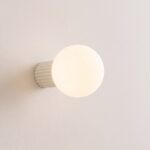
Opal glass ball wall light with fluted aluminium base
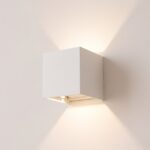
Square LED wall light, white or black aluminium, IP54
See also

Teal Bedroom Ideas: Colours, Gold Accents and the Right Light for a Dark Wall

Downstairs Toilet Lighting: The Right Light for a Small, Windowless WC or Cloakroom

Wabi-Sabi Interior Design: The Beauty of Imperfection, Right Down to the Light
