

Table of Contents
To light a garage well, start from what you do in it. Parking and storage need even general light, while DIY needs stronger light aimed at the workbench. LED battens or ceiling lights for the whole space, adjustable spots over the bench, a sensor at the door and fittings rated for damp and dust cover most garages.
A garage is rarely just somewhere to park the car. In Ireland it is as likely to hold the bikes, the lawnmower, a chest freezer and a workbench, and more and more often it becomes a utility room, a home gym or a workshop. Each use has its own lighting needs, and the single bulb in the middle of the ceiling that came with the house is almost never enough. This guide helps you choose the right brightness, the right garage lights and where to put them, the colour of light, and how to keep the installation safe, inside the garage and at the door. For the fittings themselves, our LED lights cover most of the options below.
What type of lighting is best for a garage?
Start by listing what you really do in your garage. The table matches each use with a type of light.
| Use | Light needed | Suitable fittings | Control |
|---|---|---|---|
| Parking, walking through | General, even | LED battens, ceiling lights | Sensor or switch at the door |
| Storage, finding things | General, no shadow in the shelves | Battens above the shelving | Switch |
| DIY at the workbench | Strong and directed | Adjustable spots, batten over the bench | Its own switch |
| Utility, gym, hobby room | Comfortable general light | Ceiling lights, battens, wall lights | Switch, dimmer |
| Outside the door, driveway | Safety | Outdoor wall light, sensor | Motion sensor |
In most garages, two separate controls are enough: general lighting that comes on as you walk in, and task lighting over the workbench that you turn on only when you are working. The HSA makes the same point about any workspace: light switches should be placed where they are easy to reach and use safely.
How much light does a garage need?
Two units are easily confused. The lumen (lm) measures the amount of light a source gives out; it is the figure printed on the box of a bulb or a batten. The lux measures the light that lands on a surface, and one lux is one lumen per square metre. Lighting recommendations are given in lux, but products are sold in lumens.
No rule sets the light level for a garage in a private home. The most useful guidance comes from the world of work. In its guide to the workplace regulations, the Health and Safety Authority explains that the right level depends on the visual demands of the task, from rough bench work to fine bench work, and refers to the standards of recognised bodies such as CIBSE. For an order of magnitude, the illuminance examples commonly quoted put an office building hallway at around 80 lux and ordinary office lighting at 320 to 500 lux. Walking to the car needs roughly the first; working at a bench needs at least the second, and fine work needs more.
Converting lux to lumens is simple: multiply the area by the level you are aiming for. A workbench area of 2 m² lit at 500 lux needs at least 1,000 lumens landing on it. A whole 18 m² single garage lit only to hallway level, 80 lux, needs about 1,440 lumens reaching the floor. Because part of the light is lost on the walls, the ceiling and everything stored in between, choose fittings whose total output is well above these figures, especially if the walls are bare block or painted a dark colour. Pale walls bounce the light back and reduce the need.
When you compare bulbs, always think in lumens, not watts: a standard LED bulb of 806 lumens gives the light of an old 60 W incandescent bulb, for a fraction of the consumption. SEAI suggests estimating running costs by multiplying the kWh on the energy label by the price of a unit of electricity, which it puts at around 40c. A 20 W LED batten used two hours a day uses about 1.2 kWh a month, so roughly 50c.
Garage lights: battens, ceiling lights or spots?
LED battens: the basics
LED battens are still the most common choice for a garage: long and slim, they spread the light evenly and keep shadows down. In an unheated, damp or dusty garage, choose sealed models, IP65 for example, which keep out dust and splashes. Battens with integrated LEDs have replaced the old fluorescent tubes: they come on instantly and give their full output even in a cold garage in January, which the old tubes did badly.
Ceiling lights: for a converted garage
Once the garage becomes a utility room, a gym or a dry workshop, an LED ceiling light or a bulb ceiling light gives a nicer light than a row of battens. In a small dry garage or a store room, a simple fitting like our industrial round ceiling light in grey concrete, which takes an E27 bulb, is enough to light the space. Be aware that decorative fittings like this are rated IP20: keep them for dry spaces, away from damp and splashes.
Adjustable spots: for the workbench
Over the workbench, the light needs to be strong and directed. A ceiling light with adjustable spots lets you aim it precisely at the worktop and correct shadows for each task. Our black ceiling light with adjustable spotlights, with two E27 bulbs, is one example for a garage turned into a dry workshop. Add an inspection lamp or a portable work light for working under a car or at the back of a cupboard.
Where to place lights in a garage
Position matters as much as power. A few principles avoid most dark corners.
Light the sides of the car, not just the middle. A batten above each side of the car lights the doors, the boot and the floor where you walk, whereas a single central light leaves the sides in the shadow of the bodywork. Put the workbench light in front of you, above the front edge of the bench: a light behind you casts your shadow onto what you are doing. Light the inside of the storage with a batten above the shelves, or an LED strip under a high shelf. And fit a switch at each way in, by the side door and by the door into the house, so you never cross the garage in the dark.
In a garage with a high ceiling, mount the battens on the ceiling rather than the walls: the light falls from higher up and spreads better. In a low garage, choose flat fittings that do not get in the way of a sectional or up-and-over door, or the tailgate of the car.
What colour light for a garage?
Colour is given in kelvins (K). In a garage used as a workshop, neutral white around 4,000 K gives a crisp light that helps you tell apart the colours of cables, paints or parts. Cool white above 5,000 K is sometimes chosen for precision work, but it makes the space less pleasant.
If the garage has become a living space, a gym or a place to relax, go back to warm white around 3,000 K, which is more comfortable in the evening. Nothing stops you combining the two: neutral white over the bench, warm white for the general lighting. Whatever you choose, look at the colour rendering index, shown as CRI or Ra: the higher it is, the truer the colours look, which matters when you are painting or touching up a car. Since September 2021 the EU ecodesign rules have required a CRI of at least 80 for general lighting.
Damp, dust and knocks: which IP rating?
An unheated Irish garage gets condensation, dust and sometimes water running off a wet car. Choose the fittings accordingly. The IP rating gives protection against dust (first digit) and water (second digit): IP44 protects against splashes from any direction, IP65 is dust-tight and protected against water jets. In a damp or dusty garage, aim for at least IP44, and IP65 where you wash the car or the floor.
Think about knocks too: a tool handle, a football or a ladder can hit a low fitting. The IK rating, from IK00 to IK10, measures impact resistance; a fitting with a guard or a polycarbonate diffuser stands up to knocks better than one with glass.
Wiring a garage: the Irish rules
Under the current National Rules for Electrical Installations, I.S. 10101, lighting circuits in homes must be protected by a residual current device (RCD), as Safe Electric sets out in its summary of the key changes. Running a new circuit to the garage, bringing power under the garden to a detached garage or fitting a new distribution board there are all Restricted Electrical Works: under S.I. No. 264 of 2013, only a Registered Electrical Contractor may carry them out, and they certify the work on completion. Replacing a fitting like-for-like without touching the circuit is minor works, but always switch off at the fuse board first.
Garage conversion: what changes
More and more garages become a home office, a gym, a spare room or a hobby space. The lighting has to follow. Rows of white battens on the ceiling, perfect for finding a tool, quickly make a room where you spend your evenings feel like a warehouse. Keep them for the storage end if you like, and light the rest like any room in the house: a ceiling light or an industrial pendant light for general light, wall lights for the walls, and a directed lamp on the desk or the work area. Go back to warm white for the mood lighting and fit a dimmer on the main light. Once insulation and heating are in, the garage becomes a dry room and indoor decorative fittings, like a flat ceiling light, are at home there. Think about sockets and switches too: a garage often has only one or two, and a conversion is the moment to have the installation reviewed by a Registered Electrical Contractor.
Motion sensors and lighting outside the garage door
You often come into the garage with your hands full, a box or the shopping in your arms. A motion sensor turns the light on as the door opens and off again after a set delay: no more feeling for the switch, and no light left on all night. With LEDs, which cope very well with frequent switching, it is the most practical option for the general lighting.
Outside, the way into the garage deserves its own light too. It makes reversing and manoeuvring safer and lights the path back to the house on a dark evening. An outdoor wall light beside the door, with a sensor, is enough in most cases.

For a garage or a shed with no power at all, solar wall lights and rechargeable lamps are a stopgap: they need no cable, but their run time depends on daylight and drops sharply in an Irish winter. For regular use, having power brought in by a Registered Electrical Contractor remains the reliable answer.
Garage lighting: frequently asked questions
What type of lighting is best for a garage?
For general light, LED battens or ceiling lights spread over both sides of the car and the storage, controlled by a sensor or a switch at the door. For the workbench, adjustable spots or a batten above the front edge of the bench. In a damp or dusty garage, choose sealed fittings, at least IP44, and IP65 near where you wash the car.
How many lumens do I need to light a garage?
Think in lumens, not watts, and multiply the area by the light level you want. A 2 m² workbench lit at 500 lux needs at least 1,000 lumens landing on it; a whole 18 m² garage lit to hallway level, about 80 lux, needs around 1,440 lumens reaching the floor. Choose fittings with a total output well above that, since walls and ceiling absorb part of the light.
Is 1,000 lumens enough for a garage?
Not for the whole garage. A thousand lumens spread over 15 m² gives at best about 67 lux before losses on the walls and ceiling, below even hallway level and far from the 320 to 500 lux of office lighting you want at a bench. A thousand lumens is fine for task lighting over a workbench or a shelf.
What colour light is best for a garage?
Neutral white around 4,000 K for a garage used as a workshop: the light is crisp and helps you tell colours apart. If the garage is now a utility room, gym or den, warm white around 3,000 K is more comfortable. A high colour rendering index helps when painting.
Do I need an electrician to put lights in my garage?
Replacing a fitting like-for-like without changing the circuit is minor works, though you must switch off at the fuse board first. A new circuit to the garage, power run under the garden to a detached garage or a new distribution board is Restricted Electrical Works in Ireland, which only a Registered Electrical Contractor may carry out and certify.
How can I light a garage with no electricity?
For a detached garage or shed with no supply, solar lights with an outdoor panel, rechargeable lamps and battery work lights are the options. Their run time is limited and depends on charging, and solar output drops sharply in an Irish winter. For regular use, having power brought in by a Registered Electrical Contractor is the reliable answer.
Sources
- Health and Safety Authority, Guide to the Safety, Health and Welfare at Work (General Application) Regulations 2007, Chapter 1 of Part 2: Workplace, Regulation 8, natural and artificial lighting. HSA
- Lux: definition (one lumen per square metre) and illuminance examples, including office building hallway lighting at 80 lux and office lighting at 320 to 500 lux. Wikipedia
- Safe Electric, I.S. 10101 summary of key changes: RCDs required on lighting circuits in domestic premises. Safe Electric
- Safe Electric, Restricted and Controlled Electrical Works: definitions under S.I. No. 264 of 2013, including new circuits, distribution boards and minor works. Safe Electric
- SEAI, Understanding the labelling on lighting products: energy label, kWh consumption and running cost. Sustainable Energy Authority of Ireland
Related products
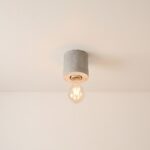
Round industrial ceiling spotlight, grey concrete
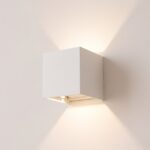
Square LED wall light, white or black aluminium, IP54

Black metal ceiling light with adjustable spots, minimalist bar
See also

How Many Lumens Do I Need? Lumens per m² for Every Room

Teal Bedroom Ideas: Colours, Gold Accents and the Right Light for a Dark Wall

Downstairs Toilet Lighting: The Right Light for a Small, Windowless WC or Cloakroom
