

Table of Contents
Lumens (lm) measure the total amount of light a source gives out; lux (lx) measure the light that lands on a surface. One lux is one lumen per square metre: to go from one to the other, divide the lumens reaching a surface by its area in m², or multiply the lux by that area.
Bulbs are sold in lumens, but lighting recommendations are given in lux. Between the two sit the area you light, the distance to the source and the way the fitting directs its light. This guide covers the three units of light, the conversion formula in both directions, why distance and beam angle change everything, how to read the figures on a product page and how to measure lux at home.
Lux vs lumens vs candela: three ways to measure light
Light can be measured as it leaves the source, in one given direction, and when it arrives on a surface. Each stage has its own unit.
| Quantity | Unit | What it measures | Where you see it |
|---|---|---|---|
| Luminous flux | lumen (lm) | All the light given out, in every direction | Bulb packaging, specifications of LED fittings |
| Luminous intensity | candela (cd) | The light sent in one direction | Spotlight data sheets |
| Illuminance | lux (lx) | The light falling on one square metre | Standards, workplace guidance, light meters |
Think of a sprinkler on a garden hose: the lumens are all the water coming out, the candela is the force of the jet in one direction, and the lux is the water landing on each square metre of lawn. The candela, a base unit of the International System of Units, takes its name from the candle: a common wax candle has a luminous intensity of roughly one candela. The lumen is derived from it, and a source of one candela shining evenly in every direction gives out about 12.6 lumens. The lux is one lumen spread evenly over one square metre. Of the three, it is the only one you can measure directly at home.
American documents also use the foot-candle, one lumen per square foot, which is about 10.76 lux. If a data sheet quotes 50 foot-candles, read about 540 lux.
How to convert lux to lumens, and lumens to lux
- Illuminance (lux) = luminous flux (lumens) ÷ area (m²)
- Luminous flux (lumens) = illuminance (lux) × area (m²)
A source of 1,000 lumens whose light all falls on 1 m² gives 1,000 lux; spread over 10 m², the same light gives only 100 lux. So there is no fixed conversion between lux and lumens, and 5,000 lux is not the same thing as 5,000 lumens: 100 lux on 1 m² takes 100 lumens, while 100 lux on 12 m² takes 1,200.
Three worked examples:
- A desk: a desktop of 1.2 m² lit to 400 lux must receive 480 lumens.
- A kitchen worktop: 3 m of worktop, 60 cm deep, is 1.8 m². To light it to 300 lux, 540 lumens must land on it.
- A living room: 2,000 lumens spread over 20 m² give at best 100 lux on average.
These figures are theoretical maximums, because part of the light goes to the ceiling and walls, or stays inside the shade. Our advice: allow a good margin over the calculation, or share the light between several fittings. To find the lumens of a bulb from the wattage of the old one it replaces, use our lumens to watts chart.
Distance: why lux fall so fast
The further away you move a lamp, the more its light spreads out. At twice the distance, the pool of light covers four times the area, and each square metre receives a quarter of the light. This is the inverse square law: illuminance (lux) = intensity (candelas) ÷ distance² (m²), for a surface facing the source.
A spotlight that sends 1,000 candelas along its axis gives 1,000 lux at 1 m, 250 lux at 2 m and about 111 lux at 3 m. The diagram applies the same principle to 400 lumens sent into a 60° beam: about 380 lux on roughly 1 m² at 1 m, and about 95 lux on 4.2 m² at 2 m.

At home, a small light close to the page lights it better than a powerful ceiling light 2 m away: that is the whole point of a reading light. Our guide to reading lights for bed applies it to the bedroom, and all our reading wall lights have a head you can bring closer to the book.

Beam angle: same lumens, very different lux
With the same output, a globe bulb sends its lumens in every direction, while a spotlight concentrates them into a cone. EU ecodesign rules call a light source directional when at least 80% of its flux falls within a cone of 120°. The beam angle is the angle of the cone inside which the intensity stays at least half of its value at the centre. Here is what 400 lumens spread evenly across the beam give:
| Beam angle | Pool of light at 1 m (diameter) | Pool of light at 2 m (diameter) | Average illuminance at 2 m |
|---|---|---|---|
| 24° | 0.43 m | 0.85 m | about 700 lux |
| 36° | 0.65 m | 1.30 m | about 300 lux |
| 60° | 1.15 m | 2.31 m | about 95 lux |
| 120° | 3.46 m | 6.93 m | about 11 lux |
These are averages, as the centre of the pool is brighter than its edge. A beam of 24 to 36° picks out a picture, a worktop or a page; a beam of 60° or wider lights a room more softly and evenly, with several spotlights.
Compare with an 806 lumen globe bulb shining equally in every direction: it sends about 64 candelas each way, or about 16 lux of direct light at 2 m. A 36° spotlight with half that output gives nearly 300. For the angle and spacing on a ceiling, see our guide to downlights, or our range of spot ceiling light fittings.

How many lux do you need?
Recommended levels are always given in lux, measured where the task happens: on the desk, the worktop or the floor of a corridor. The illuminance examples usually quoted give an idea of the range your eyes cope with:
| Situation | Typical illuminance |
|---|---|
| Full moon on a clear night | 0.05 to 0.3 lux |
| Family living room lights | about 50 lux |
| Office building hallway or toilet | about 80 lux |
| Very dark overcast day | about 100 lux |
| Railway station platform | about 150 lux |
| Office lighting | 320 to 500 lux |
| Overcast day | about 1,000 lux |
| Full daylight, out of direct sun | 10,000 to 25,000 lux |
| Direct sunlight | 32,000 to 100,000 lux |
In Ireland, the Health and Safety Authority’s guide to the General Application Regulations 2007 does not set one figure for every workplace. It asks for lighting good enough to spot obvious hazards and to work without eyestrain, and it refers to the standards of recognised professional bodies such as CIBSE, whose SLL Code for Lighting sets recommended illuminances task by task. For screen work, the same HSA guidance says that, as a general rule, 300 to 500 lux should be appropriate, with local lighting if you need more light to read documents. Our guide to office lighting turns those figures into a desk layout.
No rule applies inside your home, so these levels are benchmarks. Our advice: keep a soft general light in living areas and add local light where you read, cook or work, rather than raising the whole room to office level. It is cheaper in lumens, and more pleasant in the evening. On a stairs, where every tread has to be seen, our guide to staircase lighting gives the levels to aim for.
Reading lux and lumens on a product page
For a bulb, EU rules require the packaging to show its useful luminous flux in lumens, stating whether it is measured in a sphere (360°), a wide cone (120°) or a narrow cone (90°), and, for a directional source, its beam angle in degrees. Lux do not appear on the box: they depend on distance and area. Some desk lamps and reading lights quote them all the same, in the form “500 lux at 50 cm”. To read them:
- A lux figure without a distance means nothing: compare two lamps at the same distance.
- To change the distance, apply the inverse square: 500 lux at 50 cm is about 125 lux at 1 m.
- Lux at 1 m equal candelas on the axis: a 1,000 cd spotlight gives 1,000 lux at 1 m.
- Compare lumens measured in the same cone: 400 lumens in 90° do not have the effect of 400 lumens in a sphere.
Many fittings are sold without a bulb and state the cap and the maximum wattage instead, such as “GU10 bulb, max 10 W LED” on our natural oak wood spotlight wall light, one of our wood wall light designs: the bulb you choose then sets both the lumens and the beam angle. Our guide to LED bulbs explains the rest of the box. For a spotlight, read three lines together: the lumens, the cone they are measured in and the beam angle.
Measuring lux at home: light meter or phone app
A light meter, or lux meter, combines a light-sensitive cell, today usually silicon, filtered so that its response follows the sensitivity of the human eye, with a display. Better models add a cosine-correcting cover, so that light arriving at an angle is counted correctly. The HSA itself describes the lux meter as a simple device for measuring light levels. Our method:
- Lay the sensor flat on the surface to check: a desk, a worktop, a page, or the floor of a hall.
- Do not cast a shadow on it: stand to one side, arm stretched out.
- Measure in the evening, curtains closed, to know what your fittings alone provide.
- Take several readings, in the centre and at the edges: the gap tells you how even the light is.
Smartphone apps read the ambient light sensor that adjusts the brightness of the screen. Our advice: treat their figures as orders of magnitude, useful to compare two lighting set-ups, since that sensor is not built as a light meter. Lux also turn up on some fittings: the daylight threshold of a motion sensor light is set in lux, so that the light stays off while there is enough daylight.
Frequently asked questions about lux vs lumens
Is 5,000 lux the same as 5,000 lumens?
No. Lumens measure the light a source gives out, lux the light landing on each square metre. 5,000 lumens concentrated on 1 m² would give 5,000 lux; spread over 50 m², they give at best 100 lux. Indoors, 5,000 lux is ten times the usual office level of 320 to 500 lux.
How many lux is 2,000 lumens?
It depends on the area lit: 2,000 lux on 1 m², 200 lux on 10 m² and 100 lux on 20 m², before the losses on walls and ceiling. In a 20 m² living room, a 2,000 lumen ceiling light therefore gives a gentle 100 lux at most.
How many lumens are in a lux?
One lux is one lumen per square metre, so the lumens depend on the area: 300 lux on a 2 m² table means 600 lumens landing on it. Without the area, no conversion is possible.
How bright is 100 lux?
About the light of a very dark overcast day: a little more than an office building hallway, at around 80 lux, and less than a railway platform, at about 150. It is enough to find your way around a room, not enough for screen work, where the HSA gives 300 to 500 lux as a general rule.
What is 1,000 lumens in lux?
1,000 lux if all 1,000 lumens fall evenly on one square metre, 100 lux if they spread over 10 m². In a real room, part of the light is lost on the walls and ceiling, so expect less than the calculation.
How many lux do you need to read?
For screen work, the HSA considers 300 to 500 lux appropriate as a general rule, with local lighting added to read documents. At home, a reading light close to the page reaches that easily with few lumens, because the lux fall with the square of the distance; a ceiling light 2 m away struggles.
Sources
- Lux, Lumen (unit) and Candela, encyclopaedia articles (definitions, illuminance examples, foot-candle, a wax candle at roughly one candela, inverse square law for a point source). Wikipedia
- Light meter, encyclopaedia article (silicon sensors filtered to match the sensitivity of the eye, cosine correction). Wikipedia
- Guide to the Safety, Health and Welfare at Work (General Application) Regulations 2007: Chapter 1 of Part 2, Workplace, Regulation 8 on natural and artificial lighting; Chapter 5 of Part 2, Display Screen Equipment (300 to 500 lux as a general rule, the lux meter). Health and Safety Authority
- SLL Code for Lighting, 2022 edition (recommended illuminances for indoor and outdoor workplaces). CIBSE, Society of Light and Lighting
- Commission Regulation (EU) 2019/2020 of 1 October 2019 laying down ecodesign requirements for light sources (definition of a directional light source, beam angle, information on the packaging). EUR-Lex
Related products
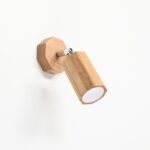
Natural oak wood spotlight wall light
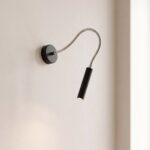
Reading wall light with adjustable head in black steel
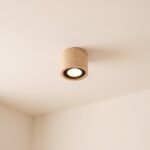
Round natural wood spot ceiling light, Scandinavian style
See also

Flickering Lights: Causes, Warning Signs and How to Fix Them

Bookcase Lighting: How to Light Your Books, Shelves and Reading Nook

How Many Lumens Do I Need? Lumens per m² for Every Room
