
Table of Contents
When a light stays on with the switch off, or an LED bulb glows faintly in the dark, a tiny current is still flowing through it: from an illuminated switch, a smart switch, dimmer or sensor wired without a neutral, current induced between cables, or a switch wired in the neutral. Two simple tests tell them apart, and only one is dangerous.
The odd thing about this fault is that it is rarely new. The same small current flowed through plenty of Irish homes in the days of the 60 W bayonet bulb, and nobody saw it, because a filament needs watts before it shows any colour. An LED lights up on a millionth of that. By swapping their bulbs for LEDs, many households fitted a fault detector without knowing it, and makers of wiring accessories have a name for what it reveals: the ghost effect, or LED ghosting. This guide sorts the causes, gives the tests that separate them without opening anything, and says which one needs a Registered Electrical Contractor.
Why an LED shows what a filament hid
An incandescent bulb is a resistance. To give off light, its filament has to reach around 2,500 °C, which takes almost all of its rated power. Pass 0.2 milliamps through an old 60 W bulb and it dissipates a few millionths of a watt: the filament stays cold, the glass stays dark, and the current flows all the same.
An LED works quite differently. Its chips start to emit as soon as the voltage across them passes a threshold, and the small power supply in its base, the driver, holds a capacitor. A tiny current takes seconds to charge that capacitor; once the voltage reaches the threshold, the chips light up while it empties, and the cycle starts again. That gives the two classic symptoms: a very faint steady glow, or a short flash every few seconds when the current is only just enough to top the capacitor up in bursts.
The third player is your eye. The International Commission on Illumination places scotopic vision, the night vision of the rods, below 0.005 candela per square metre: a bedroom with the curtains drawn, where the eye picks up what it ignored by day. The same bulb can be invisible at seven in the evening and impossible to ignore at three in the morning, with the fault itself unchanged.
One case is not a fault: an LED that fades out over a few seconds after you switch off is simply the same capacitor draining. The problem starts when the glow stays for the night, or when the light does not go off at all.
Light stays on when switch is off: full brightness or a faint glow?
These are two different problems, and the first question to ask is how bright the light is once the switch is off.
At full brightness, it is not ghosting. The fitting gets its full supply, so the switch is not breaking the circuit at all. The usual causes: a new fitting connected at a loop-in ceiling rose with the permanent live and the switch wire mixed up, a switch with stuck contacts or a broken mechanism, a smart switch, relay or timer that has stayed on, or a two-way circuit with a common terminal confused with a strapper. Each time the fitting is live when you think it is off: switch off the lighting circuit at the consumer unit and call a Registered Electrical Contractor.
A faint glow, or regular flashes, point to a residual current. The table sorts the five usual causes by what you can see.
| What you see | Most likely cause | Risk | Who deals with it |
|---|---|---|---|
| Faint, steady glow; the switch has a small light that shows in the dark | Locator light wired across the switch contacts | None | A Registered Electrical Contractor swaps the switch; you can change the bulb |
| Glow or regular flashes; the light is on a dimmer, a sensor, a timer or a smart switch | Device without a neutral, powering itself through the lamp | None | You, by changing the bulb, or an electrician if a neutral is needed |
| Very faint glow, no switch light, no electronics, long cable runs or two-way switching | Current induced between two cores lying side by side | None | You, by changing the bulb, or an electrician for a compensator |
| A clear glow, sometimes on several lights of the same circuit, and a voltage detector reacts at the switched-off fitting | The switch breaks the neutral instead of the live | Real | A Registered Electrical Contractor, without exception |
| The glow depends on the positions of the two switches of a two-way circuit | Strappers or common terminals miswired | Real if the neutral is involved | A Registered Electrical Contractor |
The five causes of a faint glow
The illuminated switch, and why not every one is to blame
Switches carry two kinds of small light that look alike and behave in opposite ways. A locator light, lit when the lamp is off so you can find the switch in the dark, is connected across the switch contacts: its current has only one way back to the neutral, through the lamp. An indicator that comes on with the lamp is wired across the load, needs a neutral in the box and never causes this fault.
The current is counted in milliamps, a fraction of a watt: invisible with a 60 W filament bulb, enough for a 5 W LED. Nothing is broken, the two technologies simply do not get on, and makers of wiring accessories list the illuminated switch among the cases their LED compensators are designed for.
Smart switches, dimmers and sensors without a neutral
A dimmer, a sensor switch, a timer or a smart switch has to stay powered all the time. In many Irish homes the switch box holds only the switch wires and the earth, with no neutral, so makers sell 2-wire versions that draw their standby power through the lamp, with a minimum load: Legrand asks for 3 W on its detectors, about 0.013 A at 230 V, and a compensator if the load stays lit more than two minutes at power-up. Below that minimum, expect a glow, a flicker, or a light that refuses to go off. Our guide to the dimmer switch explains how to work out that load and how 2-wire and 3-wire models differ, and the guide to the motion sensor light covers the same choice for a sensor switch.
Induced current: the invisible cause
Two insulated cores running side by side for several metres form a small capacitor, enough to let an alternating current through. Legrand describes it in the technical sheet of its compensator: over long cable runs, capacitive coupling creates a leakage current that can light low-power loads such as LEDs while the switch is off. The sum fits on one line: current equals voltage times 2πfC, so 230 V times 314 times the capacitance.
The textbook case in an Irish house is 2 way switch wiring. The strappers run together in the same three-core cable, often the full height of a staircase. With the light off, one strapper is live and the other, connected to the lamp at the far switch, lies right alongside it.

Keep the order of magnitude: tens to a few hundred microamps, hundreds of times less than the 78 milliamps or so a 9 W LED bulb draws when it is on. That is twice what 9 W divided by 230 V suggests, because the small drivers in these bulbs often have a power factor of about 0.5. No device is faulty here: the only thing that has changed in your home is the type of bulb.
A switch in the neutral instead of the live
This one is of a different nature. A one-way switch is a single-pole device: it is meant to break the live. If it breaks the neutral instead, the lamp goes off because the circuit is open, but the fitting stays connected to the live permanently. A small leak to earth, through the filter in the driver or the metal body of the fitting, is then enough to make an LED glow, often more clearly than in the other cases, and sometimes on several lights of the same circuit.
The fault is not the glow, it is the wiring. A fitting you believe is dead stays at 230 V, lampholder included, one more reason to switch off at the consumer unit before you change a bulb. And a blue wire in a switch box proves nothing: in Irish twin and earth cable the switch wire is blue, or black in older cable, yet it is a live conductor that should carry a brown sleeve. Checking that every single-pole switch sits in the live is the polarity test, part of the inspection and testing a Registered Electrical Contractor carries out against the National Rules for Electrical Installations, I.S. 10101.
A two-way circuit that behaves strangely
On a staircase or a long hall, a glow can come from the illuminated version of one of the two switches, which brings you back to the first case. It can also come from strappers or common terminals that were mixed up, or, worse, from a live and a neutral used as the two strappers. The sign is simple: the glow appears in some combinations of the two switches and not in others.
Four tests you can do without opening anything
Do them in this order: each one rules out a family of causes.
Test 1: move the bulb
Switch off the lighting circuit at the consumer unit, take out the glowing LED and fit it in a light controlled by an ordinary switch with no locator light, then put a different bulb in its place. If the glow follows the bulb, that bulb is unusually sensitive and replacing it is enough. If the glow stays with the light point, the cause is in the circuit. Getting the bulb out can be the hardest part: our guide on how to change spotlight bulb types covers recessed spots with and without a clip, and if the holder itself is cracked or scorched, the guide on how to change a lamp holder explains what that involves.
Test 2: add some load
If the fitting takes several bulbs, fill every lampholder. Otherwise, try a bulb of higher wattage, or an old filament or halogen bulb if you still have one in a drawer. If the glow disappears, the case is made: the residual current is too weak to light a normal load. You are in one of the first three rows of the table, none of them dangerous, and a compensator would work.
Test 3: look at the control
A small light on the switch points to a locator light. A dimmer, a sensor, a timer or a smart switch points to a 2-wire device. A light switched from two places points to two-way switching: try the four combinations of the two switches. If the glow only shows in some of them, have the wiring checked before anything else.
Test 4: look for the live with a non-contact detector
A non-contact voltage detector, the pen that beeps near a live conductor, gives the last clue. Try it on a light that works normally first, then, with the switch off, hold it close to the flex or body of the glowing fitting without touching anything. If it reacts clearly, the live is probably still there: stop and call a Registered Electrical Contractor. Never read it the other way round: it can react to a cable that simply runs past a live one, and its silence never proves a circuit dead. That takes a two-pole voltage indicator, checked on a known live source before and after.
Who can fix what in Ireland
Changing a bulb is maintenance, and it is yours to do, with the circuit switched off at the consumer unit. Everything beyond that touches the fixed wiring. Safe Electric, which registers electricians in Ireland, explains that most electrical work in a home is Restricted Electrical Works under S.I. No. 264 of 2013, carried out and certified by a Registered Electrical Contractor, who gives you a Completion Certificate. Minor works sit outside that definition, with the like-for-like replacement of a switch as the example; Safe Electric still advises using a Registered Electrical Contractor, and so do we.
Three situations rule out doing it yourself: a live still present on a switched-off fitting, a two-way circuit that seems to use the neutral as a strapper, and any box where the earth is missing. There, the glowing LED is the least serious part of the problem. Work in a bathroom is restricted in any case.
The fixes, from a real repair to an honest workaround
In order of how cleanly they solve it: the first three remove the cause, the last three work around it.
Replace the illuminated switch. A plain switch with no locator light ends the most common case for good. It is a quick job for an electrician, and the cheapest of the six.
Move the switching to the live. It is the only answer to a switched neutral, and it belongs to a Registered Electrical Contractor. Ask at the same time about bringing a neutral to the switch boxes: that is what will let you fit a 3-wire dimmer or smart switch later without running into the same fault.
Swap a 2-wire device for its 3-wire version. Where a neutral is present, the same dimmer, sensor or smart switch in its version with neutral stops drawing standby current through the lamp.
Change the bulb. A bulb of higher wattage shrugs off a given leakage current, and a fitting with several lampholders shares it out. On a circuit that already glows, try a non-dimmable bulb first, since a dimmable driver is built to keep lighting on very little power. When the cause is induced current, this is often all it takes. Our guide to LED bulbs sets out what to read on the pack, and the one that answers are LED bulbs dimmable shows where to check that line.
Have a compensator fitted. It is the fix sold as a bypass, a load corrector or an anti-ghosting capacitor, and makers of wiring accessories offer an active version, one per control, wired at the light. It diverts the residual current away from the LED rather than removing it, and the one we cite uses up to 1.5 W itself. Our view: it makes sense for induced current or when a locator light has to stay, never to hide a wiring fault. Connected at the fitting, it is a job for a Registered Electrical Contractor.
Choose a fitting with its own switch. When only one light is affected, this is often the simplest route. Among our wall lights with switch, turning the fitting off at its own switch opens the circuit right beside the lampholder, after every other part of the installation.

What a glowing LED really costs
The electricity is negligible. An induced current is almost entirely reactive and uses next to nothing. A locator light uses a fraction of a watt: even at half a watt, all year round, that is about 4 kWh, or around €1.50 at an example rate of 35 cent per unit. It is not the reason to act.
The wear is plausible, but nobody has measured it. The performance standard for LED bulbs, I.S. EN 62612, tests lumen maintenance over a limited period and puts lamps through endurance tests that include switching cycles; it does not claim to verify the lifetimes printed on packs. A driver kept under a weak, permanent excitation works outside those conditions, and no one publishes a figure for that regime. We will not invent one.
It is in the bedroom that it really matters. A steady glow ends up filed away with the rest of the room. A slow flash reminds you it is there every time, and that is exactly what a current topping up the capacitor in bursts produces: in a room where you are trying to sleep, the best reason to deal with it. If your light wavers while it is on, rather than glowing while it is off, the diagnosis is different, and our guide to flickering lights takes it step by step.
Choosing bulbs and fittings that stay dark
When you buy, four points cut the risk, even though no maker prints them as such.
Wattage. Between two bulbs that suit the fitting, the more powerful one is the less sensitive to a given leakage current. A 2 W LED behind a sensor switch is the worst case, and a small G9 capsule in a reading light is in the same family: put that kind of light on a plain switch or on its own.
The number of lampholders. A fitting with three or five bulbs shares the residual current between them, and the visible threshold is rarely reached.
The diffuser. It does not remove a glow, but an opal disc spreads it over a large surface: a flat round ceiling light with a 25 cm opal diffuser turns what remains into a pale disc instead of a bright point.
A bulb you can change. An E27, B22 or GU10 lampholder lets you try another bulb in thirty seconds, the first test in this guide. On an integrated LED fitting, that door is closed and the cause has to be dealt with in the wiring: a real criterion for a light on a sensor or a dimmer.
Frequently asked questions about a light that stays on when the switch is off
Why do my LED lights glow after I turn them off?
Because a tiny current still passes through them with the switch off: the locator light of an illuminated switch, a dimmer, sensor or smart switch wired without a neutral, or current induced between two cores side by side, typically the strappers of a two-way circuit. A few tenths of a milliamp did nothing to a filament bulb, but it charges the capacitor in an LED driver until the bulb glows or flashes. A fade lasting a few seconds after switching off is normal.
Is LED ghosting a fire hazard?
In the usual cases, no: the current is measured in microamps or a few milliamps and the installation is not faulty. One case is dangerous, a switch wired in the neutral instead of the live, because the fitting and its lampholder stay at 230 V while you believe them off. If a non-contact detector reacts at a switched-off fitting, or several lights glow together, switch off at the consumer unit and call a Registered Electrical Contractor.
How do I get rid of LED ghosting?
Start with the bulb, which you can do yourself: a higher wattage LED, every lampholder filled, or a non-dimmable bulb on an ordinary switch. If the glow persists, a Registered Electrical Contractor can replace an illuminated switch with a plain one, fit the 3-wire version of a dimmer or smart switch where a neutral is available, or add a compensator at the light. A switch wired in the neutral has one fix only: rewiring it to break the live.
Is it normal for LED strip lights to glow when off?
It is common, for the same reasons as a bulb: the residual current charges the output capacitor of the strip’s power supply, which then feeds the whole strip. The fixes are the same, and the simplest is often to run the strip from a plug-in power supply switched off at the socket, rather than through the switch that causes the glow.
Does a light fixture have power when the switch is off?
It should not, if the switch breaks the live as it is meant to, but never take it for granted. A switch wired in the neutral leaves the fitting live, and on two-way or loop-in circuits some wires stay live whatever the switch position. A wall switch is not isolation: switch off the lighting circuit at the consumer unit before changing a bulb, and leave the wiring to a Registered Electrical Contractor.
Why is my ceiling light not turning off?
If it stays at full brightness, it is not ghosting: the fitting is getting its full supply. A new fitting connected to the permanent live at a loop-in ceiling rose, a switch with stuck contacts, a smart switch or timer left on, or a miswired two-way circuit are the usual causes. Each leaves the light live when you think it is off: switch off at the consumer unit and have it checked by a Registered Electrical Contractor.
Sources
- Restricted and Controlled Electrical Works, S.I. No. 264 of 2013: definitions, minor works and the Completion Certificate. Safe Electric
- National Rules for Electrical Installations, I.S. 10101: inspection and testing, polarity of single-pole switches. NSAI
- Active compensator, technical sheet F02436FR/02, and motion detector instructions LE09811AB: capacitive coupling, the ghost effect, 3 W minimum load. Legrand
- Scotopic vision, International Lighting Vocabulary, term 17-22-017: luminance below 0.005 cd/m². International Commission on Illumination
- I.S. EN 62612, self-ballasted LED lamps for general lighting services: lumen maintenance and endurance tests including switching cycles. NSAI
Related products

Flat round ceiling light with white diffuser, 3 colours
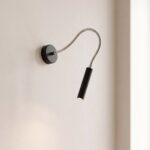
Reading wall light with adjustable head in black steel
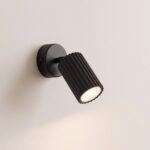
Black ribbed adjustable spotlight wall light with switch
See also

Light Stays On When Switch Is Off: Why LED Bulbs Glow and How to Stop It

Sloped Ceiling Lighting: What to Fit Under an Attic Slope

Mood Lighting: The Three Settings That Really Create It, Room by Room
