

Table of Contents
2 way switch wiring lets you turn the same light on and off from two places, such as the top and bottom of the stairs. It uses two two-way switches, each with three terminals, COM, L1 and L2, linked by two wires called strappers. The line reaches COM on the first switch, and the switch wire to the light leaves from COM on the second.
Two-way switching is the standard arrangement for every place people pass through: a staircase, a long hall or landing, a large room with two doors, a bedroom where you want to turn off the main light from the bed. This guide explains how the circuit works, what each wire does, what the markings on the back of a switch mean, and the Irish rules on who may do which part of the job. It is written so that you understand what your electrician is doing and can spot a fault, not as an invitation to rewire your stairs on a Saturday afternoon.
What is 2 way switching?
Two-way switching is a lighting arrangement that controls the same light from two switches in different places. Each switch changes the state of the light, whatever the position of the other one: if the light is on, it turns it off; if it is off, it turns it on. You come in at the bottom of the stairs, switch on, and switch off again at the top. Where to place the lights themselves is covered in our guide to staircase lighting.
In Ireland and Britain the arrangement is called two-way switching, and the switches two-way switches. In North America the same thing is called a three-way switch, counting the three terminals rather than the two positions, which is a common source of confusion when you watch a video or read a guide from across the Atlantic.
One-way and two-way switches: what is the difference?
It all shows on the back of the switch. A one-way switch has two terminals: it opens or closes a single path. A two-way switch has three, usually marked COM, L1 and L2: it is a changeover switch, a single-pole double-throw switch in engineering terms, which connects the COM terminal either to L1 or to L2. That third terminal is what allows two switches to be linked together.
The reverse also works: a two-way switch can be used as a one-way switch by using only two of its terminals, COM and L1. That is why many ranges now sell only two-way switches for lighting, since they cover both uses.
How does a two-way lighting circuit work?
Between the two switches run two wires, the strappers, sometimes called travellers. Inside each switch, a moving contact connects COM to one of the two strappers. When both contacts sit on the same strapper, the current finds a continuous path from the supply to the light, and it comes on. When they sit on different strappers, the path is broken, and it goes off.
Flicking either switch therefore always moves the circuit from one case to the other. Here are the four possible combinations:
| Switch 1 | Switch 2 | Path for the current | Light |
|---|---|---|---|
| L1 | L1 | Continuous | On |
| L1 | L2 | Broken | Off |
| L2 | L1 | Broken | Off |
| L2 | L2 | Continuous | On |
One practical consequence: on a two-way circuit, “up” and “down” mean nothing. The light can be on with both switches down, or with one up and one down. If you have ever wondered why the hall switch in your house seems to be upside down half the time, that is the reason, and it is not a fault.
2 way switch wiring: what each wire does
A complete two-way circuit involves five conductors. Three pass through the switches, and two go straight to the light fitting.

- The line, coming from the lighting circuit on the distribution board, arrives at the COM terminal of the first switch.
- The two strappers link L1 on the first switch to L1 on the second, and L2 to L2.
- The switch wire leaves from the COM terminal of the second switch and goes to the light.
- The neutral goes straight from the board to the light, without passing through the switches.
- The earth, green and yellow, also goes straight to the light fitting, and to the metal parts of each switch where there are any.
Two colours never change: blue is the neutral, and green and yellow is only ever used for earth. The other conductors in a switch circuit are all, at some point, live, whatever colour their insulation happens to be. In older houses, you may find other colours again. So never trust a colour on its own: identify every wire by what it does, and mark it before you disconnect anything.
Which wire goes on which terminal?
The rule fits in two lines. On the first switch, the line goes on COM and the strappers on L1 and L2. On the second switch, the strappers go on L1 and L2 and the switch wire on COM. The COM terminal is sometimes marked differently depending on the maker, often with a colour or a symbol, but it is always the single terminal on its own, facing the two strapper terminals.
Each switch therefore takes three wires. That is why the cable between the two switch positions has three conductors plus earth: one for each strapper and one for the line or the switch wire. The green and yellow earth conductor in that cable can never be used as a strapper; it stays reserved for earth, and it must be connected to the earth terminal in each box.
Does it matter which strapper goes on L1 and which on L2?
Not for the circuit to work. The two strappers are interchangeable: if you swap them at one switch, the light still works from both places, and only the positions of the switches that correspond to “on” change. What does matter is that COM is never confused with L1 or L2. That is the mistake behind almost every two-way circuit that behaves strangely.
Installing two-way switching in an Irish home
In Ireland, the question to ask first is not how, but who. Safe Electric, the scheme overseen by the Commission for Regulation of Utilities, sets out what counts as Restricted Electrical Work in a home: a new fixed installation, the installation or replacement of circuits, any change to the distribution board and work in the special locations of Part 7 of the National Rules for Electrical Installations. Only a Registered Electrical Contractor may carry out and certify that work, and they must give you a completion certificate. Minor works are excluded from the list, and Safe Electric gives like-for-like replacements, such as switches, as its example.
In practice, that gives you two cases. Replacing a worn or broken two-way switch with a new two-way switch, connected exactly as the old one was, is a minor work. Adding two-way switching where there was only one switch, which means running new cable between two switch positions and chasing walls, is a job for a Registered Electrical Contractor. The work follows the National Rules for Electrical Installations, I.S. 10101, and the current edition requires lighting circuits in homes to be protected by an RCD.
If you do replace a switch yourself, the method is the same as for any switch:
- Switch off the lighting circuit at the distribution board, and check with a proper voltage tester that nothing in the box is live. A switch in the “off” position is not enough: on a two-way circuit, some wires in the box can still be live whatever the position of the switch.
- Photograph and mark the wires before you disconnect the old switch: which one is on COM, which ones are on L1 and L2.
- Connect the new switch exactly the same way: the COM wire on COM, the other two on L1 and L2, the earth on the earth terminal.
- Fix the switch and test: restore the power and try all four combinations in the table above. Each switch must turn the light on and off whatever the position of the other.
If anything in the box does not match what you expected, a fourth wire, no clear COM, or a scorched terminal, stop there and call a Registered Electrical Contractor.

The light only works in some positions
This is the classic symptom of a COM terminal confused with a strapper terminal. If the line or the switch wire has ended up on L1 or L2, the circuit no longer works as two-way switching: the light depends on one switch only, or comes on in only one combination. Switch off at the board, and go back to identifying the COM terminal on each switch. If the light never comes on at all, check that both strappers really do land on L1 and L2 at each end, and that no wire is loose.
Two-way, intermediate or more: switching from three places and beyond
Using a two-way switch as a one-way switch
To control a light from a single place with a two-way switch, connect the line and the switch wire to COM and L1, and leave L2 empty. If one day you add a second switching point, the strappers can be run to it without changing the switch.
The two-gang two-way switch
A two-gang two-way switch puts two switch mechanisms on the same plate. It controls two separate lights from two places, for example the ceiling light and the wall lights of a living room with two doors. Each half is wired as an ordinary two-way switch, with its own pair of strappers and its own switch wire to its own light.
Three or more places: the intermediate switch
To control a light from three or more places, on a long landing or a staircase over several floors, an intermediate switch is inserted between the two two-way switches. It has four terminals and, each time it is pressed, it crosses the two strappers over. You can add as many intermediate switches as you need, one per extra switching point. The wiring soon becomes heavy, though, and for many switching points another approach is often preferred: push-button switches controlling a latching relay, which changes state each time any of the buttons is pressed.
One last option for a place people pass through is to do away with the switch altogether. A light on a motion sensor comes on as you pass and switches itself off, which also settles the question of the light left on all night. Its daylight threshold is set in lux, a unit our guide to lux vs lumens explains. Our guide to motion sensor lights explains how to choose one and where to put it. Smart switches and wireless switches are another route, often with less wiring, but anything connected to the fixed wiring should still be fitted by a Registered Electrical Contractor.
Which lights suit two-way switching?
All of them. Two-way switching controls a lighting point, whatever fitting is connected to it. A wooden chandelier in a modern farmhouse hall is wired in exactly the same way as a plain pendant. In a hall or on a landing, two families work well. Hallway pendant lights and staircase pendant lights, lined up along the same switch wire, give rhythm to a long space: our long black tube pendant light is a slim option for a stairwell or a hall with a high ceiling. Half-moon wall lights, which light both up and down, suit narrow halls where a pendant would be in the way. In a grey hall, choose warm white bulbs so the walls stay soft rather than steely: see what colour goes with grey.
Several lights can be controlled together by the same pair of two-way switches: they are simply connected to the same switch wire, as long as the total stays within what the circuit is designed for, which is your electrician’s call. For more ideas depending on the shape of your hall, read our guide to hallway lighting.
Think about the light source as well. An LED bulb copes easily with being switched on and off many times a day in a place people pass through, and an integrated LED fitting, such as our modern LED pendant light in smoked glass, has no bulb to change at all, a real advantage above a stairwell where reaching the fitting means a ladder. To pick an LED as bright as the bulb it replaces, use our lumens to watts chart. If you plan to dim a light on two-way switching, check the dimmer is designed for it and for LED loads: that choice belongs with the electrician too.
2 way switch wiring: frequently asked questions
How is a two-way switch wired?
The line from the distribution board goes to the COM terminal of the first switch. Two strappers link L1 to L1 and L2 to L2 between the two switches. The switch wire to the light leaves from the COM terminal of the second switch. Neutral and earth go straight to the light. In Ireland, new two-way wiring is work for a Registered Electrical Contractor.
What is COM, L1 and L2 on a 2 way light switch?
COM is the common terminal: it takes either the line coming from the board, on the first switch, or the switch wire going to the light, on the second. L1 and L2 are the two strapper terminals, linked by the two wires that run between the switches. Inside the switch, a contact connects COM to either L1 or L2.
Does it matter if you use L1 or L2 on a light switch?
On a two-way circuit, the two strappers are interchangeable: swapping them at one switch changes only which positions mean on, and the light still works from both places. On a two-way switch used as a one-way switch, you can use either, with the other left empty. What must never be swapped is COM with L1 or L2.
What wire do I need for a two-way light switch?
Between the two switches you need a cable with three conductors plus earth: two for the strappers and one for the line or the switch wire. The green and yellow earth conductor can never be used as a strapper. The size and type of cable are set by the wiring rules and chosen by your Registered Electrical Contractor.
Can I replace a two-way light switch myself in Ireland?
Safe Electric lists like-for-like replacements of switches as minor works, which are not Restricted Electrical Work. Switch off at the board, check with a voltage tester, mark each wire and connect the new switch exactly as the old one. Adding two-way switching where there was none means new wiring, which a Registered Electrical Contractor must do.
What happens if a two-way switch is wired wrong?
The usual result is a light that works only from one switch, or only in some combinations. It almost always means COM has been confused with L1 or L2. Switch off at the board and re-identify the COM terminal on each switch. A switch that buzzes, gets warm or shows scorching needs a Registered Electrical Contractor straight away.
Sources
- Restricted and Controlled Electrical Works: definitions under S.I. No. 264 of 2013, and the exclusion of minor works such as like-for-like replacements of switches. Safe Electric
- I.S. 10101 Summary of Key Changes, as highlighted by NSAI: clause 411.3.4, RCDs required on lighting circuits in domestic premises. Safe Electric
- Multiway switching: two-way circuits with single-pole double-throw switches, strappers, intermediate switches and latching relays. Wikipedia
- IEC 60446, now part of IEC 60445: green and yellow used always and exclusively for the protective conductor, blue for the neutral. Wikipedia
Related products

Small white ceramic half-moon wall light

Modern design LED pendant light in smoked glass
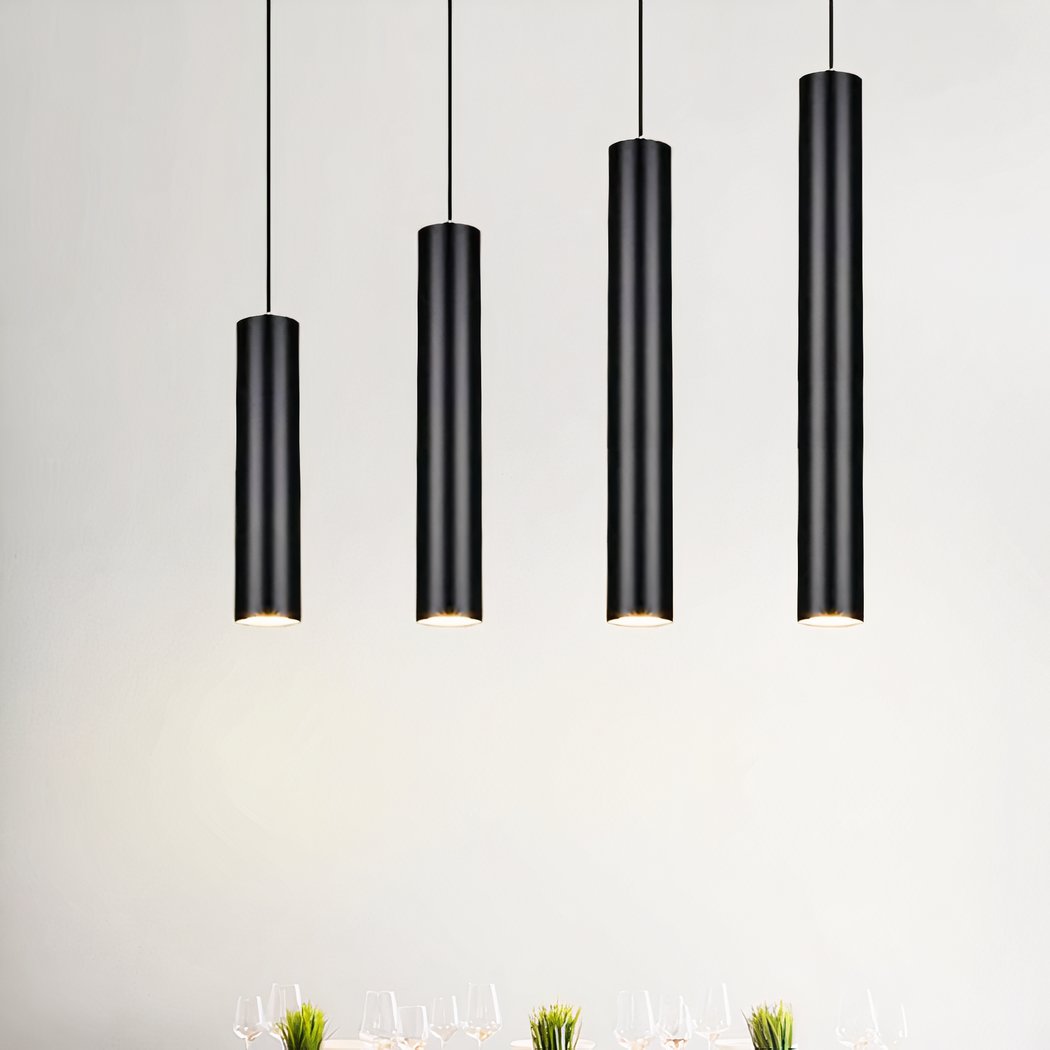
Long black tube pendant light
See also

Flickering Lights: Causes, Warning Signs and How to Fix Them

Bookcase Lighting: How to Light Your Books, Shelves and Reading Nook

How Many Lumens Do I Need? Lumens per m² for Every Room
