

Table of Contents
To brighten a dark room, first work out why it lacks light, then act in this order: a pale ceiling and walls that bounce light back, mirrors and glass that carry it further, and enough artificial light spread over several sources, lighting the walls and ceiling as well as the floor.
A dark room is rarely fixed with a stronger bulb. It lacks daylight, but it usually also lacks surfaces that return light and sources in the right places. Under Ireland’s often overcast skies, a north-facing living room or a deep terraced-house kitchen can feel dim at noon in November. This guide starts with the diagnosis, moves through colour, mirrors and glass, then spends its second half on lighting: how much light to plan, where to put it and in which shade of white.
Why your room is dark: aspect, windows and depth
Before you buy a tin of paint or a new light fitting, watch the room for a whole day. Three causes explain almost every dark room, and each calls for a different answer.
The aspect of the room
A north-facing room hardly ever gets direct sun. Its light comes from the sky: steady, but weak in winter and slightly blue, which cools every colour in the room. An east-facing room is bright in the morning and dim in the afternoon; a west-facing one is the reverse. Even a south-facing room turns gloomy behind a tall building or a mature tree. Note the hours when the room feels dark: those are the hours when your lighting has to take over.
Irish housing guidance knows this well. Quality Housing for Sustainable Communities, the Department of the Environment’s design guidelines, asks for at least one main living room facing within 90° of due south, keeps north-facing glazing to a minimum and suggests putting halls and utility rooms on the north side. The 2025 planning standards for apartments require at least a quarter of the units in a scheme to be dual aspect and accept north-facing single-aspect flats only when they overlook a park or a similar amenity. If your living room faces north, you are living in exactly the kind of room these rules try to avoid, so it needs more help than most.
Windows and room depth
The daylight you get depends first on the glazed area. A tall window lights further into a room than a low window of the same size, because light from high in the sky reaches the back of the room.
Daylight then fades quickly with distance. Our rule of thumb: beyond about twice the height of the top of the window, the back of the room depends mainly on artificial light. With a window head at 2.2 m, the useful zone stops at around 4.5 m. For its minimum level, the European standard on daylight in buildings, I.S. EN 17037, asks for 300 lux over half of the room for at least half of the daylight hours, and at least 100 lux over 95% of the room for the same time. A free light meter app on your phone gives you an order of magnitude: take a reading near the window, then at the back of the room.
| What you notice | Likely cause | First fix |
|---|---|---|
| Dull all day long | North-facing room | Warm off-white or linen walls, lights on during the day |
| Dark in the afternoon | East-facing room | Mirror on a side wall, lights on earlier |
| Bright by the window, dark at the back | Deep room | White ceiling, wall lights on the back wall |
| Dark even in summer | Overshadowing, trees, basement or ground floor | Sheer voiles, pale floor, stronger lighting |
| Only dark in the evening | Too little light, or badly placed | More lumens, several sources |
Light colours and finishes that bounce light back
Every surface returns part of the light that falls on it. That share is its light reflectance value, or LRV: 0% for a surface that absorbs everything, 100% for one that sends everything back. Some paint charts print it next to each colour. In a dark room, it matters more than the colour name.
Worked out from their colour codes, an off-white reflects about 85% of the light it receives, a linen 73%, a greige 53%, a sage green 40%, a taupe 29% and a teal 10%. I.S. EN 12464-1, the European standard for workplace lighting, recommends in its 2011 edition walls between 50 and 80%, a ceiling between 70 and 90% and a floor between 20 and 40%. At home, in a dark room, stay at the top of those ranges.

The ceiling first, then the walls
The ceiling is the largest clear surface in the room, and it is the ceiling that sends back the light of wall lights and lamps pointing upwards: keep it white. On the walls, an off-white, a linen or a light greige is enough. In a north-facing room, choose a white with a touch of warmth, which offsets the blue of the sky; a cool grey there looks flat and chilly, as our guide to what colour goes with grey explains. Our guide to greige colour shows how that soft neutral shifts with the light.
A deeper colour is still possible on one wall, ideally the one facing the window, which gets the daylight head on. It will need more light in the evening: a mid sage green reflects half as much light as an off-white, as our article on what colour goes with sage green shows. There is a second effect, measured in the lab: a pale surface looks further away than a dark one, so pale paint also makes a room feel bigger.
Matt, eggshell or satin
The finish changes the way light leaves the wall far more than the amount. A matt emulsion spreads light evenly in every direction and hides flaws. An eggshell, satin or gloss finish makes bright spots where the lamp hits it, without lighting the rest of the room any better. We recommend matt or a soft sheen on the walls and ceiling, and satinwood or eggshell on the woodwork and inside the window reveals, which then throw daylight back into the room.
Floors and furniture
A dark wooden floor or a deep carpet absorbs a large share of the light from the ceiling. Without replacing the floor, a large pale rug already changes the room. Choose pale wood over dark sideboards and dressers, and clear the space in front of the windows: a tall plant or an armchair against the glass stops light before it gets in.
Mirrors, glass and see-through materials
Mirrors, glass and light fabrics do not create light, but they carry the light that already comes in further into the room.
Where to hang a mirror
Opposite the window, a mirror makes the room look much bigger, but it sends part of the daylight straight back out the way it came. On a wall at right angles to the window, it sends light towards the back of the room: that is the position we prefer in a deep room. In the evening, a mirror hung close to a wall light doubles the source and lights a corner that would otherwise stay in shadow.
Glazed doors and voiles
A glazed internal door, a glass panel above a door or a frosted glass partition lets light travel from one room to the next: it is the answer for a hall with no window. A glass coffee table or a clear console fills space without casting a shadow. Swap heavy curtains for pale voiles, hung from just under the ceiling and wider than the window, so that the whole pane is clear during the day.
Light fittings that do not block the view
A heavy, opaque light fitting stays a dark patch in the room by day, with the light switched off. If you replace one, choose glass in clear, white or opal, which lets both light and the eye pass through. Our modern globe pendant in metal and glass is a thin black ring, 65 cm across, carrying three opal glass globes: light from a distance, it spreads a soft glow over a table and up to the ceiling. You will find other models in our glass pendant light range. Clear glass shows the bulb: take a frosted or opal bulb to avoid glare.
If you rent or cannot paint
Plenty of dark rooms belong to a landlord. Without a paintbrush, you still have a lot of room to act: wash the windows inside and out, trim back the hedge or the climber that shades them, hang voiles, lean a tall mirror against a side wall, lay a pale rug over a dark floor and add lamps. Where there is no wiring in the right place, a plug-in or rechargeable wall light fills the gap. Warm white bulbs of good quality in every existing fitting cost little and change a rented room at once.
Lighting a dark room: add more light sources
This is half the work, and the half that decorating tips tend to skip. A dark room needs more generous lighting than other rooms, by day as well as in the evening, and above all better spread.
Why a single ceiling light is not enough
A central ceiling light lights the middle of the room and leaves the walls and corners in half-light. Yet the eye judges how bright a room is by its walls, not by its floor. Take a 16 m² living room with pale walls, lit by a 1,521 lumen ceiling light, the output of an old 100 W bulb: it gets about 48 lux. Add two 470 lumen wall lights and an 806 lumen lamp in a corner, and you reach 3,267 lumens, about 102 lux, with the walls lit.

Lighting designers call this layered lighting, a principle we cover in our guide to cosy lighting. In a dark room, the goal is the opposite of cosy: you are not trying to keep pools of shadow, you are trying to get rid of them. So the layers stay on together, during the day as well.
The ceiling light: wide and diffusing
Keep general light on the ceiling, but make it wide and diffusing: opal glass globes or a white diffuser send light downwards, sideways and up onto the ceiling, which returns it. Avoid narrow spots and opaque shades, which light a circle on the floor and little else. Flat fittings with a frosted glass panel work well in a low or dark room, since they sit close to the ceiling and light it evenly; our low ceiling lighting ideas go further on that point. Browse our flat ceiling light range.

Wall lights that light the walls
The wall light is the fitting that brightens a dark room the most, because it lights the wall directly. Choose models that send light both up and down, and put them where the shadow settles: the back wall, either side of a mirror, a hall or a landing. Our white wall light selection brings together ceramic, metal and glass models that blend into a pale wall.

Lamps for the corners
A corner left in the dark makes a room look smaller. A lamp on a console, a floor lamp pointing at the ceiling or an LED strip along the top of a bookcase is enough to open it up. By the reading chair, add an adjustable light that lights the page without having to raise the whole room.
No ceiling light at all?
Some rooms, often in older houses or converted attics, have no ceiling point. Wall lights at around 1.7 m on the back wall and around a mirror can take over the general light. Without any work, a floor lamp pointing upwards turns the ceiling into a large reflector, and two or three lamps set in the darkest corners complete it.
How much light does a dark room need?
Our guide how many lumens do I need gives the rule: lumens to fit = floor area × recommended lux × 2. For a living room at 100 lux, that is 200 lumens per m², so 3,200 lumens for 16 m². If the room is dark, aim for the top of the ranges and apply the corrections from that guide: about 20% more with mid-tone walls, 40 to 50% more with dark walls.
| 16 m² room | Pale walls | Mid-tone walls | Dark walls |
|---|---|---|---|
| Living room, 100 lux | 3,200 lm | 3,840 lm | 4,480 to 4,800 lm |
| Kitchen, 200 lux | 6,400 lm | 7,680 lm | 8,960 to 9,600 lm |
Share those lumens between all the sources in the room rather than asking one fitting to provide them. If the room is used during the day, a north-facing kitchen or home office for example, plan the lumens for daytime use, then add an LED-compatible dimmer for the evening.
Which colour temperature makes up for the lack of daylight?
Colour temperature, measured in kelvins (K), tells you whether a white light is warm or cool. In a dark room, you will not choose it once and for all.
| When | Colour temperature | Why |
|---|---|---|
| Daytime, north-facing work room | 3,500 to 4,000 K | Blends with grey daylight without yellowing it |
| Daytime, living room | 3,000 K | Neutral but still warm |
| Evening | 2,700 K | Warm white, better for sleep |
Our advice: during the day, in a north-facing kitchen or home office, a neutral white of around 4,000 K tops up the grey daylight of an overcast Irish sky without tinting it yellow. In the evening, go back to warm white: the French health agency Anses recommends warm white light, below 3,000 K, for the home, and points out that light rich in blue in the evening disturbs sleep. Tunable white fittings, from 2,700 to 4,000 K, solve the dilemma in a single room. Avoid “daylight” bulbs of 5,000 to 6,500 K, which make a living room feel like an office.
Check the colour rendering index (CRI) as well. Since 1 September 2021, EU ecodesign rules have required a CRI of at least 80 for most bulbs. We recommend 90 or more in a dark room, so the colours of your walls, wood and fabrics stay true. And keep one colour temperature for all the sources that are on together: two different whites show at once on a pale wall.
Frequently asked questions about brightening a dark room
How do you brighten a room with no natural light?
Rely on the surfaces and on several light sources. Paint the ceiling white and the walls a warm off-white in matt, lay a pale rug, then combine a wide, diffusing ceiling light with wall lights that light the walls and a lamp in the darkest corner. Plan about 200 lumens per m² in a living room, and a glazed door if light can come from the next room.
What colour brightens a dark room?
A colour that reflects a lot of light: off-white, at about 85%, linen or a light greige. In a north-facing room, a slightly warm white offsets the bluish sky light. Keep the ceiling white and save deeper colours for a single wall, ideally the one facing the window.
How can I make a dark room look like it has natural light?
Light the walls and the ceiling the way the sky does, rather than relying on one central point. By day, a neutral white of 3,500 to 4,000 K blends with the daylight without yellowing it; in the evening, go back to 2,700 K. Choose bulbs with a colour rendering index of 90 or more.
How do you brighten a dark room without painting?
Wash the windows, swap heavy curtains for pale voiles, move furniture away from the glass and lean a tall mirror on a wall at right angles to the window. Add a large pale rug, lamps in the corners and a plug-in or rechargeable wall light where there is no wiring.
What lights are best for a dark room?
A wide ceiling light in opal or frosted glass for the general light, and wall lights that shine up and down to light the walls. Add a lamp in the darkest corner. Clear, white or opal glass fittings suit a dark room better than heavy, opaque ones, which stay a dark patch by day.
How do you light a room with no ceiling light?
With wall lights at around 1.7 m from the floor, on the back wall and around a mirror. Without any work, a floor lamp pointing at the ceiling, table lamps and an LED strip along the top of a bookcase are enough. Aim for about 200 lumens per m² in a living room.
Sources
- I.S. EN 17037, Daylight in buildings (minimum level: 300 lux over 50% of the reference plane and 100 lux over 95% of it, each for at least half of the daylight hours). NSAI, National Standards Authority of Ireland
- I.S. EN 12464-1:2011, Light and lighting, Lighting of work places, Part 1: Indoor work places (recommended reflectances of walls, ceiling and floor). NSAI, National Standards Authority of Ireland
- Quality Housing for Sustainable Communities, Best Practice Guidelines for Delivering Homes Sustaining Communities, 2007 (section 5.4.2, Daylighting and Solar Gain). Department of the Environment, Heritage and Local Government
- Planning Design Standards for Apartments, Guidelines for Planning Authorities, 2025 (section 3.4, Dual Aspect Ratios). Government of Ireland
- IEC 61966-2-1, Colour measurement and management, Part 2-1: Default RGB colour space, sRGB (relative luminance of a colour). International Electrotechnical Commission
- von Castell C., Hecht H., Oberfeld D., Bright paint makes interior-space surfaces appear farther away, PLOS ONE, 2018. doi.org/10.1371/journal.pone.0201976
- Health effects of light-emitting diodes (LEDs), opinion and expert report, 2019. Anses, French Agency for Food, Environmental and Occupational Health and Safety
- Commission Regulation (EU) 2019/2020 of 1 October 2019 laying down ecodesign requirements for light sources (minimum colour rendering index). European Union
Related products
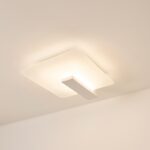
Flat wood and glass ceiling light, Scandinavian design
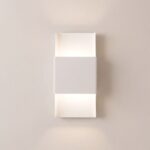
Modern white wall light with diffused lighting
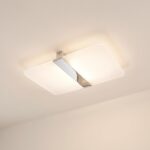
Rectangular ceiling light in frosted glass and chrome steel
See also

Mood Lighting: The Three Settings That Really Create It, Room by Room

How to Change Spotlight Bulbs, With or Without a Clip

Conservatory Lighting: Which Lights Cope With the Heat, the Glass and the Dark
