

Table of Contents
To choose a living room pendant light, start from three measurements: the ceiling height, which sets its maximum length because you want about 2 metres of clear headroom below it; the area it has to light, the middle of the room, the coffee table or a dining table; and the style of the furniture. Then add a lamp or two.
The living room, or the sitting room as many Irish homes still call it, is the room you spend most of your waking hours in, and the one where lighting has the most jobs to do: having people over, reading, watching a film, sometimes eating. Our living room pendant lights run from fabric drums to opal glass globes and woven shades. This guide does not replace falling for a design; it just stops you regretting it, by giving you the measurements to take, in the order in which they rule models out.
How low should a living room pendant light hang?
The first constraint is walking underneath it. There is no Irish rule on the clear height below a light in a home, so we recommend keeping about 2 metres between the bottom of a pendant and the floor wherever people walk, so nobody has to duck. That figure sets the maximum length of the fitting, ceiling rose and flex included.
| Ceiling height | Maximum length of the pendant | What fits |
|---|---|---|
| 2.40 m | 40 cm | A short pendant or a flush ceiling light |
| 2.50 m | 50 cm | A short pendant, flex cut to the minimum |
| 2.70 m | 70 cm | A medium shade with no difficulty |
| 3.00 m | 100 cm | A large shade, or several globes at different heights |

Watch the product pages: the height quoted often includes the flex at its full length. A fabric pendant might show a total height of well over a metre for a shade 40 cm across. The flex is shortened when it is fitted, so what has to fit in the space you have is the height of the shade plus the ceiling rose.
The 2 metre guideline applies where people walk. Above a coffee table or a reading corner, nobody passes upright, so the pendant can hang lower, as long as it does not cut across the view between the sofa and the armchairs, or towards the television. Above a dining table, the height is set by the table rather than the ceiling, which our guide to dining room lights covers in detail.
What size pendant light for a living room?
There is no standard for the diameter. Several guides give formulas, such as adding the length and width of the room and turning the result into a diameter, but they do not agree with one another and rest on no official text. It is better to start from what the pendant has to light.
In the middle of the room, it is the volume that counts. Cut a cardboard disc to the diameter of the model and hold it up to the ceiling, or tape its outline on the wall at eye level. A 20 m² sitting room under a 2.5 m ceiling rarely suits a 60 cm shade, which looks huge right in your line of sight. Above a table, a simple rule of proportion is not to exceed half the width of the top: for a coffee table 60 cm wide, a shade of about 30 cm stays in proportion. In a reading corner, a small diameter of 25 to 40 cm is enough, since the light should fall on the book, not on the whole room.
Think about visual weight too. A glass or paper shade looks lighter than dark metal of the same diameter. In a small room, pale and translucent materials let both the light and the eye through, and make the pendant feel smaller than it is.
One pendant or several in the living room?
A single central pendant suits a square living room of average size. Beyond that, or in a long room, several light points light it better and give the space some structure.
In a through room or an open-plan living and dining space, hang one pendant above the table and another over the sofa area: each one marks out its zone without a wall. Above a long table, a row of identical pendants works better than a single large one. And under a high ceiling or in a stairwell, several globes hung at different heights from one ceiling plate form a cluster: our multi-light pendants are designed for that.
When you line up several pendants, choose identical ones or pieces from the same family of materials. Different models side by side compete instead of answering one another.
Which style of pendant light suits a living room?
The material of the shade decides the light as much as the style. The table sums up what each family gives.
| Material | Light | Living room style | Watch out for |
|---|---|---|---|
| Fabric, linen | Soft, diffused downwards and through the shade | Classic, cosy, contemporary | Choose a pale fabric so it does not darken the room |
| Opal glass | Diffused in every direction | Scandinavian, Japandi | Weight, fixing to the ceiling |
| Clear or smoked glass | Sparkling, bulb on show | Designer, vintage | Needs a decorative filament bulb |
| Metal | Directed downwards, a sharp circle | Industrial, modern | Strong contrast with the rest of the room |
| Wood, rattan, bamboo | Filtered, patterns on the walls | Boho, natural | Dust in the weave |
| Paper | Very soft and even | Japanese, minimalist | Fragile; use a cool-running LED |
A Scandinavian pendant light in light wood and white metal goes with most living rooms today. If you want to carry the look through the whole room, our guide to Scandinavian interior design covers the colours and materials. A fabric pendant light is the safest choice for soft light over the sofa. Black metal and concrete suit industrial interiors, as long as you balance their very directed light with lamps around the room.
What light should a living room pendant give?
The living room is used mostly in the evening, so the colour of the light matters. A warm white around 2,700 K gives the tint closest to the old filament bulbs, and every bulb sold in the EU must show its colour temperature on the box. Evening light is not neutral for sleep: in a controlled study published in The Journal of Clinical Endocrinology and Metabolism, ordinary room light of under 200 lux in the hours before bedtime delayed the release of melatonin in 99 % of participants and shortened it by about 90 minutes, compared with dim light. A warm, dimmable light for the evening is the sensible choice.
Three points to check before you buy:
- The bulb cap. The product page states the cap of the lampholder: E27 for standard bulbs, E14 for small ones, G9 or GU10 for compact models. Many fittings made for the European market take an E27 rather than the B22 bayonet common in Irish homes, so your spare bulbs may not fit.
- Bulb included or not. Many pendants are sold without a bulb: plan for one, within the maximum wattage the maker gives.
- A dimmer. A living room pendant is at its best when you can turn it down: bright for tidying, soft for a film. You then need LEDs marked “dimmable” and a dimmer switch rated for LEDs. European rules require bulbs that cannot be dimmed to say so on the packaging, and our guide to LED bulbs explains the other figures on the box.
The bulb you can see
Under a clear or smoked glass shade, or on an open design with no shade at all, the bulb becomes part of the look. Decorative LED filament bulbs, in globe, teardrop or tube shapes, keep the warm glow of the old filament bulbs while using a fraction of the power. Choose them dimmable if the pendant is on a dimmer. Dim to warm bulbs go one step further: European rules define them as light sources that shift towards a lower colour temperature as they are dimmed, so at a low level they turn amber, like a filament bulb, instead of staying the same white. Above a sofa or a coffee table, where you spend the evening, that is the most comfortable light you can give a pendant.
High ceilings, beams or slopes: the special cases
Not every living room has a flat ceiling at 2.5 m. Under a vaulted or double-height ceiling, the space below the pendant becomes huge, and a 40 cm shade lost 5 m up lights nothing: bring it down on a long flex to put the light back near the seating, keeping 2 metres of headroom where people walk, or choose a cluster of globes that fills the volume.
With exposed beams, fix the pendant to a beam rather than between two, where it would look squeezed; a linear pendant set along the line of the beam underlines the structure instead of cutting across it. Under a sloping ceiling, you need an angled ceiling plate or a flex that hangs straight despite the slope, and the pendant goes on the high side, where people stand and walk.
In each of these cases, the fixing matters as much as the style: an old beam and a sloping plasterboard ceiling do not carry the same load. Check the weight on the product page before you choose an imposing model.
Pendant, chandelier or ceiling light in the living room?
A pendant hangs on a flex and usually carries a single light source under a shade: it concentrates light on one area. A chandelier carries several sources or a decorative frame and fills more of the room. A flush ceiling light stays against the ceiling and gives an even light without taking up any height.
| Pendant | Chandelier | Flush ceiling light | |
|---|---|---|---|
| Ceiling height | 2.50 m and more | 2.70 m and more, or a flush mount model | Any |
| Light | Concentrated under the shade | Spread out, decorative | Even, diffuse |
| Best placed | Over the coffee table, the sofa or a table | Centre of a large room | Small room, low ceiling |
Under a 2.5 m ceiling, a flush ceiling light or a short pendant is the most comfortable option. Above 2.7 m, a living room chandelier finds its place in the middle of the room, with a pendant over the table or the sofa.
Add other lights to the living room pendant
A single pendant in the middle lights the living room from above and leaves the walls in shadow. The rooms that feel good in the evening mix three heights of light: the ceiling, the walls and low points near the seating.

A pendant brought down over a side table makes a reading corner with no floor lamp. On the walls, living room wall lights throw light up and down, add depth and let you switch the pendant off in the evening. Together they give the warm, layered light that makes a sitting room feel cosy on a winter evening.
Looking after a living room pendant
A pendant hangs in the middle of the room, at the height where dust settles, so a little care keeps it looking and lighting its best. Always switch off and let the bulb cool before cleaning. Fabric and linen shades take a soft brush or the brush attachment of a vacuum cleaner on a low setting. Rattan, bamboo and natural fibre need a dry paintbrush worked into the weave once a month. Glass comes off for a wash in warm soapy water, dried fully before it goes back. Paper shades only want a feather duster: water marks them for good. A clean shade lets through noticeably more light than a dusty one, which is worth remembering before you decide a room needs a brighter bulb.
Fitting a living room pendant light safely
Replacing one light with another on the same ceiling point is listed by Safe Electric as minor work, outside the Restricted Electrical Works that only a Registered Electrical Contractor may carry out and certify. A new ceiling point, a new circuit or a change to the fuse board is restricted work. If you have any doubt about the wiring, have a registered electrician fit the pendant and ask for the completion certificate.
Whoever fits it, switch off at the fuse board, not just at the wall switch, and check that the circuit is dead before touching any wire. The weight of the pendant hangs from the ceiling hook or bracket, never from the flex. Set the flex length before you close the ceiling rose, keeping 2 metres of headroom where people walk. On plasterboard, use a fixing rated for the weight of the fitting.
The method comes down to a few steps: measure the ceiling height, take away 2 metres, keep the pendants that fit into the space left, choose the diameter for the area it lights, then the material for the light you want. A warm white bulb and one or two lamps do the rest.
Living room pendant light: frequently asked questions
How do you choose a pendant light for a living room?
Measure the ceiling height and take away about 2 metres of clear headroom: that is the maximum length of the pendant, ceiling rose included. Choose the diameter for the area it lights, the middle of the room, the coffee table or a reading corner, then the material for the light you want. Finish with a warm white, dimmable bulb.
How low should a pendant light hang in a living room?
Where people walk, keep about 2 metres between the bottom of the pendant and the floor: under a 2.5 m ceiling, the pendant can be 50 cm long at most. Above a coffee table or a reading corner, where nobody walks, it can hang lower, as long as it does not block the view between the sofa, the armchairs and the television.
What size pendant light for a living room?
There is no standard. In the middle of the room, hold a cardboard disc of the model’s diameter up to the ceiling to judge it. Above a table, a shade no wider than half the table top stays in proportion: about 30 cm for a coffee table 60 cm wide. In a reading corner, 25 to 40 cm is enough.
Should a living room have one pendant or several?
One central pendant suits a square living room of average size. In a long room or an open-plan living and dining space, use several: one over the table and one over the sofa, each on its own switch. Above a long table, a row of identical pendants works better than one large model.
Can you put a pendant light in a room with a low ceiling?
Yes, with a short pendant and the flex cut to the minimum, keeping about 2 metres of headroom where people walk. Under 2.4 m, a flush ceiling light is often more comfortable. Above a coffee table or in a corner where nobody walks, a pendant can hang lower without getting in the way.
What colour light is best for a living room?
A warm white around 2,700 K to 3,000 K, shown in kelvins on the packaging of every bulb sold in the EU. It gives the soft tint of the old filament bulbs and suits evenings, when research shows that brighter light delays the sleep hormone melatonin. Put the pendant on a dimmer with LEDs marked dimmable.
Sources
- Gooley JJ et al., Exposure to room light before bedtime suppresses melatonin onset and shortens melatonin duration in humans, The Journal of Clinical Endocrinology and Metabolism, 2011. doi.org
- Commission Regulation (EU) 2019/2020, ecodesign requirements for light sources: colour temperature on the packaging and the warning for light sources that cannot be dimmed. EUR-Lex
- Restricted and Controlled Electrical Works, definitions under S.I. No. 264 of 2013, including minor works. Safe Electric
Related products
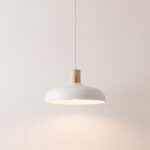
Round Scandinavian pendant light in metal and natural wood
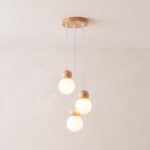
3-light glass and wood minimalist pendant light
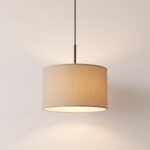
Beige fabric drum pendant light, timeless design
See also

Flickering Lights: Causes, Warning Signs and How to Fix Them

Bookcase Lighting: How to Light Your Books, Shelves and Reading Nook

How Many Lumens Do I Need? Lumens per m² for Every Room
