
Table of Contents
A light bulb uses its wattage times the hours it is on. An 8 W LED uses 0.008 kWh an hour: a third of a cent at 40 cent per unit, the SEAI average for Irish homes in late 2025. Three hours a day for a year costs €3.50; the same light from an old 60 W bulb cost €26.28.
The arithmetic takes one line. The useful answer starts when you compare two bulbs that give the same light, multiply by the bulbs in a fitting, and set the total against a real Irish electricity bill. That is what this guide does, starting from what matters most to us: the light you get, not only the units you pay for.
The sum: watts, hours and the price of a unit
A watt is a power, the rate at which the bulb draws energy. A kilowatt-hour, the “unit” on an Irish bill, is an amount of energy: what a 1,000 W appliance uses in an hour. Going from one to the other takes three steps:
- multiply the wattage of the bulb by the number of hours it is on;
- divide by 1,000 to get kilowatt-hours;
- multiply by the price of a unit on your bill.
A full example with an 8 W LED lit three hours a day. Over a day: 8 × 3 = 24 watt-hours, or 0.024 kWh. Over a year: 8 × 1,095 hours = 8,760 Wh, or 8.76 kWh. At the price used throughout this guide, that is €3.50 a year. Nothing else enters the sum: a B22 bayonet, as in most Irish ceiling roses, uses the same as an E27 screw of the same wattage.
That leaves the price of a unit. SEAI collects household electricity prices every six months under the EU rules on energy price statistics. For July to December 2025, homes in band DC (2,500 to 5,000 kWh a year), one of the two largest consumption bands, paid an average of 40.4 cent per kWh, all taxes included. SEAI calls it an effective unit price: the revenue suppliers collected divided by the units they delivered. We round it to 40 cent for every example that follows.
Do not copy that figure as a permanent truth. It moves twice a year and depends on how much you use: 34.4 cent in band DD (5,000 to 15,000 kWh) and 50.8 cent in band DB (1,000 to 2,500 kWh) over the same period. Find the unit rate on your last bill and put it in place of 40: every amount here scales in proportion, a quarter less at 30 cent, a quarter more at 50 cent. The standing charge and the PSO levy are fixed, paid whether the lights are on or off.
How much electricity a light bulb uses per hour, by type
Comparing an 8 W LED with a 60 W bulb means nothing unless both give the same light. So we take an official reference: 806 lumens, the output European labelling rules match to an old 60 W incandescent bulb, the light of a sitting room lamp.
For those 806 lumens, the incandescent bulb needed 60 W. A clear halogen bulb, in the last generation allowed on sale before it was phased out, was capped at about 52 W for that output by the 2009 ecodesign formula. A typical class F LED, the kind found on every shelf, uses 7.3 to 9.5 W; we take 8 W. The most efficient, in class A, come down to 3.8 W.
| For 806 lumens | Power | Per hour | Per year (1,095 h) | Cost a year |
|---|---|---|---|---|
| Incandescent | 60 W | 0.060 kWh, 2.4 cent | 65.7 kWh | €26.28 |
| Halogen | 52 W | 0.052 kWh, 2.1 cent | 56.9 kWh | €22.78 |
| LED, class F | 8 W | 0.008 kWh, 0.32 cent | 8.8 kWh | €3.50 |
| LED, class A | 3.8 W | 0.0038 kWh, 0.15 cent | 4.2 kWh | €1.66 |
1,095 hours is three hours a day for a year, at 40 cent per kWh. Over a year of normal use, the gap between the hungriest and the most frugal of these bulbs is €24.62, for exactly the same light in the room.

Plenty of halogen is still in Irish homes: GU10 spotlights in kitchen and bathroom ceilings, desk lamps, capsule bulbs in wall lights. Its bar is almost as tall as the incandescent one, and swapping it for an LED is the change that pays most, by a long way.
For the match with an old bulb other than the 60 W, our lumens to watts chart gives the output to look for at every old wattage. And if your fitting is marked “max 40 W” and you wonder whether you can use a 60 W bulb in a 40 W lamp, the answer is about heat, not about your bill.
Watts measure electricity, lumens measure light
While every bulb was a filament, the watt was a fair guide to brightness. Today it tells you one thing only, what the bulb takes from your meter, and two 8 W LEDs can give 680 or 1,000 lumens depending on their class.
The right measure is efficacy, in lumens per watt, and the energy label has graded it since 1 September 2021: class A means at least 210 lumens per watt, B 185, C 160, D 135, E 110 and F 85. An ordinary 806 lumen bulb drawing 8 W runs at 101 lumens per watt. Do the division yourself: the lumens and the watts are printed side by side on the box. The label’s kWh per 1,000 hours is simply the wattage: 8 kWh/1000h for an 8 W bulb.

The same reading works for fittings with integrated LEDs, which state their power and output like a bulb. Our LED ring chandelier declares 32 W for 4,231 lumens in warm white, or 132 lumens per watt: as much light as five 806 lumen bulbs, for about €14 a year at three hours a day. To know how many lumens you need before you look at the watts, our guide to how many lumens you need gives the figures room by room.
One figure escapes efficacy yet weighs on comfort: the colour rendering index. At equal lumens and watts, a lamp with a high index shows colours without dulling them, a gain that costs nothing on the bill. Our LED lights state it on their product pages, next to the output and the power.
One bulb, a five-light pendant, a seven-light chandelier: the cost of a year
Nobody lights a house with a single bulb, and the sum becomes telling once you multiply by the light points. Take our 8 W LED again, three hours a day:
- one bulb: 8.76 kWh a year, or €3.50;
- a five-light pendant: 40 W, 43.8 kWh a year, or €17.52;
- a seven-light chandelier: 56 W, 61.3 kWh a year, or €24.53.
A seven-light chandelier in LED therefore costs less to run than a single old 60 W bulb. That is exactly what changed with LED: plenty of light, spread over several sources, became affordable. Our 7-bulb spider pendant light takes E27 bulbs of up to 15 W in LED; fitted with 8 W bulbs, it costs €24.53 of electricity a year. The same seven sockets with 60 W filament bulbs would have drawn 420 W and cost €183.96.
So the number of light points matters far less than it used to. What weighs now is the technology of each one, then the hours. A light on six hours a day costs twice as much as one on for three, and four times as much as one on for an hour and a half. The ones to watch are lights that burn for long hours with nobody looking at them: outside lights, the hall, the landing, the garage, a child’s night light.
What lighting really weighs on an Irish electricity bill
Lighting is not what makes an Irish electricity bill, and it weighs less than it used to. The last time SEAI isolated it, in its 2013 report on energy in the residential sector, it estimated that lighting took 16% of household electricity in 2011, about 825 kWh per home, a figure worked out from the BER research database. SEAI itself described its end-use figures as more tentative than the rest of the report. Here is that breakdown of electricity usage.
| Use | Share of household electricity, Ireland 2011 |
|---|---|
| Hot water | 25% |
| Small appliances and other | 19% |
| Lighting | 16% |
| Washing machines, dishwashers, dryers | 11% |
| Fridges and freezers | 10% |
| Cooking | 8% |
| Space heating | 7% |
| Central heating pumps and fans | 4% |
SEAI estimates for the housing stock as a whole; a home with electric heating or an electric shower looks very different.
That picture dates from a stock still lit largely by filament, halogen and compact fluorescent bulbs. SEAI’s later reports group lighting with appliances, which together took 68% of household electricity in 2016, and we found no newer Irish figure that isolates lighting alone. So here is our own estimate for a home that has gone fully LED: twenty light points of 8 W, on for two hours a day on average, use 116.8 kWh a year, about €47. That is roughly a seventh of the 2011 figure, and 2% to 5% of the electricity of a home in band DC. This is our worked example, not an official statistic, but the order of size is hard to argue with.
Two consequences follow. If your bill has jumped, do not blame the bulbs: look first at heating, the immersion and the tumble dryer. And since lighting costs so little, there is no reason to live in the gloom. Two lamps rather than one ceiling light, a reading lamp on in the evening: all of that is counted in euro a year, not tens of euro.
Four sums that mislead
Switching off when you leave a room for two minutes. The habit is right, but two minutes of an 8 W LED is 0.27 watt-hours, about a hundredth of a cent; four times a day for a year, 16 cent. The old advice to leave a light on for short absences came from fluorescent tubes, whose electrodes wore with every start. An LED reaches full output instantly, so switch off, knowing this is not where your bill is decided.
The standby of lamps you control remotely. This one is real. A lamp run from a remote control, an app or a voice assistant keeps a receiver powered even when it is off. EU ecodesign rules cap the standby power of a light source at 0.5 W, and the networked standby of a connected light source at 0.5 W too, since 1 September 2021, without adding the two together. Take that ceiling as the worst case: 0.5 W over 8,760 hours is 4.38 kWh, or €1.75 a year, half of what an 8 W LED costs lit three hours a day. Our smart connected LED corner floor lamp, run from a remote control, belongs to this family, and our guide to smart bulbs covers the rest. That is a reason not to put them everywhere, and to switch a smart lamp off at the wall when it is not needed for weeks.
The LED that glows faintly when the switch is off. It costs almost nothing: the current is tiny and often reactive. Even the 3 W minimum load some two-wire controls ask for is only 0.013 A at 230 V. The glow is still worth sorting out, for a dark bedroom and for the wiring fault it can point to: see our guide to the light that stays on when the switch is off.
Believing that dimming changes nothing, or everything. A dimmer does cut the power drawn, and the saving follows the lumens. But on an LED that already draws only a few watts, the saving is counted in watts, and an electronic dimmer stays powered all the time. Dimming is an excellent way to make a room comfortable and a modest way to save money.
Where your lighting bill is really decided
Three decisions make almost all the difference, and none is about switching off more often.
Replace whatever is still halogen or filament. It is the only change that divides a consumption by six or seven at once. Look for recessed spotlights, desk lamps, bathroom wall lights and decorative bulbs on show. Our guide to LED bulbs goes through the choice cap by cap.
Buy on lumens per watt, not on the price tag. Between a class F bulb of 8 W and a class A bulb of 3.8 W giving the same light, the gap is €1.84 a year for a light on three hours a day. Over ten light points and ten years, that is about €184, to set against the difference in purchase price. The sum only holds, though, for lights that really are on for long hours.
Cut the hours where they pile up with nobody there. An outside light, a hall or a garage left on for several hours a day costs more than a sitting room. That is where a motion sensor or a timer really pays its way, long before the reflex of switching off as you cross the living room.
Our advice: do the sum once for your home. Count your light points, estimate their hours, apply the three steps above, and you will know whether lighting costs you €30 or €150 a year. Then give your attention to what matters more: the quality of the light, its colour temperature, where it falls and how it shows colours.
How much electricity does a light bulb use: frequently asked questions
How much does it cost to have a light bulb on for 1 hour?
Divide the wattage by 1,000 and multiply by your unit rate. At 40 cent per kWh, the SEAI average for band DC homes in late 2025, an old 60 W bulb costs 2.4 cent an hour, a 52 W halogen 2.1 cent, and an 8 W LED giving the same 806 lumens about a third of a cent. Three hours every evening for a year, that is €26.28 for the filament bulb against €3.50 for the LED.
How much does it cost to run one light bulb for 24 hours?
An 8 W LED left on for 24 hours uses 0.192 kWh, about 7.7 cent at 40 cent per unit; an old 60 W bulb used 1.44 kWh, about 58 cent. Over a whole year without switching off, the LED comes to €28.03 and the filament bulb to €210.24. Note that the LED left on day and night costs more than the old bulb used three hours a day: hours count as much as watts. A timer or a sensor saves more than any choice of bulb.
Do light bulbs use a lot of electricity?
Not any more. SEAI estimated that lighting took 16% of Irish household electricity in 2011, when filament and halogen bulbs were still common. A home that has gone fully LED, with twenty 8 W light points on for two hours a day on average, uses about 117 kWh a year, roughly €47: our own estimate, and 2% to 5% of the electricity of a home using 2,500 to 5,000 kWh a year. Heating, hot water and drying clothes weigh far more.
Is it cheaper to leave LED lights on or turn them off?
Turn them off. An LED reaches full output the moment it is switched on, with no warm-up, so switching off always saves something and leaving it on never does. The amounts are small: two minutes of an 8 W LED cost about a hundredth of a cent. The old rule of leaving a light on for short absences came from fluorescent tubes, whose electrodes wore with every start, and it does not apply to LEDs.
How much does it cost to leave a light on for 8 hours?
With an 8 W LED, 8 hours use 0.064 kWh, about 2.6 cent at 40 cent per unit. With an old 60 W bulb, 0.48 kWh, about 19 cent. Every night for a year, the LED comes to €9.34 and the filament bulb to €70.08. For a light that stays on through the night, outside or on a landing, a low wattage LED on a timer or a dusk sensor is the right choice.
What uses the most electricity in a house?
Heating water, first of all. In SEAI’s estimate for Irish homes in 2011, hot water took a quarter of household electricity, ahead of small appliances at 19%, lighting at 16%, washing machines, dishwashers and dryers at 11%, and fridges and freezers at 10%. Where the heating or the shower is electric, heat dominates the bill. LED lighting has shrunk its own share since then: if your bill rises, look at heating, hot water and drying before you look at the bulbs.
Sources
- EPR Semester Update, Irish Electricity and Gas Prices, July to December 2025: household prices, all taxes included, 40.4 cent per kWh in band DC, 34.4 in band DD, 50.8 in band DB; effective unit price = revenue collected ÷ energy delivered (Regulation (EU) 2016/1952). Domestic Fuels, Comparison of Energy Costs, 1 July 2026: band DC 40.42 cent per kWh. Sustainable Energy Authority of Ireland
- Energy in the Residential Sector, 2013 report, section 4.5.2 and Appendix 6: electricity end use in 2011, lighting 16% and 825 kWh per household (BER research database); 2018 report, Table 6: lighting and appliances 68% of residential electricity in 2016. Sustainable Energy Authority of Ireland
- Commission Regulation (EU) 2019/2020, ecodesign requirements for light sources, Annex II, point 1(a): standby and networked standby power each limited to 0.5 W from 1 September 2021, not to be added together. Official Journal of the European Union
- Commission Delegated Regulation (EU) 2019/2015, energy labelling of light sources: classes A to G (Annex II, Table 1); 470 lm for 40 W and 806 lm for 60 W (Annex V, Table 7). Official Journal of the European Union
- Commission Regulation (EC) No 244/2009, non-directional household lamps, Annex II, Table 1: maximum power of a clear lamp, 0.8 × (0.88 √Φ + 0.049 Φ), 51.6 W for 806 lumens. Official Journal of the European Union
Related products
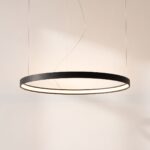
LED ring chandelier, 78 cm, 4 finishes
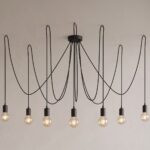
Pendant light, 7-bulb spider with black textile cables

Smart Connected LED Corner Floor Lamp
See also

How Much Electricity Does a Light Bulb Use? The Cost per Hour, per Year and per Fitting

Beamed Ceiling Lighting: Where to Fix the Light and What to Choose

Can You Put a 60 W Bulb in a 40 W Lamp? What the Limit Really Protects
