

Table of Contents
Good staircase lighting leaves no step in shadow, never dazzles you on the way down and can be switched on from every floor. In most Irish homes that means wall lights that follow the slope of the stairs, low step lights for the night and, over a tall stairwell, a pendant.
A step you cannot see is a step you can miss. In a typical semi-detached or terraced house, the hall, the stairs and the landing form one tall space lit from two floors, often by a single pendant on a long flex. Technical Guidance Document K, which shows how to meet Part K of the Building Regulations on stairways, sets the headroom and the shape of the steps but says nothing about lighting. The choices are yours, and this guide takes them in order, from the type of stairs to the switches.
Staircase lighting by type of stairs: straight, winder or spiral
The shape of the flight decides where the light has to land.
- Straight stairs. Wall lights follow the slope along one wall, with a point at the bottom and another at the top, so that the first and last steps are always lit. Between two walls, one side is enough.
- Winder or quarter-turn stairs. Tapered steps are narrow on the inside of the turn, and that is where a foot lands badly. TGD K itself warns that their varying width can make people misjudge distances and lead to falls, and it allows a going of just 75 mm at the narrow end. Add a light at the turn, aimed at the tapered treads.
- Spiral stairs. The light comes from above, along the central column. On its own it lights the way down better than the way up, when your own body shades the steps: our advice is to add a second point halfway up. TGD K accepts tight spiral stairs mainly in a loft conversion serving a room used infrequently, which is exactly where they tend to end up lit by one bare bulb.
| Stairs | Where to put the light | Beam direction | Watch out for |
|---|---|---|---|
| Straight | Along the wall, at the bottom and at the top | Down, or up and down | The first and last step |
| Winder or quarter turn | One extra point at the turn | Onto the tapered treads | The inside of the turn, where treads are narrowest |
| Spiral | Above the central column and on the stairwell wall | Down, from above | The way up |
Keep the same warm white, 2,700 to 3,000 K, on every point, so that the hall, the stairs and the landing read as one space.
Stair wall lights: height, spacing and beam direction
A wall light is the safest choice for a stairs: it lights the treads from close by, and you can change its bulb without scaffolding. Among our interior wall light designs, flat fittings and half-moons suit a stairs best.
- Height. TGD K asks for headroom of generally not less than 2 m over the whole width of the stairs, measured above the pitch line, the line joining the nosings. A wall light that projects from the wall sits over part of that width, so our advice is to mount it about 2 m above the nosing of the step opposite, measured from that step and not from the hall floor. Our guide to wall light height gives the heights for the other rooms.
- Spacing. Our rule of thumb: one wall light at the bottom, one at the top, then one about every 2 m along the slope.
- Beam direction. On the way down, your eyes pass level with the lower wall lights, and a bare bulb dazzles you just where you need to see the edge of the steps. Choose a closed diffuser, an up-and-down wall light, or adjustable spots turned towards the treads.

Watch the depth as well as the height. TGD K only asks for a clear width of 800 mm on private stairs, and on a flight that narrow a deep fitting at shoulder height is soon caught by a shoulder or a laundry basket. Keep deep models high, and choose a slim one if it has to sit lower.

Step lights and lighting the treads
Step lights do not replace the main lighting. They are a low, soft light that picks out the edge of each step at night.
- Recessed wall step lights. Our advice: about 30 cm above the tread, one on every step or every other step, with the light aimed down at the floor. Each needs its own box and cable, so plan them before the walls are plastered.
- LED strip lights in an aluminium profile with a diffuser, under the nosings or under the handrail: the most discreet form of LED stair lighting.
- Battery step lights with a motion sensor, with no wiring at all: useful in a rented home or on the night-time route to the bathroom, but a stopgap rather than a real light point. Our guide to battery operated wall lights covers the options.
Contrast matters as much as brightness. On a carpeted stairs, still very common in Irish homes, the nosing blends into the tread under a flat light from above. Light that grazes the steps from the side or from low down brings that edge back.
Stairwell pendant: drop and lowest point
In a tall stairwell, a staircase pendant light fills the void and is seen from the front door as well as from the landing. Hung high, it lights the lower steps poorly: it adds to the wall lights rather than replacing them.
The lowest point. The 2 m of headroom in TGD K applies under a pendant too: the bottom of the fitting stays at least 2 m above the pitch line of the steps below it. In a loft conversion, where TGD K accepts 1.9 m of headroom at the centre of the stairs, the margin is smaller still, and the pendant is better placed over the landing.

The drop. Start from the height of the stairwell. With a ceiling 5.2 m above the hall floor and a pendant over a step 1.4 m up, the lowest point cannot go below 3.4 m, which leaves 1.8 m at most for the flex and the fitting. An adjustable cable is set once the pendant is up: the one on our modern LED pendant light in smoked glass adjusts up to 230 cm, and its integrated LED means no bulb to change, a real advantage where reaching the fitting takes a ladder over the stairs.
How much light does a staircase need?
No rule sets a light level inside a home. For workplaces, the European standard I.S. EN 12464-1:2021 asks for at least 100 lux on stairs, measured at floor level, rising to 150 lux where conditions call for more: the same values it gives for corridors. We aim for that range at home too, closer to 150 lux on steep or winding stairs. Lux count the light landing on the steps, not what the bulb gives out, as our guide to lux vs lumens explains.
Our calculation: a straight flight 0.9 m wide and 3.5 m long covers about 3 m², so 150 lux means 450 lumens landing on the steps. Part of the light ends up on the walls and the ceiling, so install about double, 900 to 1,000 lumens, shared between two or three points. For the hall and the landing around the stairs, our guide to hallway lighting completes the picture.
Switching: 2-way, intermediate, sensor or timer
A stairs light you cannot switch on from the floor you are standing on gets left off, or left on all night. There are four options, often combined.
- 2-way switching: one switch at the foot of the stairs, one on the landing, each able to turn the same light on or off. It is the standard arrangement in Irish homes, and our guide to 2 way switch wiring shows how it works.
- Intermediate switching: for a third switching point, on a stairs serving three floors or in a hall with a front and a back door, an intermediate switch goes between the two two-way switches. Beyond that, push-buttons on each landing controlling a latching relay keep the wiring simpler.
- A motion sensor light: the light comes on before your first step, hands full or not. Place the sensors so that they see you before you reach the stairs, at the bottom and at the top, with zones that overlap on a stairs that turns.
- A timer switch: it switches the light off by itself after a set time, sometimes when you are halfway down. Set a generous delay, or choose a model that dims before it switches off.
What the Irish rules say. Fixed wiring follows the National Rules for Electrical Installations, I.S. 10101, and the current edition requires lighting circuits in homes to be protected by an RCD. Safe Electric classes a new circuit or a new fixed installation as Restricted Electrical Work, which only a Registered Electrical Contractor may carry out and certify, while a like-for-like replacement of a light fitting or a switch is minor work. Swapping the landing pendant for a new one on the same ceiling point is therefore minor work; running new cable for wall lights along the stairs, step lights or a second switch on the landing is a job for a Registered Electrical Contractor. Check the cap before buying bulbs, too: an old ceiling rose on the landing usually takes a B22 bayonet bulb, while many wall lights, like the two in the photos above, take an E27 or a GU10.
Staircase lighting: frequently asked questions
What’s the best lighting to use on a staircase?
Wall lights that follow the slope, about 2 m above the nosing in our advice, low step lights for the night and, in a tall stairwell, a pendant. No step should stay in shadow, especially the first, the last and those on the turn of a winder stairs.
What are some good lights to put on stairs?
Closed or up-and-down wall lights that do not dazzle you on the way down, adjustable spot wall lights turned towards the treads, recessed step lights about 30 cm above the tread and LED strips under the nosings. Battery step lights with a sensor help at night but remain a back-up.
How can I add lights to my staircase?
Without wiring, battery step lights with a motion sensor are the quickest route. Wired wall lights or step lights need new cable from the lighting circuit: in Ireland that is Restricted Electrical Work, carried out and certified by a Registered Electrical Contractor.
What are some good lighting options for a stairwell?
A pendant on a long, adjustable flex fills a tall stairwell, as long as its lowest point stays at least 2 m above the steps below it. Pair it with wall lights along the flight, because a pendant hung high lights the lower steps poorly.
Is LED lighting a good choice for stairwells?
Yes. LED copes with being switched on and off many times a day, works with motion sensors and timers, and lasts for years, which counts where changing a bulb means a ladder over the stairs. Choose warm white, 2,700 to 3,000 K, and a dimmer rated for LED if you want one.
How many lux do you need on stairs?
No rule applies inside a home. For workplaces, I.S. EN 12464-1:2021 asks for 100 lux on stairs at floor level, up to 150 lux where conditions call for more. On a straight flight of about 3 m², that means 300 to 450 lumens landing on the steps.
Sources
- Technical Guidance Document K, Stairways, Ladders, Ramps and Guards, Building Regulations 2014: Table 1, par. 1.1.6 (tapered steps), 1.1.9 (headroom), 1.1.10 (width of private stairs). Government of Ireland
- I.S. EN 12464-1:2021, Light and lighting, Lighting of work places, Part 1: Indoor work places, Table 9 (stairs: 100 lx, 150 lx modified, at floor level). NSAI
- I.S. 10101, National Rules for Electrical Installations, summary of key changes: RCDs required on lighting circuits in domestic premises. NSAI and Safe Electric
- Restricted and Controlled Electrical Works, and minor works, guidance for householders. Safe Electric
Related products
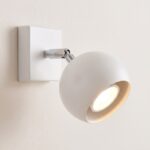
Round adjustable wall light in white or black steel
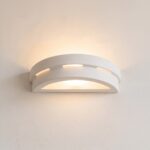
White half-moon ceramic wall light, indirect lighting
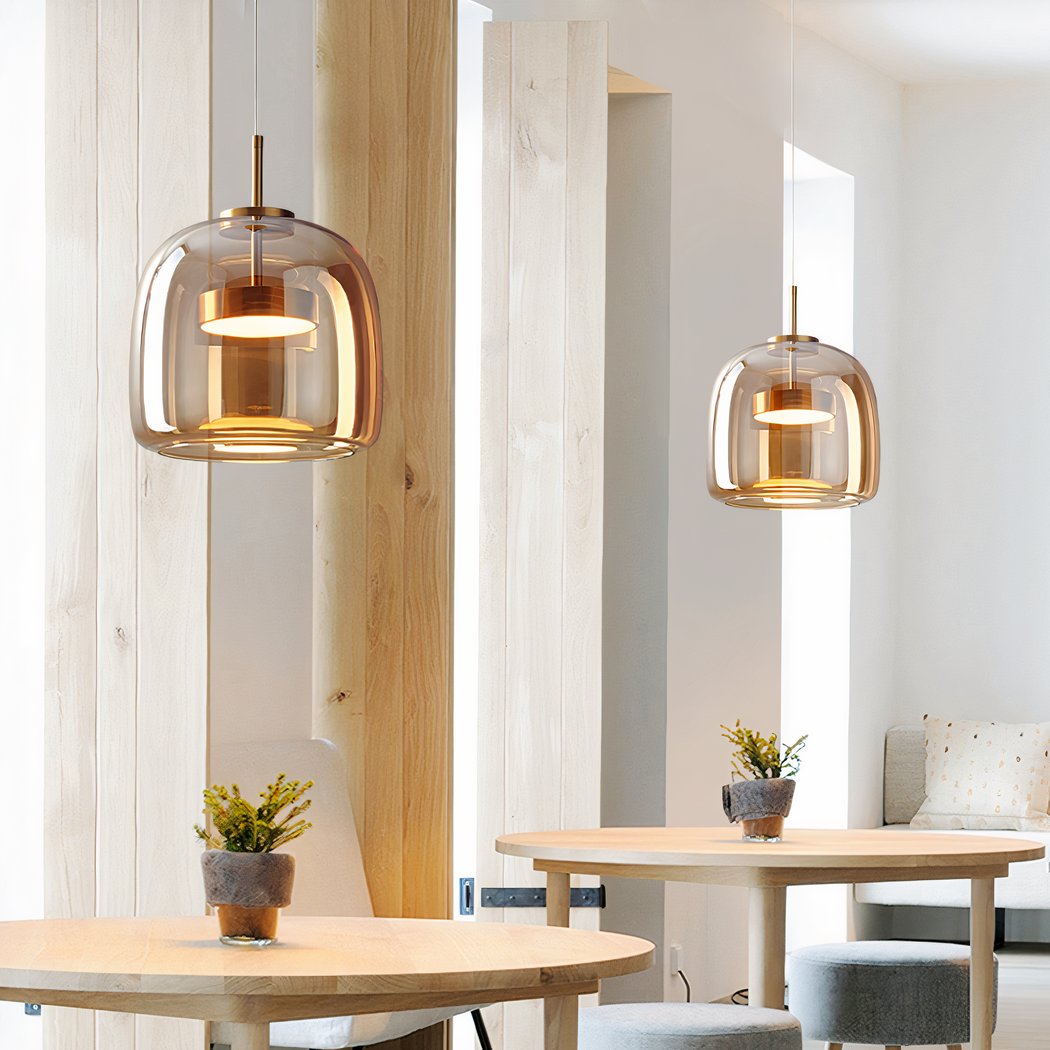
Modern design LED pendant light in smoked glass
See also

Flickering Lights: Causes, Warning Signs and How to Fix Them

Bookcase Lighting: How to Light Your Books, Shelves and Reading Nook

How Many Lumens Do I Need? Lumens per m² for Every Room
