

Table of Contents
For a downstairs toilet, one compact ceiling light or a wall light is usually enough: aim for 400 to 600 lumens of warm white light, between 2,700 and 3,000 K, from opal glass or a diffuser that does not dazzle. In a windowless toilet, add a presence sensor and a low night light, and let the fitting itself bring the character.
The downstairs toilet is often the smallest room in the house, squeezed under the stairs or at the end of the hall, and often the only one without a window. Guests use it, children use it at night, and nobody spends long in it. Its lighting has to come on quickly, show the room clearly without glare and give a metre or two of floor some personality. This guide covers the choice between ceiling light, wall light and pendant, where to put the light for each shape of room, how many lumens and what colour of light, what to do in a windowless toilet, our ideas for lighting with character, and what changes when the toilet shares the room with a shower or a bath.
Ceiling light, wall light or pendant: what works in a downstairs toilet
Four families of fittings share the small toilet. The right one depends on the ceiling height, the shape of the room and where the existing light point is.
| Fitting | Strengths | Limits | Best for |
|---|---|---|---|
| Ceiling light | Spreads light over the whole room, fits the existing ceiling point | On its own and too bright, the light looks flat | Every toilet, especially narrow ones |
| Wall light | Soft light bounced off the wall, decorative even when off | Needs a wiring point on the wall | Long toilets, toilets with a hand basin |
| Pendant | Instant character, draws the eye upwards | Takes headroom under a low ceiling | High ceilings, period houses |
| Downlights | Clean, discreet light | Need a ceiling void to be recessed | Sloping ceiling under the stairs, false ceiling |
The ceiling light remains the simplest answer: it goes on the existing point and lights all four walls at once. In a narrow toilet, choose a compact model with opal glass or a diffuser, so you never see the bare bulb when you look up. Our designer ceiling light range includes small fittings made for exactly this kind of room. A surface-mounted cylinder sends its light downwards like a spotlight, without any need for a ceiling void, which suits the sloping ceiling of a toilet under the stairs.

Check the cap before you buy bulbs. In many Irish homes the ceiling point is a rose with a pendant set that takes a B22 bulb, the bayonet cap. Many fittings designed for the European market take another one: the three shown in this guide use G9 or GU10 bulbs, so the old B22 bulb will not go back in.
A wall light gives a gentler light, reflected by the wall. It fits above the hand basin, opposite the door or above the cistern. Our starting point for wall light height is about 1.70 m from the floor to the centre of the fitting. In a narrow room, choose a shallow model and place it a little higher, so you do not catch it with your shoulder as you turn round.
The pendant, finally, turns the toilet into a small room with real character, especially under the high ceiling of an older house. Our advice is to keep at least 2.15 m between the bottom of the fitting and the floor, so nobody hits their head. Under a ceiling of around 2.4 m, choose a short drop, or a ceiling light.
Where to put the light in a small toilet
In a small room, the position of the light matters as much as its brightness. Our rule: the light should fall on the free space in front of the toilet, not behind you. A light fixed just above the door lights the back of the neck of whoever is sitting down and throws their shadow in front of them.
- Narrow toilet, about 1 m²: one ceiling light in the middle of the ceiling is enough. This is the most common case.
- Long toilet, more than 1.5 m deep: put the ceiling light halfway between the door and the toilet, or add a wall light on the back wall.
- Toilet with a hand basin: keep the ceiling light for general lighting and add a wall light above the basin or the mirror, to light hands and face from the front.
- Toilet under the stairs: the ceiling slopes, so fix the light at the high end, over the space in front of the toilet, where nobody can knock into it.

How many lumens and what colour of light for a downstairs toilet?
Think in lumens, the amount of light a bulb gives out, not in watts: our lumens to watts chart gives the match for every type of bulb. There is no legal minimum for the toilet in a home. The workplace standard gives a useful benchmark all the same: I.S. EN 12464-1, the European standard for lighting indoor workplaces, published in Ireland by NSAI, asks for 200 lux in cloakrooms, washrooms, bathrooms and toilets. One lux is one lumen per square metre (see our guide to lux vs lumens), so 200 lux over 1.5 m² means 300 lumens reaching the floor.
Part of the light is lost on the walls and the ceiling, or stays inside the fitting. Our rule of thumb is therefore: lumens to fit = floor area × lux × 2.
| Floor area | Lumens reaching the floor at 200 lux | Our rule: lumens to fit |
|---|---|---|
| 1 m² | 200 lm | 400 lm |
| 1.5 m² | 300 lm | 600 lm |
| 2 m² | 400 lm | 800 lm |
| 2.5 m², with a hand basin | 500 lm | 1,000 lm, over two lights |
Go up a step if your walls are dark: a deep paint colour absorbs much of the light that a white wall would send back. Many fittings are sold without a bulb, with their cap and maximum wattage, such as “G9, 8 W LED maximum”: it is the bulb that sets the lumens, so read them on its box.
For the colour, stay with a warm white, between 2,700 and 3,000 K. In a room you also visit in the middle of the night, a cool white of 4,000 K or more dazzles and wakes you up. Above a hand basin with a mirror, look at the colour rendering index as well: the workplace standard asks for at least Ra 80 in toilets and washrooms, a good minimum for seeing your face in its true colours.
Lighting a windowless toilet: presence sensor, extractor fan and night light
In a toilet with no window, often under the stairs, electric light is the only light, and the one most often left on. A sensor solves both problems: the light comes on when you walk in and goes off after you leave. It still has to be the right kind. Sitting down, you hardly move, and a motion sensor light can switch off halfway through. A presence detector, which picks up the small movements of someone sitting still, is the better choice.
- Time delay: our advice is to set it to at least 5 minutes, so you are never left in the dark.
- Daylight threshold: without a window it has no use. Set it so the sensor switches on whatever the light level.
- Where it goes: electrical manufacturers such as Hager and Legrand make sensor switches that take the place of the wall switch. Have a Registered Electrical Contractor check that it suits your wiring and your LED bulbs.
The extractor fan is the other half of the job. Technical Guidance Document F, the ventilation guidance under the Building Regulations, asks for an extract fan of 6 litres per second in a toilet without a bath or shower, used intermittently, with an opening window accepted instead. Where the room has neither an opening window nor a background vent, the fan should keep running for 15 minutes after it is switched off, with a manual override. That guidance applies to new homes and building work, but it is a sound benchmark for an existing toilet too. In many homes the fan comes on with the light: if you add a sensor, ask your electrician to keep the fan’s overrun working when the light goes off.
Then there is the night. Switching on 600 lumens at three in the morning dazzles. Sleep researchers who published consensus recommendations in 2022 advise keeping the light that acts on the body clock to 10 lux at most during the three hours before bed, and to the same 10 lux if you need light for a task during the night. The answer is a second, low and warm light: a battery night light with a sensor, an LED strip under the basin or behind a low unit (our guide to LED strip lights covers the choice), or a dimmer on the main light with compatible bulbs. In a room without daylight, pale walls and a mirror also send more light back into the room.
Downstairs toilet lighting ideas
The downstairs toilet is the place to be bold. The room is small, nobody stays long, and a colour or a shape you would never risk in the living room becomes a playful touch. A few ideas that work:
- A coloured wall light on a plain wall: an opal globe on a coloured base is enough to give the room an identity, even when it is off.
- Wood and opal glass, for a Japandi look: our Japandi ceiling light in light wood and opal glass, 12 cm across and 19 cm high, fits the smallest toilet and gives a soft, diffused light.
- A dark wall and a directed light: a deep green, a terracotta or a navy gives depth, as long as you add lumens to make up for it.
- A fluted tube on the ceiling: the grooved aluminium cylinder shown above adds a graphic line to a plain ceiling and aims its light straight down.
- A pendant above the hand basin, if the height allows: it lights your hands and becomes the focal point of the room.
- A wall light on wallpaper: light grazing the wall brings out the pattern or the texture.

Toilet in the bathroom: zones, IP ratings and who does the work
In Ireland, electrical installations follow the National Rules for Electrical Installations, I.S. 10101, published by NSAI. Their Part 7 covers special locations, and the one that concerns us is the room containing a bath or a shower. A separate downstairs toilet with only a toilet and a hand basin is not in that category: an ordinary indoor fitting, rated IP20, is allowed there. Steam and splashes from the basin are real all the same, and we suggest a fitting rated at least IP44 above it.
Everything changes when the toilet shares the room with a shower or a bath, in an en suite or a family bathroom. The space around the bath and the shower is divided into zones: zone 0 is inside the bath or the shower tray, zone 1 is the space directly above it up to a set height, and zone 2 is a band around zone 1. The closer a zone is to the water, the higher the IP rating and the stricter the type of fitting allowed. The exact dimensions are applied by the electrician on site, measured from your own bath and shower. I.S. 10101 also requires every lighting circuit in a home to be protected by an RCD of no more than 30 mA. Our guide to bathroom lighting goes through each zone, and our article on IP ratings explains how to read the code. For the fittings themselves, our bathroom wall lights give the IP rating of each model.
Then comes the question of who does the work. Safe Electric describes the like-for-like replacement of a light fitting on the same point as minor electrical works, which must still comply with I.S. 10101. A new light point on the wall, a new circuit or any work in a room with a bath or a shower is Restricted Electrical Works under S.I. No. 264 of 2013: only a Registered Electrical Contractor may carry it out, and they must give you a Completion Certificate. Whoever does it, switch off the lighting circuit at the fuse board and prove it dead before touching any wire.
Frequently asked questions about downstairs toilet lighting
What is the best type of lighting for a downstairs toilet?
A compact ceiling light with opal glass or a diffuser, fitted on the existing ceiling point, suits almost every downstairs toilet. In a long toilet or above a hand basin, add a wall light at about 1.70 m. Keep a pendant for high ceilings, with at least 2.15 m clear below it.
How many lumens do I need for a downstairs toilet?
Our rule of thumb is floor area × 200 lux × 2: about 400 lumens for 1 m², 600 lumens for 1.5 m² and 800 lumens for 2 m². Add more if the walls are dark. The 200 lux figure is the workplace benchmark of I.S. EN 12464-1; there is no minimum for homes.
What colour light is best for a toilet?
A warm white between 2,700 and 3,000 K. Avoid cool white of 4,000 K or more in a room you use at night, as it dazzles and wakes you up. At a mirror, choose a bulb with a colour rendering index of Ra 80 or higher.
How do you light a toilet with no window?
Use a presence detector rather than a motion sensor, with a delay of at least 5 minutes, and add a low, warm night light. Pale walls and a mirror bounce the light around. Ventilation guidance also asks for an extract fan that runs on for 15 minutes after switch-off.
Do I need an IP rated light in a downstairs toilet?
Not in a separate toilet with only a hand basin: it is not a special location under I.S. 10101, and an IP20 indoor fitting is allowed. We still suggest IP44 above the basin. If the room has a shower or a bath, the zones apply and a Registered Electrical Contractor must do the work.
Can I change the light in my downstairs toilet myself?
Replacing a light fitting like for like on the same point counts as minor electrical works for Safe Electric, and it must still comply with I.S. 10101. A new light point, a new circuit or any work in a room with a bath or shower is a job for a Registered Electrical Contractor.
Sources
- Restricted and Controlled Electrical Works, and Completion Certificates, guidance for customers (S.I. No. 264 of 2013, minor works, Registered Electrical Contractors). Safe Electric
- I.S. 10101 Summary of Key Changes: Chapter 7, special installations or locations, following the CENELEC HD 60364 series, and RCD protection of lighting circuits. Safe Electric
- Technical Guidance Document F, Ventilation, Building Regulations 2019, Table 1 (6 l/s intermittent extract or an opening window for sanitary accommodation without a bath or shower) and paragraph 1.2.4.3 (15 minute overrun). Department of Housing, Local Government and Heritage
- I.S. EN 12464-1, Light and lighting, Lighting of work places, Part 1: Indoor work places (200 lx maintained illuminance and Ra 80 for cloakrooms, washrooms, bathrooms and toilets). NSAI
- Brown T. M. et al., Recommendations for daytime, evening, and nighttime indoor light exposure to best support physiology, sleep, and wakefulness in healthy adults, PLOS Biology, 2022. doi.org
Related products
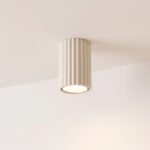
Beige grooved aluminium tubular ceiling light
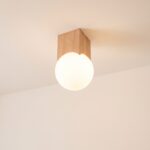
Japandi ceiling light in light wood and opal glass

Colourful designer aluminium wall light
See also

Flickering Lights: Causes, Warning Signs and How to Fix Them

Bookcase Lighting: How to Light Your Books, Shelves and Reading Nook

How Many Lumens Do I Need? Lumens per m² for Every Room
