
Table of Contents
Picture lights work best when their light reaches the painting at about 30° from the vertical of the wall: the glare falls towards the floor and the frame casts almost no shadow. Under a standard 2.40 m ceiling, a spotlight therefore sits about 46 cm out from the wall. Choose a warm white LED with a CRI of 90 or more.
A badly lit picture loses half its impact: a white streak of glare across the glass, the top of the canvas in the shadow of the frame, colours turned yellow. This guide covers the three ways to light artwork at home, the 30° rule with the right distance for your ceiling height, then the settings that protect the work: CRI, colour temperature, UV and light levels.
Picture light, spotlight or track: three ways to light a picture
Three families of fittings share the job, and they combine well: a gallery wall often pairs a spotlight bar with a picture light over the main piece.
| Picture light | Adjustable spotlight | Track or spotlight bar | |
|---|---|---|---|
| Where it goes | On the wall just above the frame, or on the frame itself | On the ceiling, or on the wall above the picture | On the ceiling, parallel to the wall |
| Best for | A single painting, a classic room | One specific picture, a photograph behind glass | A gallery wall, several pieces you move around |
| Drawbacks | Brighter at the top of the canvas, strong reflections on glass | Needs a light point in the right place | More work to install, and a more visible bar |
The picture light
This is the traditional lamp for a painting: a horizontal bar on one or two arms, shining down over the canvas. Our advice: choose a bar that covers roughly half to three quarters of the frame width, on an arm long enough for the light to reach the bottom. Sitting so close, the light arrives at a grazing angle: it brings out the brushstrokes of an oil painting, but leaves a large canvas brighter at the top than at the bottom.
The adjustable spotlight
Spotlights are what galleries use: fixed at a distance and aimed at the work, they light the whole surface more evenly. On the ceiling, spotlight ceiling lights connect to the existing light point if it is in the right place. On the wall, an adjustable spot fixed above the picture suits a medium format: our white adjustable spot wall light with ribbed texture has a swivelling head of 10 by 6.5 cm and takes a GU10 LED bulb.
Track or spotlight bar
A track carries several spotlights that you slide along and aim one by one, the tool for gallery walls and changing collections. A two-spot bar on the ceiling is the simple version, for one large painting or two frames side by side. In a suspended ceiling, adjustable downlights do the same work while staying out of sight.
What about wireless picture lights?
Battery picture lights, recharged by USB, avoid a cable down the wall: handy on a wall with no light point or in a rented home, at the cost of regular recharging and a weaker light. Our guide to battery operated wall lights compares them with plug-in fittings.
The 30° rule: how far from the wall to avoid glare and shadows
Our advice follows the rule of thumb used by museum lighting designers: light the centre of the picture at about 30° from the vertical of the wall. At that angle, the reflection on glass or varnish bounces towards the floor, below eye level, and the frame throws hardly any shadow onto the canvas.
Mounted too close to the wall, the spotlight grazes the canvas: the top is overexposed and the frame casts a shadow. Mounted too far out, it sends the glare back at eye level, and anyone walking past shades the work.
The distance between spotlight and wall therefore depends on the height between the ceiling and the centre of the picture. Our advice: hang the centre of the picture at around 1.50 to 1.60 m from the floor, at eye level. The distance is then that height multiplied by 0.58 (the tangent of 30°). With the centre of the picture at 1.60 m, the spotlight sits 46 cm from the wall under a 2.40 m ceiling, 64 cm under 2.70 m, 81 cm under 3.00 m and 1.10 m under the 3.50 m ceilings of some period houses.

For a deep or heavy frame, our advice is to move the spotlight a little further out, towards 35°, or the moulding shades the top of the canvas. For a photograph or a print behind glass, stay at 30° or slightly under, because glare is the main problem there; anti-reflective glass solves it at the source.
Which light suits the size of your picture
It depends mostly on the width of the work:
- Small format, up to 50 cm wide: one ceiling spotlight, or an adjustable spot on the wall above the frame, with a narrow beam.
- Medium format, 50 cm to 1 m: a spotlight with a wider beam, or a picture light covering half to three quarters of the width.
- Large format, over 1 m: two crossed spotlights, each aimed at the opposite half of the canvas. A two-spot bar does it from a single light point.
With spotlights, the beam angle matters as much as the fitting. Most of our spotlights take a GU10 LED bulb, so the bulb sets the beam, the colour and the CRI. Our advice: around 24° for a small frame lit from a distance, 36° for a medium canvas, 60° or more to wash a gallery wall. In Ireland, most ceiling pendants still take a B22 bayonet bulb, which cannot be aimed: our guide to the B22 bulb shows how to tell it from a GU10.

CRI, colour temperature and UV: protecting the colours of the work
Once the fitting is in place, the bulb decides how the picture looks. Three figures on the packaging of any decent LED bulb matter more for a painting than for anything else in the house.
CRI: how true the colours look
The colour rendering index measures, on a scale up to 100, how faithfully a light shows colours compared with a reference source; incandescent bulbs score close to 100. Since 2021, EU ecodesign rules have required most LED bulbs sold in Ireland to reach at least 80. Our advice for a picture: a CRI of 90 or more. Below that, reds and skin tones look dull.
Colour temperature
Measured in kelvins, it describes the tint of white light: 2,700 K warm, 4,000 K neutral, 6,500 K cool, while daylight ranges from about 4,000 to 7,500 K. Our advice: 2,700 to 3,000 K for an oil painting in warm tones or an evening mood; 3,000 to 4,000 K for a black and white photograph, a graphic print or a canvas full of blues and greens, which a very warm white turns yellow. Keep the same white as the rest of the room.
UV, heat and the amount of light
Light damages artwork: it fades pigments and yellows paper, and the damage grows with the dose received, meaning the light level multiplied by the hours of exposure. Ultraviolet is the most harmful part. LED lamps give off virtually no UV and little heat, whereas an incandescent bulb turns well over nine tenths of its energy into heat: the main reason to swap an old halogen spotlight above a canvas for an LED.
For original works, the International Commission on Illumination sets limits for light level and annual exposure in its publication CIE 157, according to how sensitive the materials are:
| Type of work | Maximum light level | Annual exposure |
|---|---|---|
| Oil painting, acrylic, tempera | 200 lux | 600,000 lux hours |
| Watercolour, pastel, drawing, print on paper | 50 lux | 150,000 lux hours |
| Silk, very fragile dyes, old photographs | 50 lux | 15,000 lux hours |
At home, these figures are a guide rather than a rule: a poster can be replaced, a family watercolour cannot. For fragile works, our advice is to switch the accent lighting on only in the evening, keep them out of direct sun, and fit a dimmer switch with dimmable bulbs to control the level.
Lighting a gallery wall or a large wall
A gallery wall is lit as one surface, not frame by frame, so that no frame looks more important than the others.
- A line of spotlights on the ceiling, parallel to the wall at the 30° distance worked out for the centre of the arrangement, evenly spaced and all tilted to the same angle.
- Wide beams, of 60° or more, that overlap on the wall: the light then forms a continuous wash instead of bright circles.
- A strip of light in a cornice or under a picture ledge. Our guide to LED strip lights explains how to choose their colour and CRI.
- The same white for every spotlight, with identical bulbs, or the wall looks patchy.

For one large painting over a sofa or a sideboard, two crossed spotlights placed either side of the centre line are enough. Above a teak sideboard, framed posters and prints are also part of the mid century modern look. On its own switch, the accent lighting can stay on alone in the evening, next to a single lamp.
Fitting picture lights in Ireland, and mistakes to avoid
A ceiling spotlight or a wall light connects to an existing light point. Switch off the circuit at the fuse board first. In Ireland, electrical work must comply with I.S. 10101, the National Rules for Electrical Installations. Replacing a fitting like for like counts as minor work, but running a new cable to put a light point where you want it extends the circuit: that is a job for a Registered Electrical Contractor, who certifies the work. See our guide on how to install a ceiling light. The mistakes we see most often:
- The spotlight right against the wall, which only makes a bright patch at the top of the picture.
- The old halogen spotlight, which runs hot and gives off UV: replace it with a GU10 LED of the same cap.
- Cool white light and a low CRI, which make colours look flat.
- A picture facing a window: the window reflects in the glass by day, and direct sun fades the work.
Frequently asked questions about picture lights
Are picture lights a good idea?
Yes, if the light is well placed and the bulb is right. A picture light or an adjustable spotlight makes a painting the focal point of the room in the evening. Choose an LED, which gives off virtually no UV and little heat, with a CRI of 90 or more so the colours stay true.
What is the rule of thumb for picture lights?
Aim the light at the centre of the picture at about 30° from the vertical of the wall: the glare falls towards the floor and the frame casts almost no shadow. The spotlight then sits 0.58 times the height between the ceiling and the centre of the picture from the wall, about 46 cm under a 2.40 m ceiling.
What are the best picture lights?
For most homes, an adjustable ceiling spotlight with a GU10 LED: it lights the canvas evenly, and the bulb sets the beam, the colour and the CRI. A traditional picture light suits a single painting, a spotlight bar a gallery wall.
What is the best way to light a painting?
From a distance and at an angle: a spotlight aimed at 30° from the vertical, with a warm white LED of 2,700 to 3,000 K, or up to 4,000 K for blues, greens and black and white photographs. Give the painting more light than the wall around it.
How do you light a picture without wiring?
With a wireless picture light: a battery lamp, recharged by USB, fixed above the frame, with no cable or building work. The trade-off is regular recharging and a weaker light than a wired fitting. If there is a socket nearby, a plug-in wall light is a stronger alternative.
What colour light is best for artwork?
Warm white of 2,700 to 3,000 K suits oil paintings in warm tones. Neutral white of 3,000 to 4,000 K suits black and white photographs, graphic prints and canvases full of blues and greens. Whatever the colour, look for a CRI of 90 or more, and match the white of the rest of the room.
Sources
- CIE 157:2004, Control of damage to museum objects by optical radiation (limits on light level and annual exposure by material sensitivity). International Commission on Illumination
- Commission Regulation (EU) 2019/2020, ecodesign requirements for light sources (minimum colour rendering index of 80 for most light sources). European Commission
- I.S. 10101, National Rules for Electrical Installations. NSAI
- Minor works and controlled works, guidance for householders (Registered Electrical Contractors and certification). Safe Electric
- Color rendering index and Color temperature, encyclopaedia articles (scale up to 100, warm, neutral and cool white, daylight). Wikipedia
Related products

Grooved aluminium ceiling light, 2 spots, 6 colours
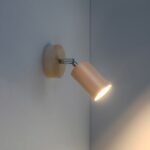
Natural wood adjustable spot wall light
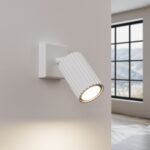
White adjustable spotlight wall light with ribbed texture
See also

Flickering Lights: Causes, Warning Signs and How to Fix Them

Bookcase Lighting: How to Light Your Books, Shelves and Reading Nook

How Many Lumens Do I Need? Lumens per m² for Every Room
