

Table of Contents
Mid century modern is the design style of the mid twentieth century, roughly 1945 to 1970. Born of the Bauhaus and developed in the United States, Scandinavia and Europe, it combines clean lines without ornament, teak and walnut, tapered legs, organic shapes, warm colours and lighting that became iconic, from the opal globe to the multi-arm pendant.
Also written mid-century modern, or MCM, it has hardly aged in seventy years. Here are its history, its codes, its colours and, above all, its lighting.
What is mid century modern?
Mid century modern is a style of architecture, furniture and industrial design defined by clean, simple lines and a lack of embellishment, at its peak between about 1945 and 1970. The phrase was in use by the 1950s, but a 1984 book by the American writer Cara Greenberg, Mid-Century Modern: Furniture of the 1950s, made it the name of the whole movement.
From the Bauhaus to California
The roots are European. The Bauhaus, founded by Walter Gropius in Weimar in 1919 to unite art and industry, closed in 1933 under pressure from the Nazi regime. Several of its masters left for the United States, among them Gropius, Marcel Breuer, Ludwig Mies van der Rohe and László Moholy-Nagy, and their simple, honest forms shaped a generation of American designers.
After the war, the Case Study Houses programme, launched in Los Angeles in January 1945, set the scene: open plans, big glass walls, flat roofs. Charles and Ray Eames moulded plywood into chairs, then fibreglass shells from 1948. From 1947, George Nelson designed lamps made of a metal frame covered in a stretched membrane, among the first lights of the style.
Denmark, France and Ireland
In Denmark, Hans Wegner, Finn Juhl and Arne Jacobsen made teak the signature of Danish furniture, while Poul Henningsen worked on a light that never dazzles, its bulb hidden behind layered shades. In France, Serge Mouille designed black-painted metal lights with articulated arms between 1953 and 1962.
Ireland has its own landmark. Busáras, Dublin’s central bus station by Michael Scott, opened in 1953; American and British journals hailed it as Europe’s first postwar office building, and it mixes Irish oak, brass and mosaics by Patrick Scott. In 1963, the Irish Export Board set up the Kilkenny Design Workshops, after Scandinavian designers had audited Irish design in what became known as the Scandinavian Report.

The key elements of mid century modern style
Tapered legs, slim and angled outwards, lift sideboards, tables and chairs off the floor. Teak and walnut, often veneered, keep an oiled finish that shows the grain. Organic shapes soften clean lines: moulded shells, oval tables, curved backs. New materials, moulded plywood, fibreglass, tubular metal and glass, are shown without decoration. Furniture stays low and practical, and the home opens to the outside with big windows and large-leaved plants.
Danish furniture is part of mid century modern, and today’s Japandi style owes it a lot: oiled wood, low lines, warm light. The retro look of the 1970s pushes colour, curves and plastic much further.
Mid century modern colours
Four warm bases cover most of your room: cream, #F1E8D6, on walls and ceiling; teak, #9A5B34, for the sideboard, table or floor; walnut, #5C4033, for an armchair or frames; and brass, #B5985A, for lights and handles. Then come the accents: mustard, #C9982E, on an armchair or cushions; olive green, #6F6F36, on a velvet sofa; burnt orange, #C1602B, on a vase or throw; and teal, #1F5F6B, on a feature wall.

Our advice: two accents per room are enough. At night, a green, amber or yellow glass globe tints the wall with its glow, without repainting.
Mid century lighting: the iconic shapes
More than the furniture, the lights sign a mid century interior: objects to look at, switched off as much as on.
The opal globe
A sphere of milky white opal glass hides the bulb and spreads a soft light in every direction. It is the most common shape of the style, and the easiest for you to use today. Our globe pendant light in gold steel and glass follows this design: a white globe 20, 30 or 40 cm across with a gold cap, for an E27 LED bulb. Clear, smoked and coloured versions are in our globe pendant light collection.
The multi-arm pendant
On 4 October 1957, the launch of Sputnik 1 opened the Space Age, and designers followed with metal arms radiating from a core, each carrying a bulb or a globe: Sputnik lights. Three to five curved arms with opal globes suit an ordinary ceiling. Our modern globe pendant light in metal and glass gathers three opal globes on a black metal frame 65 cm across; see also our multi-light pendant range.

Mushroom lamps, layered shades and brass wall lights
A mushroom lamp, a rounded cap on a stem, throws a warm pool of light onto your sideboard. How bright that pool looks depends more on distance than on lumens, as our guide to lux vs lumens shows. Layered shades and stretched membranes both hide the bulb completely, and arm wall lights in brass or black metal bring the light to your armchair or bed.
| Light | Shape | Materials | Where |
|---|---|---|---|
| Opal globe | Milky white sphere | Opal glass, brass | Over a table, hall |
| Multi-arm pendant | Radiating arms | Brass, black metal, glass | Living or dining room |
| Mushroom lamp | Rounded cap on a stem | Glass, lacquered metal | Sideboard, bedside |
| Layered shades | Slats that hide the bulb | Metal, glass | Over the table |
| Stretched membrane | Round or oval volume | Metal frame, membrane | Living room, bedroom |
| Arm wall light | Fixed or articulated arm | Brass, black metal | By an armchair or bed |
To mix period shapes with newer designs, browse our vintage pendant light collection.
How to light a mid century modern interior
These interiors were designed under warm incandescent bulbs. Three rules bring that light back with LEDs.
Warm light around 2,700 K
Choose warm white bulbs around 2,700 K, the shade of old incandescent bulbs: teak glows, brass shines, mustard stays warm. Under cool white, from 4,000 K, the same colours turn dull and wood looks grey. Keep one colour temperature across the room.
A hidden bulb, no glare
You see the lamp, not the bulb. Under clear or coloured glass, choose an opal bulb or an amber filament LED. Then check the cap: many Irish ceiling roses end in a B22 bayonet holder, while our globe pendant takes an E27 and our three-globe fittings take G9 capsules, as our B22 bulb guide explains.
Pools of light rather than one ceiling light
Light your room by zones: a pendant over the table, a lamp on the sideboard, a wall light by the armchair. The shadows between them give depth. Our guide to dining room lights gives the pendant heights, and a dimmer takes you into the evening, as in any home built on cosy lighting.
Getting the look without living in a museum
All teak and all vintage turns a home into a film set: choose one strong piece per room and mix it with today’s furniture. In the living room, a sideboard on tapered legs and a multi-arm pendant are enough; our living room pendant light guide helps with size and height. In the dining room, hang one opal globe over a small table, two or three in a row over a long one. In the bedroom, fit two brass arm wall lights either side of a low wooden bed. If you change only one thing, change the light.
Have a vintage lamp checked before you plug it in, as old cables often need rewiring. A new light point is a job for a Registered Electrical Contractor, working to I.S. 10101.
Mid century modern: frequently asked questions
What is the mid-century modern style?
A design style from about 1945 to 1970, heir to the Bauhaus: clean lines without ornament, teak and walnut, tapered legs, organic shapes, warm accents and lights such as the opal globe.
What are the 5 key elements of mid century modern decor?
Tapered legs, warm woods such as teak and walnut, organic shapes, new materials shown honestly, and statement lighting, above all the opal globe and the multi-arm pendant.
Are the 70s considered mid century?
Not strictly: the period runs from about 1945 to 1970. The 1970s have their own retro look, with more colour and plastic, although the mushroom lamp bridges the two.
What colours are mid century modern?
A cream base, the browns of teak and walnut and a touch of brass, then one or two accents: mustard, olive green, burnt orange or teal.
Is mid century modern still popular?
Its shapes are still widely made and mix easily with contemporary furniture. Our advice: a few strong pieces, such as a sideboard and a globe light, date less than a full period room.
What bulb should I use in a mid century globe pendant?
A warm white LED around 2,700 K. Under clear or coloured glass, choose an opal bulb or an amber filament LED. Respect the cap and maximum wattage: an E27 LED of 15 W at most for our gold steel and glass globe pendant.
Sources
- Mid-century modern, encyclopaedia article (definition, 1945 to 1970, Cara Greenberg’s book of 1984). Wikipedia
- Bauhaus, encyclopaedia article (founded in Weimar in 1919, closed in 1933, its masters’ emigration to the United States). Wikipedia
- Case Study Houses, Charles and Ray Eames, George Nelson, Poul Henningsen and Serge Mouille, encyclopaedia articles. Wikipedia
- Busáras and Kilkenny Design Workshops, encyclopaedia articles (opening in 1953, founding in 1963, the Scandinavian Report). Wikipedia
- Space Age and Colour temperature, encyclopaedia articles (Sputnik 1 on 4 October 1957, shades of white light). Wikipedia
- Home Safety: always use a Registered Electrical Contractor for electrical works. Safe Electric
Related products
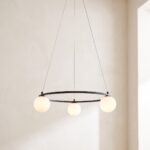
Modern globe pendant light in metal and glass, black ring
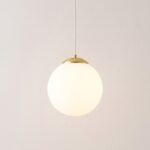
Modern globe pendant light, gold steel and glass

Timeless modern ceiling light with glass globes
See also

Flickering Lights: Causes, Warning Signs and How to Fix Them

Bookcase Lighting: How to Light Your Books, Shelves and Reading Nook

How Many Lumens Do I Need? Lumens per m² for Every Room
