

Table of Contents
The best reading lights for bed are wall-mounted reading lights or bedside lamps with an adjustable head, fitted with a warm white bulb around 2,700 K and placed a little above and behind your shoulder. The beam lights the page rather than the room, so you read without glare, without a shadow on the book and without waking the person beside you.
Reading in bed is one of life’s small pleasures, as long as the light is right. A badly chosen lamp shows itself straight away: a light so white it keeps you awake, a beam so wide it bothers your partner, a lamp so low that your own hand throws a shadow across the page. This guide helps you choose reading lights for bed according to your bedroom, the way you read and the person who shares your nights. It covers the four main types of lamp, the colour and amount of light that are kindest to your eyes, where to put the lamp, and how to wire or plug it in an Irish home. If you already know you want a wall-mounted light, our reading lights for bed are all designed for exactly this job.
Which reading light for bed should you choose?
Four families of lamp share the bedside table and the headboard. They do not light the page in the same way, and that should guide your choice long before the style.
The adjustable wall-mounted reading light
Fixed to the wall above the headboard, a wall reading light leaves the bedside table completely free. Its adjustable head or flexible arm puts the light exactly on the page, and most models take a bulb with a concentrated beam, such as a GU10 spot or a small G9 capsule. It is the most precise option when two people read in the same bed: each of you points your own lamp at your own book.
A long arm makes a real difference if you read propped up against the pillows. The reading light in our photo, a reading wall light with an adjustable head in black steel, reaches up to 52 cm from the wall on its flexible arm, so the light arrives above the book rather than from behind your head. Our headboard lights follow the same logic with more decorative lines.
The one thing to plan for is the power supply, which we come back to below: a wall light needs a supply point in the wall, or a model with a cable and a plug.
The bedside lamp with a shade
This is the most common lamp of all, and the most pleasant for the mood of the room in the evening. A fabric shade spreads a soft light around the whole bedroom, and that is also its weakness for reading: the light goes in every direction, lights up your partner’s face and reaches the page more weakly. For reading, choose a model with a flexible arm or a tilting head, or an opaque shade that is open at the bottom. Make sure you cannot see the bulb from your reading position either: if you can see it, it will dazzle you.
The clip-on LED book light
A clip-on light fixes to the headboard, a shelf or the book itself. Its light is very localised, which makes it the best friend of small bedrooms and of readers who absolutely do not want to disturb the other side of the bed. Its small size limits the amount of light, though, and many cheap models give out a cold white light: check the colour temperature on the packaging before you buy.
The rechargeable reading light
Cordless and light, it sits on the table, clips on or hangs around your neck, depending on the model. It is handy when travelling, in a spare room or when there is no socket within reach. Battery life and brightness vary enormously from one model to the next: it is a back-up light, rarely the long-term answer for a bedroom.
| Type of lamp | Where it goes | Light | Disturbance to your partner | Best if |
|---|---|---|---|---|
| Adjustable wall reading light | On the wall, above the bed | Beam aimed at the page | Low | You read often, and two of you read |
| Bedside lamp with a shade | On the bedside table | Diffused, the whole room | High | You mainly want atmosphere |
| Bedside lamp with an adjustable head | On the bedside table | Directed, adjustable | Medium | You cannot drill the wall |
| Clip-on LED book light | On the book or the headboard | Very localised, not very bright | Very low | You read a little, in a small room |
| Rechargeable light | Portable | Varies with the model | Low | You travel or have no socket |
What light is best for reading in bed without tiring your eyes?
Once you have chosen the type of lamp, three settings make the difference between comfortable reading and eyes that sting after ten pages: the colour of the light, the amount of light and its direction.
Colour temperature: warm white, around 2,700 K
Colour temperature is measured in kelvin (K) and printed on the packaging of every bulb. The lower the number, the warmer and more amber the light; the higher it is, the whiter and bluer. In the evening, in a bedroom, aim for a warm white around 2,700 K. Avoid bulbs of 4,000 K and above, sold as neutral or cool white: they suit an office or a workshop, not the last hour before sleep.
There is a good reason for that advice. Light rich in short wavelengths, the blue end of the spectrum, has an alerting effect in the evening. A controlled study published in the Proceedings of the National Academy of Sciences compared reading on a light-emitting e-reader with reading a printed book in the hours before bed: participants who read on the e-reader took longer to fall asleep, secreted less melatonin, had a later body clock and were less alert the next morning. The study was about screens held close to the eyes, not about bedside lamps, but the lesson for the bedroom is the same: keep evening light warm and moderate, and put the tablet down before you turn in.
Reading on an e-reader or a tablet in bed
Many people now read in bed on a screen, and the lamp question changes a little. An e-ink reader with no light of its own behaves like paper: it needs a reading light exactly as a book does, and a warm, directed beam suits it perfectly. Many recent e-ink readers have a built-in front light that shines onto the screen rather than into your eyes, often with a setting that warms the colour in the evening. With one of those, a reading light becomes optional, though a soft light elsewhere in the room still makes the contrast easier on your eyes.
A tablet or a phone is a different matter, because the screen itself is the light source, held a short distance from your face. Turn the brightness down, switch on the warm or night setting, and keep the bedside lamp on low so that the screen is not the only bright thing in a dark room. Better still, keep the last half hour before sleep for a printed book under a warm reading light: the study mentioned above found exactly that difference between the two.
The amount of light: think in lumens
With LED bulbs, watts no longer tell you how bright a bulb is: they tell you how much electricity it uses. The right unit is the lumen (lm), the amount of light, always shown on the packaging. As a guide, the European rules on lamp packaging set the equivalences a manufacturer is allowed to claim: an LED bulb of 249 lumens corresponds to an old 25 W incandescent bulb, 470 lumens to a 40 W bulb, and 806 lumens to a 60 W bulb.
For a reading light placed close to the book, a bulb in the range of an old 25 W to 40 W bulb is usually enough, because all its light is concentrated on the page. The closer the lamp, the fewer lumens you need: the light reaching the page falls off very quickly as the source moves further away. The most comfortable arrangement is one you can adjust. A dimmable LED bulb with a suitable dimmer, as we explain in our guide to the dimmer switch, lets you bring the light down as sleep arrives. Our guide to LED bulbs covers the other figures on the box, from colour rendering to beam angle.
The direction of the beam
A directed beam puts the light where you are reading and nowhere else. That is the whole point of adjustable heads and reflector bulbs such as the GU10, whose beam angle is often printed on the packaging: the narrower it is, the sharper the pool of light. Before you buy a replacement bulb, check which base your lamp takes. A GU10 has two short pins and a quarter turn, a G9 has two looped pins and pushes straight in, and an E14 is a small screw. The product page of each light gives the base and the maximum wattage.
Where should you place a reading light for bed?
Even the best lamp gives poor light in the wrong place. The right position is found sitting in bed, in your usual reading position, rather than by measuring a bare wall.

Above and slightly to the side. The light source should sit a little above your shoulder and set back from your face. The light then falls on the page without reaching your eyes. On the side that avoids shadows. If the shadow of your hand or your head falls across the book, move the lamp to the other side or angle it further forward. If you are right-handed and turn the pages with your right hand, a light on your left usually works best, and the other way round.
Never the bulb in view. From your reading position you should not be able to see the bare light source: that is what dazzles and tires your eyes. The switch within reach. Being able to turn off without getting up changes everything when sleep arrives. Our wall lights with a switch solve the question without extra wiring for a second switch.
Test before you drill. Before you fix a wall light, sit in bed with a book and ask someone to hold a torch where you plan to put the lamp. Move it up, down and sideways until the page is evenly lit, your hand casts no shadow and you cannot see the torch itself without turning your head. Mark that spot on the wall with a pencil. It takes two minutes, and it saves you from a lamp that is ten centimetres too low for the rest of its life. If two of you read, do the test on both sides: people sit differently against the headboard, and the two lights do not always end up at the same height.
A soft background light as well. Reading with a single pool of light in a completely dark bedroom creates a strong contrast between the page and the room, which your eyes have to keep adjusting to. Many readers find it more comfortable to keep a small, dim ambient light on elsewhere in the room, a table lamp turned low or a ceiling light on a dimmer. In a living room, the display light of a bookcase does that job well, as our guide to bookcase lighting explains.
How to read in bed without disturbing your partner
This is often the real reason people start looking for a reading light. The answer comes down to four points.
- One light each. Two reading lights, one on each side of the bed, each with its own switch, mean nobody has to negotiate the time the light goes out.
- A narrow beam turned towards you. Point the head of the lamp at your book, never towards the middle of the bed.
- A warm, moderate light. A 2,700 K light, set to the lowest comfortable level, is far less disturbing than a bright white one.
- A clip-on light as back-up. For nights when the other person is already asleep, a small light clipped onto the book lets almost nothing escape.
Our gold adjustable reading wall light with a switch brings those qualities together: a head that turns towards the book, a GU10 bulb with a concentrated beam of up to 10 W LED, and a switch on the lamp itself. Its gold finish stands out beautifully on a dark wall, as in our teal bedroom ideas. For a more discreet look, the white or black steel bedside wall light also takes a GU10 and works as a matching pair either side of the headboard.
Wiring a reading light in an Irish home
A wall reading light needs power where it hangs, and in many Irish bedrooms there is no supply point above the bed. You have three options, from the simplest to the most permanent.
The first is a wall light with a cable and a plug. It fixes to the wall with two screws, the cable runs down to an existing socket, often hidden behind the headboard or tidied into a small cable channel, and there is no electrical work at all. The second is a light with no cable, running on a rechargeable battery: our guide to battery operated wall lights sets out what they can and cannot do. The third is a new supply point in the wall, wired into the lighting circuit, with the switch where you want it.
That last option is electrical installation work. In Ireland, Safe Electric, the scheme overseen by the Commission for Regulation of Utilities, sets out what counts as Restricted Electrical Work in a home: a new fixed installation, the installation of new circuits and any change to the distribution board may only be carried out and certified by a Registered Electrical Contractor, who gives you a completion certificate. Minor works, such as moving a light fitting without affecting the circuit, are excluded from that list. Whatever the job, switch off at the distribution board before anyone touches a light fitting, and if you are not sure which category your project falls into, ask an REC before you start.
If you are redecorating anyway, it is worth planning the bedroom lighting as a whole while the walls are open: two reading light points either side of the bed, a switch for each within reach of the pillow, and a two-way switch for the main light so that it can be turned off from the bed as well as from the door. It costs little extra at that stage, and it makes the room far easier to live with.
Our tips for reading comfortably in bed
Choose LED bulbs. They run cool, which matters when the lamp is a few centimetres from your head. Respect the maximum wattage printed on the lamp: the black steel reading light shown above, for example, takes a G9 bulb of 8 W LED at most, and the gold reading light a GU10 of 10 W LED at most. Adjust the height and angle to the way you read: sitting upright against the headboard does not call for the same position as lying on your side.
Keep reading and mood separate. The reading light lights the page; a bedroom pendant light on a dimmer or a lamp with a shade sets the atmosphere of the room. Do not read in total darkness, and take a break when your eyes start to feel tired. And if you read on a tablet or a phone in bed, turn the screen brightness down and switch to its warm or night setting: the screen is a light source in its own right, and it is the one closest to your eyes.
Older readers often need more light than they used to. The eye lets in less light with age and focuses less easily at close range, so a reading light that was perfect at thirty can feel dim at sixty. The answer is not a colder bulb but a closer, slightly brighter warm one, a narrower beam, and good reading glasses. A dimmable bulb gives you the margin to adjust as your eyes change.
Reading lights for bed: frequently asked questions
What is the best light for reading in bed?
For regular reading, an adjustable wall-mounted reading light works best: it aims the light at the page, frees the bedside table and hardly disturbs the person beside you. Choose an adjustable head or a flexible arm, a warm white bulb around 2,700 K and, if possible, a switch on the lamp itself. A clip-on book light is the best back-up for reading without disturbing anyone.
What type of light is best for reading in bed?
A warm white light, around 2,700 K, in a directed beam. Warm light is more restful in the evening than neutral or cool white, which suits an office better. A directed beam from an adjustable head or a reflector bulb such as a GU10 lights the page without spreading across the room. Being able to dim it is a real bonus as sleep arrives.
How bright should a reading light for bed be?
Think in lumens, not watts. For a reading light close to the book, a bulb in the range of an old 25 W to 40 W bulb is usually enough, which EU rules put at 249 to 470 lumens for an LED bulb. The closer the lamp is to the page, the fewer lumens you need. A dimmable bulb lets you fine-tune it.
Are bedside lamps good for reading in bed?
Some are. A lamp with a fabric shade gives a lovely soft light for the room but spreads it everywhere, so the page gets less and your partner gets more. For reading, choose a bedside lamp with an adjustable head or a flexible arm, or a shade that is open at the bottom, and make sure you cannot see the bulb from your reading position.
What is the best reading light for older readers?
One that puts more warm light on the page without glare. The eye lets in less light with age, so older readers often need a brighter, closer source. Choose an adjustable wall light or a lamp with a flexible arm, a warm white bulb that can be dimmed up and down, and position it above and slightly behind the shoulder.
Can I read in bed without disturbing my partner?
Yes. Fit one reading light on each side of the bed, each with its own switch, and point the beam at your book, never towards the middle of the bed. Keep the light warm, around 2,700 K, and at the lowest comfortable level. On nights when your partner is already asleep, a small clip-on book light lets almost no light escape.
Sources
- Chang AM, Aeschbach D, Duffy JF, Czeisler CA. Evening use of light-emitting eReaders negatively affects sleep, circadian timing, and next-morning alertness. Proceedings of the National Academy of Sciences, 2015, 112 (4): 1232-1237. doi.org
- Commission Regulation (EC) No 244/2009 on ecodesign requirements for non-directional household lamps, Table 6: rated luminous flux and claimed equivalent incandescent lamp power (249 lm = 25 W, 470 lm = 40 W, 806 lm = 60 W for LED lamps). EUR-Lex
- Restricted and Controlled Electrical Works: definitions under S.I. No. 264 of 2013, including new fixed installations, new circuits and the exclusion of minor works. Safe Electric
Related products
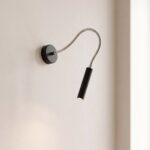
Reading wall light with adjustable head in black steel
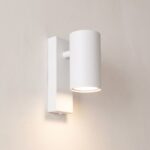
White or black steel bedside wall light
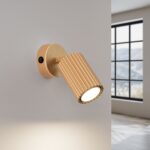
Reading wall light in gold with ribbed texture
See also

Flickering Lights: Causes, Warning Signs and How to Fix Them

Bookcase Lighting: How to Light Your Books, Shelves and Reading Nook

How Many Lumens Do I Need? Lumens per m² for Every Room
