
Table of Contents
Not with a filament or halogen bulb: the “max 40 W” on a lamp is a heat limit, and a 60 W filament bulb gives off half as much heat again as the fitting was tested with. With an LED, yes: a “60 W equivalent” LED gives the same 806 lumens for 6 to 9.5 real watts, far below the limit.
The lamp in the sitting room feels dim, you look for a stronger bulb, and there it is, printed under the shade ring or stamped on the base: “max 40 W”. The bulb in your hand says 60 W. This guide explains what that small figure limits, why the answer changed when filament bulbs left the shelves, what gets damaged when the limit is exceeded, and how to get more light without going near it.
What “max 40 W” on a lamp really limits
Start with what it is not: a limit on brightness, or the electrical capacity of the lamp holder.
The standard for screw lamp holders, I.S. EN IEC 60238 in Ireland, is built on the assumption that an E14 cap serves a lamp drawing no more than 2 amps, an E27 cap a lamp of no more than 4 amps and the large E40 a lamp of up to 16 amps. That is an assumption about lamps, not a rating stamped on your holder, but it puts the figure in perspective: at 230 volts, 4 amps is the current of a lamp of about 920 watts. The 40 W on your lamp has nothing to do with the current the contact is expected to carry. The same standard says so in its own words: once lamp holders are built into a fitting, their maximum working temperatures are set by the luminaire standard. Most Irish ceiling roses hold a B22 bayonet rather than a screw cap, and the logic is the same.
The figure is a heat limit, and it belongs to the whole fitting, the fixture in American guides, not to the holder, the flex or the shade on its own. The luminaire standard, I.S. EN 60598-1, gives a full section to endurance and thermal tests, with tables of the highest temperatures allowed for parts and materials. They are type tests, carried out on a fitting of each rated wattage in a range: it runs with a lamp of that wattage until its temperatures stabilise, and each sensitive part is checked. The number you read is the strongest lamp the fitting passed that test with.
It has to be written somewhere because the European Low Voltage Directive requires the characteristics needed for safe use to be marked on the equipment or in a document supplied with it, and requires that the equipment produces no dangerous temperatures, even under foreseeable overload. One caveat: the text of I.S. EN 60598-1 is not freely available, only its contents and general clauses are, so we quote no temperature from it. What follows about the consequences rests on physics and on what can be seen on the fittings themselves.
Filament or LED: why the answer is no longer the same
Old incandescent bulbs turn a tiny share of their electricity into visible light, and halogens barely more. The European energy labelling regulation sets the official equivalences: 470 lumens for a 40 W bulb, 806 lumens for a 60 W. That is 11.8 lumens per watt for the first and 13.4 for the second. Set against the theoretical maximum of 683 lumens per watt, which follows from the definition of the candela, the efficiency is under 2%. The other 98% comes out as heat. A 60 W filament bulb is, near enough, a small 60 W heater a few centimetres from a shade designed for 40.
An LED plays in another league. The same regulation sorts light sources by efficacy: at least 210 lumens per watt for class A, 185 to 210 for B, 160 to 185 for C, 135 to 160 for D, 110 to 135 for E, 85 to 110 for F and under 85 for G. For an ordinary mains bulb that shines in every direction, those thresholds apply as they stand.
Do the division. For the 806 lumens of an old 60 W bulb, a class F LED draws 7.3 to 9.5 watts, a class E 6.0 to 7.3 watts and a class A 3.8 watts at most. Even at class F, that is four times below a 40 W limit. To draw 40 W while giving 806 lumens, a bulb would have to manage barely 20 lumens per watt, which is filament and halogen territory.
| Bulb giving 806 lumens | Real power drawn | Within a 40 W limit? |
|---|---|---|
| Incandescent 60 W | 60 W | No, 50% over |
| LED, class F | 7.3 to 9.5 W | Yes, about 4 times below |
| LED, class E | 6.0 to 7.3 W | Yes, 5 to 7 times below |
| LED, class D | 5.0 to 6.0 W | Yes, 7 to 8 times below |
| LED, class A | 3.8 W at most | Yes, over 10 times below |

Hence one rule with no exceptions: compare the limit with the real wattage printed on the bulb, never with the “equivalent” wattage. A bulb sold as “100 W equivalent” must give 1,521 lumens and draws 7 to 18 watts depending on its class; it goes into a fitting marked 40 W without difficulty. The opposite mistake, reading the equivalence as real watts and settling for too little light, is far more common.
Many fittings in our bulb wall light range show two figures. Our industrial black steel wall light with an exposed bulb reads “max 15 W in LED (60 W in a traditional bulb)”. The second number looks bigger, yet the first allows more light: 15 W of LED gives about 1,300 to 2,000 lumens depending on its class, well above the 806 lumens of a 60 W filament bulb. The LED limit only looks strict because the scale of the unit has changed.
Where the heat goes: a filament radiates, an LED conducts
Two bulbs drawing the same power do not treat a fitting the same way, because they shed their heat by different routes. That decides which part gets damaged.
A filament radiates. Glowing at somewhere between 1,700 and 3,000 °C, it gives off mostly invisible infrared radiation. Part of it goes through the glass in straight lines and heats whatever it meets: the fabric of the shade, a glass globe, the ceiling paint above. The rest heats the glass itself, which on an ordinary filament bulb can reach 200 to 260 °C, right next to the lamp holder. The more closed the fitting, the more that heat builds up. A halogen bulb is a filament bulb too, and the limit applies to it in full.
An LED conducts. Its chip sends almost no infrared forwards: its heat, plus that of its driver, leaves through the back of the bulb, the aluminium or ceramic heat sink, then the cap and the lamp holder. The temperature rise of a lamp cap even has its own standardised measuring method, IEC 60360, which the luminaire standard lists among its references.
The consequences run against intuition. With an LED, a fabric shade has nothing to fear, even close around the bulb. The hot spot has moved to the lamp holder, the least ventilated place in the fitting, and it is the bulb’s own electronics that suffer. An LED that fades after a few months, or causes the kind of flickering lights that send you back to the shop, has rarely gone over the fitting’s limit: it has cooked its own driver inside a closed globe. And a fitting with integrated LEDs has no bulb and no marked maximum at all: the source is designed with the fitting.
What happens if you use a higher wattage bulb
To keep things in proportion: a 60 W filament bulb in a lamp marked 40 W will not set the room on fire on the first evening. What happens is slower, and that is what makes it dangerous, because nothing warns you.
The plastics yellow, then warp. The body of the lamp holder, its shade ring, the cord grip: these materials have a working temperature, and held above it they brown, turn brittle and lose their shape. The luminaire standard has a thermal test of its own for thermoplastic fittings and a whole section on resistance to heat and fire.
The insulation of the wires ages. This is the most serious effect and the hardest to see, because it happens inside the stem or the arm. Above its rated temperature, cable insulation stiffens and cracks, and the cracks often only show years later, when the flex is moved.
The insulation fault comes last. Cracked insulation eventually lets a live conductor touch another one or a metal part. On an earthed Class I fitting, the RCD or the breaker trips. On a Class II fitting, or an old installation with no earth at that point, nothing is there to warn you. Meanwhile the shade browns above the bulb and a hot smell appears when the light comes on: signals, not accidents.
The signs that should make you take the fitting apart: a lamp holder yellowed or blackened around its contacts, a shade ring that no longer screws on straight, a flex that is hard or cracked near the holder, a lingering smell of hot plastic. The answer is then not a weaker bulb but a new holder or a new fitting. On a pendant set or a table lamp, our guide on how to change a lamp holder shows how to open each type without breaking it. If the damage reaches the cable at the ceiling rose or the fixed wiring above it, stop and call a Registered Electrical Contractor.
And if a 60 W bulb has spent a year in a lamp marked 40 W? Switch off, take it apart and look. Most of the time you will find nothing, because the tests keep a margin and a sitting room lamp is not on all day. But look rather than assume.
Open shade, closed globe, recessed spotlight: the margin changes
The same bulb in two different fittings does not produce the same temperature rise. That is why the figure is written on the fitting, not on the bulb.
| Type of fitting | Where the heat goes | What it changes |
|---|---|---|
| Bare bulb, no shade | Freely into the room | The easiest case: the limit applies but is rarely tight |
| Fabric shade open at top and bottom | Rises and escapes through the top | The fabric takes a filament’s radiation; with an LED, almost nothing |
| Closed globe or diffuser | Stays trapped around the bulb | The smallest margin and the lowest limits: 8 W in LED on our ceramic wall light with an opal glass globe |
| Recessed spotlight | Into the void above the ceiling | Depends on what lies above, insulation in particular |
| Integrated LED | Through the body of the fitting | No maximum marked: there is no bulb to choose |

The recessed spotlight carries two markings that hardly anyone reads. The first concerns the surface it is fitted to: the luminaire standard deals separately with fittings for mounting on normally flammable surfaces, such as a timber ceiling. The second concerns insulation: a whole annex covers the marking of fittings not designed to be covered with thermal insulation. Under a top floor ceiling with insulation laid over the joists, a downlight can sit in a pocket with no ventilation at all. There the maximum wattage really matters, LED included, because the heat sink can no longer shed anything. Our guide on how to change a spotlight bulb covers getting at the bulb without disturbing what sits above it.
One last point, not about heat, spoils many swaps: size. Globe and decorative filament LEDs are often longer than the light bulbs they replace, so measure the space inside the shade before buying, and if the lamp is on a dimmer, choose an LED marked dimmable. Check the cap on the holder rather than on the old bulb: most Irish pendant sets take a B22 bulb, while many newer fittings take an E27 or an E14.
More light without more watts
If you want a 60 W bulb instead of a 40 W, it is not watts you are after: the room lacks light. Since filament bulbs went, the watt measures what the bulb takes from your meter, not the light it gives.
Count in lumens. Going from 470 to 806 lumens means 71% more light, and the figure is printed on every box. Our lumens to watts chart gives the matches for every type of bulb, and our guide to how many lumens do I need works out, room by room, what you actually need: 200 to 300 lumens per square metre in a living room.
Add sources rather than power. A room lit from a single ceiling point always looks dark in the corners, whatever the bulb. General lighting backed by two or three lower sources puts the light where you use it, and each bulb stays well below its limit.
Look at where the light goes. An opaque shade that sends everything down lights a table; the same output in an opal globe fills the room softly but lights no task. A new bulb never corrects the wrong fitting.
Check the quality of the light. At equal output, two bulbs do not look equally bright, depending on their colour temperature and on how faithfully they show colours. Our guide to the colour rendering index explains which figure to read.
Our four checks before you fit the bulb
- Read the limit on the fitting, not on the old bulb. It is stamped on the lamp holder, printed under the base or on the ceiling plate, or given in the instructions. If it separates LED from traditional bulbs, the LED line is the one for you.
- Compare it with the real wattage of the new bulb. The figure followed by a plain W, never the one after “equivalent”.
- Choose the light output in lumens. That figure decides whether the room will be bright enough.
- Look at the lamp holder while you are there. A yellowed holder, a warped ring, a hard or cracked flex: nothing goes back in until that part is replaced.
The short answer, if only one should stay with you: with an LED, a 40 W limit is out of reach of any ordinary household bulb, and only the LED limits of closed fittings, sometimes 8 or 10 W, need a glance. With a filament or halogen bulb, the answer is no.
Using a 60 W bulb in a 40 W lamp: frequently asked questions
What happens if you put a 100 W bulb in a 40 W lamp?
With a filament or halogen bulb, the fitting has to cope with two and a half times the power it was tested with, nearly all of it as heat. The damage is the same as with a 60 W bulb, only faster: browned holder, cracked flex insulation, scorched shade. An LED sold as “100 W equivalent” gives 1,521 lumens for 7 to 18 real watts, well within a 40 W limit.
Can I use a 60 watt LED bulb in a 40 watt socket?
Yes, in practice. A “60 W” LED is almost always a 60 W equivalent: about 806 lumens for only 6 to 9.5 real watts. That real figure, printed next to the plain W on the box, is the one to compare with the limit on the fitting. An LED that truly drew 60 W would give thousands of lumens, and household bulbs are not made that way.
Can you use a 40 W bulb in a 60 W lamp?
Yes, without any risk. The figure on the fitting is a maximum, not a target: a lower wattage means less heat and, with a filament bulb, less light, 470 lumens instead of 806. The same goes for an LED of any wattage below the limit. If the room then feels dim, choose more lumens rather than more watts.
Is there a big difference between 40 W and 60 W?
In light, yes: 470 lumens against 806 under the official equivalences, so 71% more, which shows clearly in a reading lamp or a small room. In heat, a 60 W filament bulb gives off half as much again as a 40 W. With LEDs the gap shrinks to a few watts: roughly 3.5 to 5.5 W for 470 lumens, 6 to 9.5 W for 806.
How bright is a 9 W LED bulb?
It depends on its energy class. In class F, 85 to 110 lumens per watt, a 9 W LED gives about 765 to 990 lumens; in class E, 110 to 135, about 990 to 1,215 lumens. That is roughly the light of an old 60 W bulb, 806 lumens, up to a 75 W, 1,055 lumens. The lumen figure on the box tells you exactly.
Does wattage matter for LED bulbs?
For two things, but not for brightness. The real wattage is the figure to compare with the maximum marked on the fitting, and it sets the running cost. Brightness is given in lumens: two LEDs of the same wattage can differ by a quarter or more in output depending on their class. Choose the lumens first, then check the real watts against the limit.
Sources
- I.S. EN IEC 60238, Edison screw lampholders, clause 1 (scope): based on lamps drawing no more than 2 A on an E14 cap, 4 A on an E27 and 16 A on an E40; maximum working temperatures of lampholders in luminaires specified in IEC 60598. International Electrotechnical Commission and NSAI
- I.S. EN 60598-1 (IEC 60598-1:2020), Luminaires, general requirements and tests: marking (section 3), endurance and thermal tests (section 12), resistance to heat and fire (section 13), normally flammable surfaces (4.16), luminaires not to be covered with insulation (Annex N), thermoplastic luminaires (Annex W), type tests per rated wattage, IEC 60360 as a normative reference. Public preview only. International Electrotechnical Commission and NSAI
- Directive 2014/35/EU (Low Voltage Directive), Annex I, points 1(a), 2(b) and 3(c): marking of essential characteristics, no dangerous temperatures, safety under foreseeable overload. Official Journal of the European Union
- Commission Delegated Regulation (EU) 2019/2015, energy labelling of light sources: classes A to G and factor 1.000 for non-directional mains sources (Annex II, Tables 1 and 2); equivalences of 470 lm for 40 W, 806 lm for 60 W and 1,521 lm for 100 W (Annex V, Table 7), consolidated version read on EUR-Lex on 17 October 2026. Official Journal of the European Union
- Candela (683 lumens per watt at 540 terahertz) and Incandescent light bulb (filament at 2,000 to 3,300 K, glass of a general service lamp at 200 to 260 °C, most of the energy emitted as infrared), English editions. Wikipedia
Related products
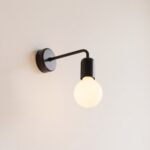
Industrial black steel wall light with exposed bulb
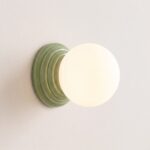
Design ceramic enamel wall light with glass globe
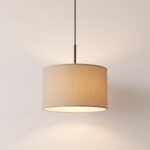
Beige fabric drum pendant light, timeless design
See also

Can You Put a 60 W Bulb in a 40 W Lamp? What the Limit Really Protects

Calming Colours: The Palette, and the Evening Light It Depends On

Colour Rendering Index: The Number That Decides Whether Your Colours Look True
