

Table of Contents
Good bathroom lighting combines three layers: general light from the ceiling, light on your face at the mirror and a softer light for the evening. Each fitting must suit its place in the room: the closer it is to the bath or the shower, the higher its protection against water has to be, and the wiring is a job for a Registered Electrical Contractor.
A bathroom asks two things of its lighting that seem to pull in opposite directions: a precise light to shave or put on make-up, and a gentle one for a bath at the end of the day. It also has a constraint no other room has: water, which brings strict wiring rules. This guide starts with the Irish rules and the IP ratings that decide which fitting goes where, then shows how to light the mirror, the ceiling and the mood, with the right colour of light. When you are ready to choose, our bathroom wall lights are rated for the room.
What is the best lighting for a bathroom?
As in a kitchen, one light in the middle of the ceiling is not enough. It lights the top of your head and leaves your face in shadow in front of the mirror. Plan three layers of light, ideally on separate switches.
| Layer | What it is for | Suitable fittings |
|---|---|---|
| General lighting | Seeing the whole room, cleaning, moving about | Flush ceiling light, recessed spotlights, bathroom chandelier |
| Mirror lighting | Shaving, make-up, doing your hair | Wall lights on either side of the mirror, a light bar above it |
| Mood lighting | A bath, winding down in the evening | LED strip in a niche, a soft wall light, a dimmer |
Before you choose any fitting, mark the bath, the shower and the basin on a plan of the room. They decide the zones, and so the fittings allowed in each spot.
Bathroom zones in Ireland: what the wiring rules say
In Ireland, electrical installations are designed and installed to the National Rules for Electrical Installations, I.S. 10101, published by NSAI. A bathroom is one of the special locations in Part 7 of those rules. The space around the bath and the shower is divided into zones, and the closer a zone is to the water, the stricter the rules on what may be fitted there:
- Zone 0 is the inside of the bath or the shower tray, where water collects.
- Zone 1 is the space directly above the bath or the shower, up to a set height.
- Zone 2 is a band that surrounds zone 1.
The rules set the exact dimensions of each zone, the minimum IP rating and the type of fitting allowed in it, as well as the requirements for the rest of the room. They are applied by the electrician on site, measured from your own bath and shower, which is one more reason the work is not a DIY job. Two further rules in I.S. 10101 concern every bathroom. All lighting circuits in a home must be protected by an RCD rated at no more than 30 mA, and a distribution board may not be installed in a bathroom. A separate toilet with no bath or shower is not one of these special locations, as our guide to downstairs toilet lighting explains.
Above all, any electrical work in a bathroom is Restricted Electrical Works under S.I. No. 264 of 2013: only a Registered Electrical Contractor may carry it out, and they must certify it with a Completion Certificate. Ask them which zone each light point falls in before you buy the fittings. In practice, place decorative fittings as far from the water as the room allows, above the basin or on the ceiling away from the shower, and let your electrician confirm each position. And before you touch any fitting, even to change a bulb, switch it off.
What IP rating do bathroom lights need?
The IP rating, defined by the international standard IEC 60529, has two digits. The first gives the protection against solid objects and dust, the second against water. In a bathroom, the second digit is the one that matters, which is why you often see it written IPX4: the X simply means the first digit has not been specified.

- X4: water splashing against the fitting from any direction has no harmful effect.
- X5: water projected in jets from a nozzle, from any direction, has no harmful effect, for example a shower head aimed at the fitting.
- X7: the fitting withstands temporary immersion, up to one metre deep.
Even away from the bath and the shower, steam and splashes are part of daily life. A fitting rated at least IP44 is a sensible choice above the basin or near the shower. Our modern square decorative wall light, for example, is rated IP54: protected against dust and splashes, with adjustable brightness. Note that the IP rating says nothing about the electrical class of the fitting, which also counts close to the water: your electrician will check both.
How to light a bathroom mirror
This is the light you use most every day, and the one most often got wrong. A spotlight in the ceiling above the basin lights the top of your head and casts shadows under your eyes, nose and chin. The answer is to light your face from the front.
The best layout is one wall light on each side of the mirror, at roughly face height. The two sources balance each other and cancel out the shadows. If there is no room at the sides, a light bar or a wide wall light above the mirror, aimed forwards, is a good compromise. Frosted or opal glass globes give a soft light that does not dazzle when you look closely: that is the case of our sleek aluminium and glass ball wall light, rated IP44, which takes a G9 LED bulb. Globe designs are gathered among our ball wall lights.
For the mirror, also look at the colour rendering index, written CRI or Ra. The higher it is, the more true to life your skin tone and make-up will look.
Bathroom ceiling lights: flush fitting, spotlights or chandelier?
On the ceiling, a flush fitting is still the simplest answer. Choose an enclosed or globe model that shields the bulb from steam, and place it away from the shower. A slim LED ceiling light suits a low ceiling, and a flat ceiling light keeps the room clear under a sloping attic roof.
In a large or long bathroom, recessed spotlights spread the light more evenly. Those above the shower must suit the zone they are in, both in IP rating and in type of fitting: that is for your electrician to confirm. If the ceiling is high enough, a bathroom chandelier or a bathroom pendant light, fitted well away from the bath and the shower where your electrician confirms it is allowed, gives the room real character.
What colour and brightness of light should you choose?
Colour temperature, measured in kelvins (K), sets the tone of the room. A warm white of 2,700 to 3,000 K creates a relaxed mood and flatters the skin. Some people prefer a neutral white of around 4,000 K at the mirror, for a crisper light in the morning. If you mix the two, put them on separate switches so they are not on together.
The evening is a good reason to keep the warm light for the bath. In 2022, sleep and circadian researchers published consensus recommendations for indoor light: plenty of light during the day, then, from three hours before bedtime, no more than 10 lux of the light that acts on the body clock, measured at eye level. A dimmed warm white is the easiest way to get there.
For brightness, think in lumens, the amount of light a bulb gives out, not in watts. European ecodesign rules tied that claim to a light output: under the 2009 regulation on household lamps, a bulb claimed to be equivalent to a 60 W incandescent bulb had to give at least 741 lumens. Add up several sources rather than looking for one very powerful ceiling light: it is the mirror light that makes a bathroom comfortable, not the power of the ceiling. And think about the walls: pale tiles reflect light back into the room, dark tiles absorb much of it.
How to create a relaxing mood in the bathroom
The third layer turns a practical bathroom into a place to unwind. An LED strip in a shower niche, under a floating vanity unit or behind a mirror draws a soft, indirect line of light. Choose a strip and a driver made for damp rooms, with the right IP rating for where they go, and remember that fitting them is part of the bathroom wiring. Our range of LED lights offers other ways to add that glow.
A dimmer on the ceiling light or the wall lights lets you move from the bright light of the morning to the soft light of a bath, as long as you use dimmable LED bulbs. A small wall light with a warm glow does the same job without any extra wiring if a point is already there: the colourful designer aluminium wall light, with its frosted glass globe and IP44 rating, adds a touch of colour as well.
Common bathroom lighting mistakes
Most disappointing bathrooms share the same few faults, and each has a simple fix.
- One light in the centre of the ceiling. It lights the floor and the top of your head, never your face. Add a light at the mirror before anything else.
- A downlight straight above the basin. It casts the harshest shadows on your face at the very spot where you look closest. Move the light to the sides of the mirror.
- Buying the fitting before checking the zone. A fitting that is perfect in the hall may not be allowed near the bath. Settle each position with your electrician first, then choose.
- Reading only the first digit of the IP rating. IP20 or IP40 fittings have no protection against water at all. In a bathroom, look for a second digit of 4 or more.
- Cold light for the whole room. A cool white that suits the mirror in the morning makes a bath feel clinical at night. Keep the cooler light on its own switch and use warm white for the rest.
- Everything on one switch. Separate circuits or a dimmer let you go from a bright morning light to a soft evening glow without changing a single bulb.
Remember four things: check the zones before you buy, choose each fitting for its place, light your face from the front at the mirror, and keep a warm light for the rest. Your bathroom will be safe, practical and pleasant to be in.
Bathroom lighting: frequently asked questions
What is the best type of lighting for a bathroom?
A combination of three layers: a flush ceiling light or recessed spotlights for general light, a wall light on each side of the mirror to light your face without shadows, and a soft mood light, such as an LED strip in a niche. Each fitting must suit the zone it sits in and carry the right IP rating.
What are the bathroom zones in Ireland?
The National Rules for Electrical Installations, I.S. 10101, treat a bathroom as a special location and divide the space around the bath and shower into zones. Zone 0 is inside the bath or shower tray, zone 1 is directly above it and zone 2 surrounds zone 1. Your electrician applies the exact dimensions and the requirements for the rest of the room.
How can I tell if a light is suitable for a bathroom?
Check its IP rating: the second digit gives its protection against water, and 4 means it withstands splashing from any direction. Then check with your Registered Electrical Contractor that the rating and the type of fitting suit the zone where it will go. Even away from the bath and shower, IP44 is a sensible minimum near the basin.
Can I install a bathroom light myself in Ireland?
No. Electrical work in a bathroom is Restricted Electrical Works: only a Registered Electrical Contractor may carry it out, and they must give you a Completion Certificate. You can still choose the fittings, change a bulb with the power switched off, or add a plug-in lamp outside the bathroom.
What lighting is best for a bathroom mirror?
Two wall lights, one on each side of the mirror at roughly face height, light your face from the front and cancel shadows. If there is no room at the sides, a wide light above the mirror aimed forwards is a good compromise. Frosted or opal glass diffusers avoid glare when you look closely.
How to make bathroom lighting more flattering?
Light your face from the front rather than from above, choose a warm white of 2,700 to 3,000 K for the evening and bulbs with a high colour rendering index, and put the ceiling light, the mirror lights and the mood light on separate switches or a dimmer so you can soften the light when you want.
Sources
- Restricted and Controlled Electrical Works, and Completion Certificates, guidance for customers. Safe Electric
- Safe Electric Newsletter, March 2020: changes introduced by I.S. 10101, RCD protection of lighting circuits and location of distribution boards. Safe Electric
- IP code (IEC 60529), encyclopaedia article. Wikipedia
- Commission Regulation (EC) No 244/2009 on ecodesign requirements for non-directional household lamps, Annex II, table of equivalence. EUR-Lex
- Brown T. M. et al., Recommendations for daytime, evening, and nighttime indoor light exposure to best support physiology, sleep, and wakefulness in healthy adults, PLOS Biology, 2022. doi.org
Related products
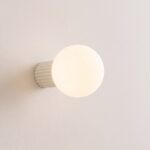
Opal glass ball wall light with fluted aluminium base
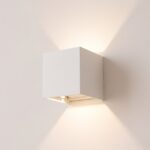
Square LED wall light, white or black aluminium, IP54

Colourful designer aluminium wall light
See also

Flickering Lights: Causes, Warning Signs and How to Fix Them

Bookcase Lighting: How to Light Your Books, Shelves and Reading Nook

How Many Lumens Do I Need? Lumens per m² for Every Room
