

Table of Contents
To choose fairy lights, start with where they will hang. Indoor sets can be IP20, but anything going outside needs at least IP44, and IP65 if it will take the rain. Then pick the style (micro LED wire, festoon or ball lights), the power source (mains, battery, USB or solar) and the colour, warm white for a soft glow.
Fairy lights have long since escaped the Christmas tree: along a headboard, round a mirror, over a patio table, and plenty of Irish homes now leave them up all year. Under the one name sit very different products, from a battery copper wire in a jam jar to a thirty-metre connectable festoon, and safety varies as much as price. This guide shows you how to choose the right set for each spot, how to avoid the dangerous ones, and how to pair them with proper lighting, because fairy lights set a mood but rarely light a room on their own. For that part, our LED lights and outdoor wall lights do the work.
What are the different types of fairy lights?
The shape of the set decides the effect far more than its length. These are the families you will come across most often.
| Type | Effect | Typical use | Usual power source |
|---|---|---|---|
| Micro LED on copper or silver wire | A shower of tiny points, the wire almost invisible | Jar, shelf, picture frame, dinner table | Battery or USB |
| Festoon lights | Large, evenly spaced bulbs, a street party look | Patio, pergola, garden | Mains or solar |
| Ball lights | Cotton, paper or rattan balls that diffuse the light | Bedroom, headboard, living room | Battery, USB or mains |
| Curtain and icicle lights | A sheet of vertical strands | Window, wall, eaves | Mains |
| Rope light | A flexible tube lit along its whole length | Steps, balcony railing | Mains |
Micro LED lights on copper or silver wire are the most discreet: the wire bends by hand, winds round a branch, and the light seems to float. Festoon lights show off round or pear-shaped bulbs and give an outdoor space an instant party feel. Ball lights filter the light through cotton or paper, which is why they are so popular in bedrooms.
And what about string lights? In Ireland and Britain the two names are used almost interchangeably. When people make a distinction, “fairy lights” means small, closely spaced LEDs on a fine wire, and “string lights” covers anything on a cable, including festoons with full-size bulbs.
Indoor or outdoor fairy lights: the IP rating
This is the number one safety check, and it is printed on the box. The IP code, set out in the international standard IEC 60529, gives the protection against solid objects (first digit) and against water (second digit).
- IP20: no protection against water. Dry indoor rooms only: living room, bedroom, home office.
- IP44: protected against water splashing from any direction. The minimum outdoors, under a canopy, a covered pergola or a sheltered porch.
- IP65: dust-tight and protected against water jets. For a set that will stand in the rain, in a tree or along a fence.
Watch for the detail that catches people out: the rating on the lights applies to the lights only. The transformer, the plug, the timer and every connector each have their own. An IP44 set plugged into an indoor transformer sitting on wet decking is not an outdoor installation. Check that every part left outside carries a suitable rating, and keep the transformer under cover.
Outdoor fairy lights can be used indoors; the reverse is dangerous. An indoor set left on a balcony takes on moisture, water gets into the bulb holders and joints, and a short circuit becomes a real possibility. With Irish weather, where a dry evening can turn to driving rain in half an hour, it is worth buying one rating higher than you think you need.
Outdoor fairy lights for the patio and garden
Outside, fairy lights become real mood lighting, and a few practical choices make the difference between a set that lasts for years and one that comes down in the first gale.
Length and distance to the socket
Measure the real route: the distance between your fixing points, plus the sag the lights will take between them, and then the distance back to the socket. Many sets have a lead of only a few metres before the first bulb, so check it on the product sheet. For a large space, connectable fairy lights let you add sections on a single socket, up to the total length the maker states. Never go beyond it.
Bulb spacing and type
On festoon lights, the gap between bulb holders changes everything: close spacing gives a dense ribbon of light, wide spacing a lighter, airier feel. Choose shatterproof plastic bulbs if the lights are within reach of hands or a football, and check that the bulbs can be replaced, so one broken bulb does not write off the whole set.
Fixing
Fairy lights should not carry their own weight over long spans. First run a steel support wire between two solid points, then clip the lights to it. Never pull on the electrical cable, trap it in a door or window, or staple through it. On a wall, outdoor adhesive hooks or screw-in eyes keep the cable intact.
The socket and RCD protection
Plug outdoor lights into a weatherproof outdoor socket. What protects you if water gets into a connector is the RCD, the trip switch in your fuse board: Safe Electric describes it as the device that protects against current flowing to earth, and advises testing it twice a year, when the clocks change, by pressing its test button. If you have no outdoor socket, do not run an indoor extension lead through a window left ajar. Running a new circuit out to the garden is Restricted Electrical Works in Ireland: under S.I. No. 264 of 2013 only a Registered Electrical Contractor may carry it out, and they certify it. Adding a socket to an existing circuit counts as minor works, but outdoors it still calls for a competent electrician and a weatherproof, RCD-protected socket. Without a socket, solar or battery fairy lights remain the simplest answer.
Mains, battery, USB or solar: which power source?
- Mains (plug-in fairy lights): the choice for long runs and everyday use. The light stays steady all evening. Many sets use a transformer that lowers the voltage before the lights, which is a safety plus, as long as the transformer stays dry.
- Battery: perfect for occasional decoration away from a socket, in a jar or on a table centrepiece. Pick a set with a timer, which switches off on its own and saves the batteries.
- USB: powered at 5 V from a USB port, a power bank or a phone charger, so no throwaway batteries. Handy near a desk or a bed.
- Solar: a small panel charges a battery by day and the lights come on by themselves at dusk. No cable to run and nothing on the electricity bill. The trade-off is that run time depends on daylight, and it drops sharply in an Irish winter or when the panel sits in shade.

Where a fence or a garden wall has no power at all, solar wall lights make a good partner for a solar set: they charge on the same daylight and switch on at the same time.
Warm white, cool white or multicolour?
Warm white, around 2,700 K to 3,000 K, is the most versatile choice. It recalls candlelight and old filament bulbs, sits well with timber and linen, and is kind to faces in the evening. Cool white, with a bluish tinge, gives a crisp, wintry look that suits outdoor Christmas displays but feels harsh in a living room. Multicolour sets play the party card, usually with several programmes.
Most sets offer around eight modes, from steady light to fast flashing. For every day, the steady mode, dimmed if possible, is the most restful; save the flashing effects for parties. Indoors, fairy lights look best layered with lamps and living room wall lights, each at its own height.
Do fairy lights use much electricity?
No, and that is their great advantage over the old incandescent sets. Working out the consumption is simple: the wattage, shown on the label or the transformer, multiplied by the hours of use.
Take a 5 W set lit for 6 hours a night for 30 nights: 5 W x 6 h x 30 = 900 Wh, or 0.9 kWh over the month. That costs well under a euro at Irish unit rates. Even a large festoon of several tens of watts stays modest on a household bill. The real saving comes from a timer, which stops the lights burning all night. A solar set, of course, uses nothing from the grid at all.
Can fairy lights catch fire?
LED fairy lights run far cooler than incandescent ones, but the risk is not zero. It rarely comes from the LEDs themselves and almost always from poor manufacture: cables that are too thin, missing insulation, live parts within reach, no real weatherproofing on sets sold for outdoor use. When the consumer organisation Which? tested 12 sets of Christmas lights costing £15 or less, bought from online marketplaces, 10 failed to meet the safety requirements; some presented a risk of electric shock and one also a fire hazard, with poor soldering and control boxes a child could pull apart. In Ireland, the CCPC regularly publishes safety notices on LED fairy string lights that fail the standards, often for missing insulation on the cable.
A few habits keep the risk down:
- Buy from a seller you can identify, and check for the CE mark, the name of the maker or importer, the IP rating and instructions in English.
- Keep to the intended use: indoors for an IP20 set, outdoors only if the rating allows it.
- Do not connect more sets than the stated limit, and do not mix sets from different makers.
- Inspect the lights every time they come out of the box: a bare wire, a cracked bulb holder or a transformer that runs unusually hot, and they go to recycling.
- Switch them off at night and when you go out, ideally with a timer, and never cover them with fabric.
Lighting chains have their own safety standard, EN 60598-2-20, published in Ireland by NSAI as I.S. EN 60598-2-20. It sets the particular requirements for fairy lights used indoors and out, and a serious product refers to it in its documentation.
Hanging and caring for fairy lights
Indoors, there is no shortage of ways to hang them: clear adhesive hooks along a wall, pegs on a line to show off photos, fine pins in a timber headboard. Above a bed, fairy lights for the bedroom work best alongside a pair of proper headboard lights for reading. In a child’s room, keep the lights out of reach of small hands, choose battery sets whose case closes with a screw, and switch them off at bedtime or use a timer. A soft children’s pendant light takes care of the main lighting.
Clean them with a dry cloth, unplugged, and store them wound round a piece of card, somewhere dry, transformer separate. An outdoor set used all year deserves a check in spring and autumn, especially at the connectors.
Fairy lights and light fittings: lighting a patio
Fairy lights create atmosphere; they do not really light a space. On a patio, they work best with functional lighting: a wall light by the back door so you can move around safely, a solar light on a fence or wall with no power, and the fairy lights over the table for the evening. Our modern square wall light, rated IP54 and available in black, throws a beam up and down the wall that frames a festoon without competing with it.
Indoors the principle is the same: the fairy lights draw the decoration, a globe pendant light or a lamp provides the useful light. Our wood and opal glass globe pendant gives that soft, even glow over a table, with fairy lights on the shelves around it. Together they make a room warm without making it dark.
Three questions are enough to choose your fairy lights: the location sets the IP rating, whether there is a socket sets the power source, and the mood sets the type and the colour. The rest is build quality, which you cannot see in the photo but can read on the label.
Fairy lights: frequently asked questions
What is the difference between string lights and fairy lights?
The two names are often used for the same thing. When a distinction is made, fairy lights are small, closely spaced LEDs on a fine wire, often copper or silver, while string lights is the wider term for any lights on a cable, including festoon lights with full-size bulbs spaced further apart.
Can you leave fairy lights on all night?
It is better not to. Even LED fairy lights can overheat if they are badly made or damaged, and a set left on unattended is a needless risk. Switch them off at bedtime and when you go out, ideally with a built-in or plug-in timer, and never cover them with fabric.
Are fairy lights safe in the bedroom?
Yes, if you choose a well-made set with a CE mark and an identifiable maker, keep it clear of bedding and curtains, and switch it off when you go to sleep. In a child’s room, pick a battery set whose battery box closes with a screw and hang it out of reach.
How many hours will battery fairy lights last?
It depends on the number of LEDs and the batteries, so check the run time on the pack. A timer makes a big difference: a set that switches itself off after a few hours each evening can last for weeks on one set of batteries, where a set left on continuously is flat within days.
Do fairy lights use much electricity?
Very little. Multiply the wattage by the hours of use: a 5 W set lit for 6 hours a night for 30 nights uses 0.9 kWh in the month, well under a euro at Irish unit rates. Solar fairy lights use nothing from the grid at all.
What IP rating do outdoor fairy lights need?
At least IP44, which protects against splashing water, for a sheltered spot such as a covered pergola. For lights exposed to the rain, in a tree or along a fence, choose IP65. Remember that the transformer, plug and connectors need a suitable rating too, or must be kept under cover.
Sources
- Safe Electric, Home safety: residual current devices (RCDs) and testing the trip switch twice a year. Safe Electric
- Safe Electric, Restricted and Controlled Electrical Works: definitions under S.I. No. 264 of 2013, including new circuits, reserved to Registered Electrical Contractors, and minor works such as adding a socket to an existing circuit. Safe Electric
- Which?, Beware illegal Christmas lights sold on online marketplaces, 13 December 2022: 10 of 12 sets tested failed the safety requirements. Which?
- CCPC, Product recalls and notifications: product safety information notices on LED fairy string lights. Competition and Consumer Protection Commission
- I.S. EN 60598-2-20, Luminaires, Part 2-20: Particular requirements, lighting chains. NSAI
Related products

Japandi-style wood and opal glass globe pendant light
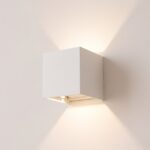
Square LED wall light, white or black aluminium, IP54
Waterproof solar LED wall light
See also

Flickering Lights: Causes, Warning Signs and How to Fix Them

Bookcase Lighting: How to Light Your Books, Shelves and Reading Nook

How Many Lumens Do I Need? Lumens per m² for Every Room
